あみぐるみ
amigurumiThe Japanese art of crocheting or knitting small, stuffed animals and anthropomorphic creatures, beloved for their round shapes and kawaii aesthetic.
Meaning
あみぐるみ (amigurumi) refers to small, stuffed toys crocheted or knitted from yarn. The word is a compound of two Japanese terms: 編む (to knit or crochet) and ぬいぐるみ (stuffed toy or plushie). Together, they form a word that captures the essence of the craft — a stitched, yarn-wrapped creature brought to life.
Typical amigurumi are small enough to fit in the palm of a hand. They most often depict 動物 (animals) — bears, cats, rabbits, and pandas are perennial favourites — but they can also represent mythical creatures, food items, household objects, and characters from anime, manga, or video games. A defining feature of the form is the exaggerated proportions: an oversized, round head relative to a small body, stubby limbs, and large button or safety eyes. These features are not accidental — they are a direct expression of Japan's kawaii (cute) aesthetic sensibility.
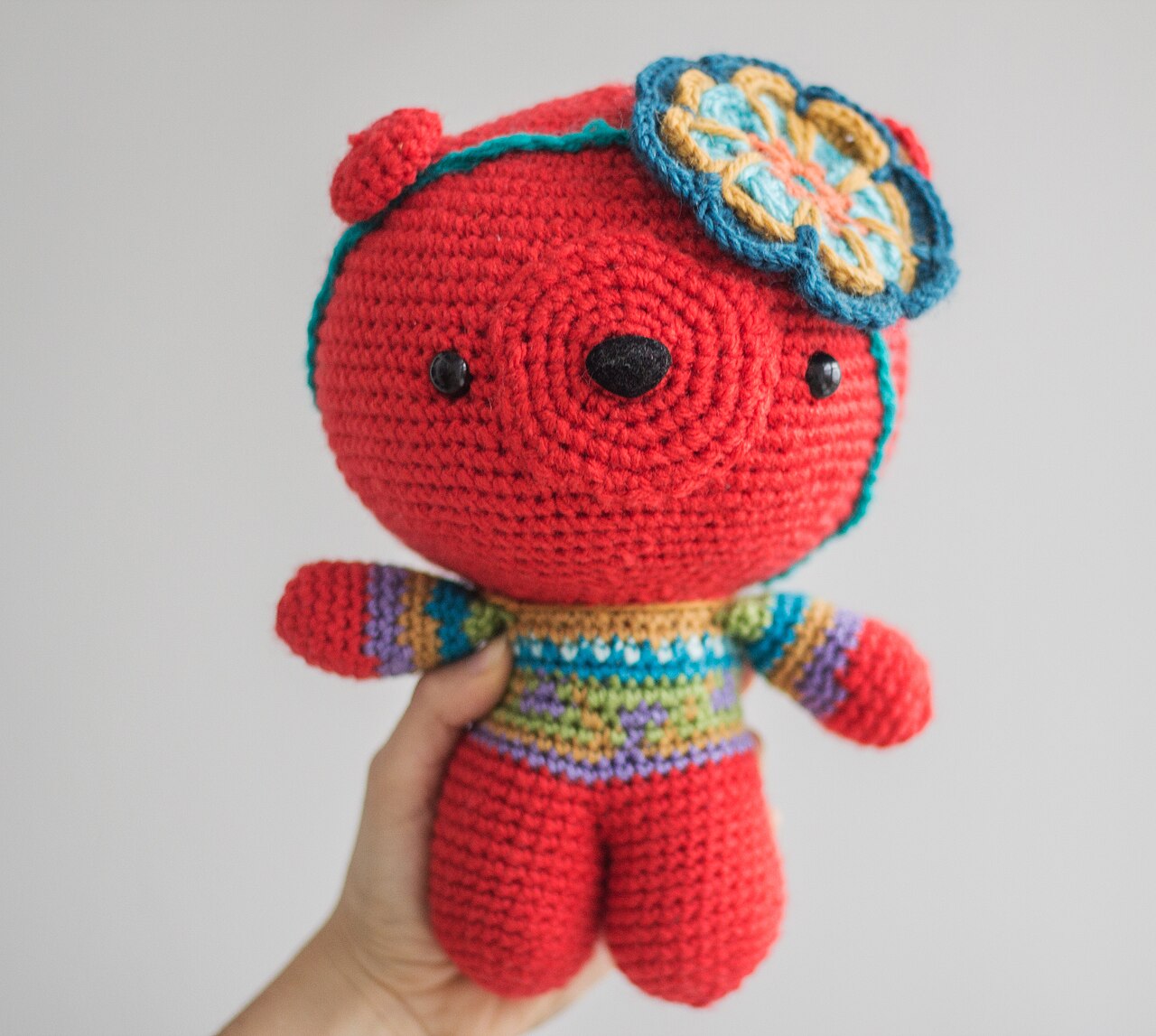
A handmade amigurumi bear illustrating the characteristically round head and compact body. Photo: Thesunandtheturtle, CC BY-SA 4.0, via Wikimedia Commons.
Origins
Crochet and knitting techniques arrived in Japan primarily through contact with Dutch traders during the Edo period (1603–1868), gradually being absorbed into Japanese domestic 手芸 (handicraft) culture. Japanese artisans adapted these Western techniques to their own sensibilities, combining them with a long tradition of 人形 (doll) making.
Amigurumi as a distinct craft form is generally considered to have coalesced in the mid-twentieth century. The post-war economic recovery of the 1950s and 60s brought new consumer goods and leisure time to Japanese households, and with them a renewed enthusiasm for home crafts. The kawaii movement, which gathered momentum through the 1970s with the launch of characters like Hello Kitty (1974) and the rise of cute handwriting culture among Japanese schoolgirls, gave amigurumi a cultural framework in which tiny, soft, round creatures were not just charming — they were a legitimate aesthetic statement.
Craft magazines dedicated to knitting and crochet began featuring amigurumi patterns in the 1980s and 1990s, cementing its status as an established Japanese craft tradition. By the early 2000s it was sufficiently mainstream in Japan to have its own dedicated publications and pattern books.
Techniques
Most amigurumi are worked in crochet rather than knitting, and almost exclusively in continuous spiral rounds — meaning the crafter works in a continuous circle rather than joining each round with a slip stitch, which would leave a visible seam. This technique produces a dense, even fabric with no obvious gaps through which the internal stuffing (typically polyester fiberfill or 綿) would show.
The starting point for nearly every amigurumi piece is the magic ring (マジックリング, majikku ringu), a technique in which yarn is looped around the fingers, stitched into, and then pulled tight to create a hole-free centre. This is essential for rounded parts like heads and bodies.
かぎ針 (crochet hook) sizes used for amigurumi tend to be smaller than the weight of the yarn would normally suggest. Using a hook one or two sizes smaller than recommended creates a tighter stitch that prevents stuffing from peeking through.
The construction process typically follows this sequence:
- Head — worked in the round from a magic ring, increased to the desired diameter, then decreased to close
- Body — worked separately in the same technique
- Limbs and appendages — arms, legs, ears, tails crocheted as small tubes or flat ovals and stuffed
- Assembly — all parts sewn together with a yarn needle
- Face — safety eyes inserted before closing, with embroidered or felt features added last
The 毛糸 (yarn) of choice is typically an acrylic worsted-weight yarn for its uniformity, washability, and wide range of colours. Cotton yarn is favoured by makers of food-themed pieces or items intended for babies and young children, as it tends not to pill and is free of synthetic materials.
Cultural Significance
Amigurumi sits at the intersection of several threads in Japanese popular culture. Its visual language — soft forms, simple eyes, pastel or bold colours — is continuous with the broader kawaii aesthetic that shapes everything from stationery to mascot characters and character merchandising.
In Japan, making and gifting handmade items carries particular social weight. A hand-crocheted amigurumi presented as a gift (particularly as an omiyage, a souvenir or gift brought back from a trip) communicates care and personal effort in a way that a purchased item cannot. This gifting culture has helped sustain interest in amigurumi across generations.
Amigurumi also participates in Japan's rich tradition of yuru-kyara — the loose, wobbly mascot characters used by municipalities, companies, and events to project an approachable image. Many yuru-kyara designs translate naturally into amigurumi form, and fan-made versions of beloved mascots circulate widely through craft markets and online shops.
Japanese craft fairs, particularly those held alongside major otaku events like Comiket, often feature independent amigurumi sellers. The craft occupies an interesting space between folk tradition and contemporary fan creativity.
Global Spread
Amigurumi achieved international visibility rapidly in the early 2000s, driven almost entirely by the internet. Japanese craft blogs and pattern-sharing sites introduced the word and the aesthetic to English-speaking crafters, who quickly adopted both the name and the techniques.
The launch of Ravelry in 2007 — a social network and pattern database for knitters and crocheters — provided a global infrastructure for sharing amigurumi patterns and projects. At time of writing, Ravelry hosts tens of thousands of amigurumi patterns from designers across dozens of countries. Platforms like Etsy, Pinterest, and later Instagram accelerated the craft's reach further, allowing independent designers to sell original patterns and finished pieces to a worldwide audience.
A number of English-language books on amigurumi — most notably the Amigurumi World series by Ana Paula Rimoli, published from 2008 onward — brought the Japanese craft vocabulary into Western crochet discourse. Today the word amigurumi is widely understood in crafting communities around the world without needing translation.
The international amigurumi community has developed its own sub-genres: hyper-realistic animals, food-themed pieces, pattern adaptations of popular media characters, and charitable projects in which makers donate finished pieces to hospitals or disaster-relief organisations.
Variations and Related Styles
| Style | Description |
|---|---|
| リアル系 (riaru-kei) | Realistic proportions, detailed features; less common but growing |
| 食べ物系 (tabemono-kei) | Food-themed: sushi, onigiri, taiyaki, fruit |
| キャラ系 (kyara-kei) | Based on anime, manga, or game characters |
| ミニ系 (mini-kei) | Thumb-sized or smaller, often worn as accessories or keyrings |