達磨
darumaA round red papier-mâché good-luck doll based on Bodhidharma; one eye is painted in when making a wish and the second eye upon fulfillment.
Meaning & Origin
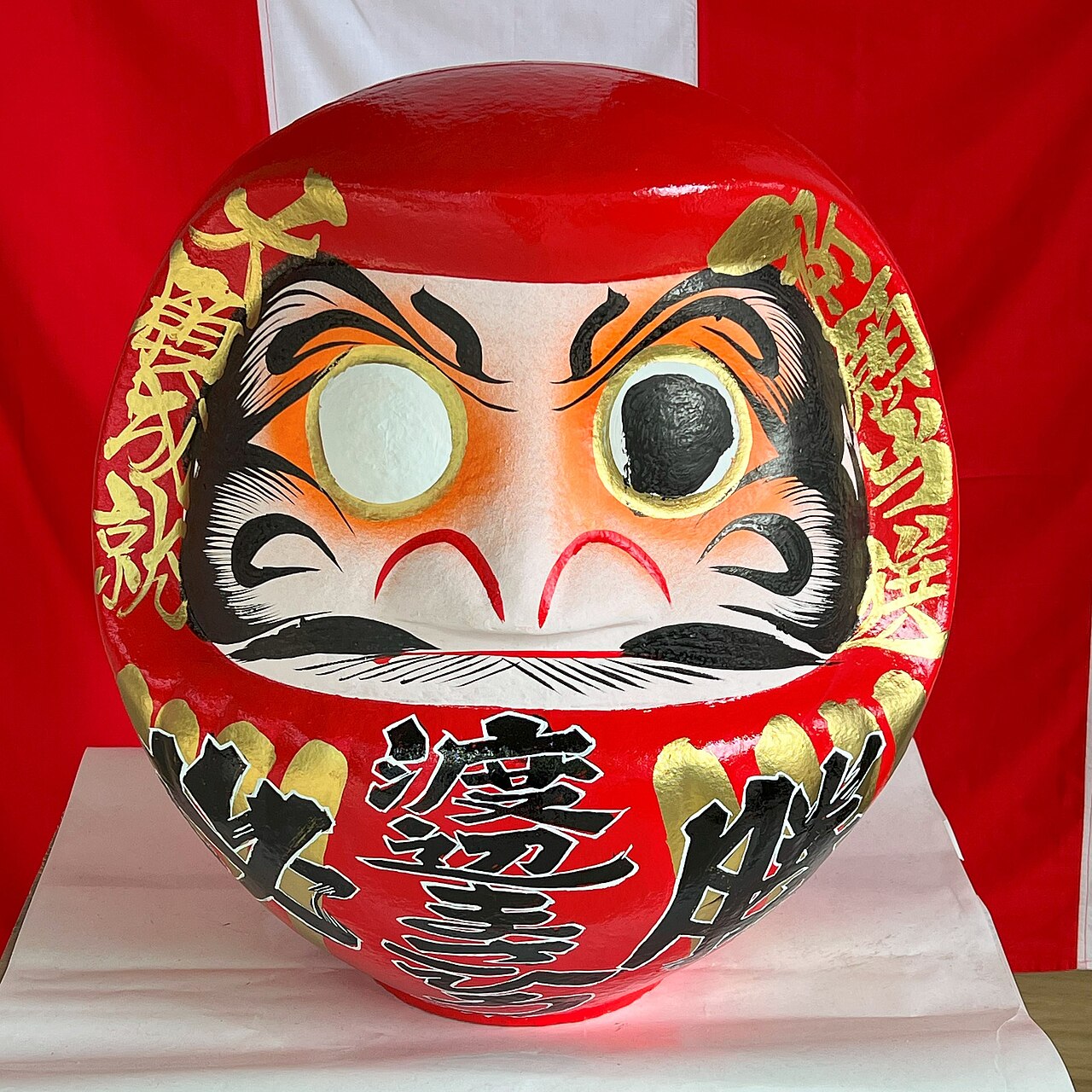
A classic red Takasaki daruma doll with unpainted eyes, ready for a wish. Public domain, via Wikimedia Commons (Asanagi, CC0).
達磨 (だるま, daruma) is Japan's most iconic good-luck talisman: a hollow, round, weighted doll that rights itself when knocked over. The name and form derive from Bodhidharma (菩提達磨, Bodai Daruma), the semi-legendary Indian monk who brought 禅 (Chan/Zen) 仏教 to China in the 5th or 6th century CE.
According to tradition, Bodhidharma meditated facing a cave wall for nine years, during which his arms and legs withered away — which is why the daruma doll has no limbs. His legendary perseverance became the spiritual foundation of the object. The round, bottom-weighted design (a 不倒翁 or okiagari koboshi, "tumbling roly-poly") embodies the proverb:
七転び八起き (nana korobi ya oki) — Fall seven times, rise eight.
This resilience philosophy makes the daruma not merely a decoration but a living reminder of persistence in the face of setbacks.
The production of papier-mâché daruma dolls is closely associated with the Shōrinzan Daruma-ji temple (少林山達磨寺) in 高崎, Gunma Prefecture, which began distributing them in the late Edo period (18th century). Today Takasaki produces roughly 80% of all daruma dolls sold in Japan.
The Eye-Painting Tradition
The defining ritual of the daruma is the eye-painting ceremony (開眼, kaigan, literally "eye-opening").
When a person acquires a daruma — typically at 正月 (New Year) or when embarking on an important endeavor — they paint in one eye (片目を塗る) while stating their 願い (wish) or goal. The doll then sits in a prominent place as a daily visual reminder of the commitment.
When the wish is fulfilled or the goal achieved, the owner paints in the second eye, completing the doll. The now two-eyed daruma is taken to a temple at year's end for a daruma kuyō (達磨供養), a ceremonial burning that releases the doll's spirit with gratitude. Many thousands of daruma are burned at these ceremonies each January.
Which eye to paint first? The traditional rule in most regions is to paint the left eye (from the doll's perspective, the viewer's right) first. However, this varies by region and use — political candidates sometimes follow different conventions.
The blank white 眼 staring back at the owner is intentional: the doll is said to be "watching" you, silently holding you accountable to your 願掛け (vow).
Daruma Markets & Celebrations
Daruma dolls are sold year-round but reach peak importance at daruma-ichi (達磨市), specialized markets held at temples and shrines around the new year.
The most famous is the Daruma-ichi at Shōrinzan Daruma-ji in Takasaki, held over January 6–7, drawing over 200,000 visitors. Vendors set up rows of red daruma in every size — from palm-sized to enormous dolls exceeding a meter in height. Priests perform eye-opening ceremonies, and the air fills with the sharp smell of ink and incense.
Other celebrated daruma markets include:
| Market | Location | Dates |
|---|---|---|
| Jindai-ji Daruma-ichi | Chōfu, Tokyo | March 3–4 |
| Kawasaki Daishi Daruma-ichi | Kawasaki, Kanagawa | January 1–3 |
| Nishi-Arai Daishi | Adachi, Tokyo | New Year season |
| Katsuoji Temple | Minoo, Osaka | Year-round |
At Katsuoji 寺 in Osaka, hundreds of daruma dolls with their second eyes painted in cover every surface of the temple grounds — left as offerings of gratitude after wishes came true.
Regional Varieties
While the classic Takasaki daruma (高崎だるま) — bright red with gold and black facial features — is the national archetype, dozens of regional styles exist across Japan:
| Region | Style | Notable Features |
|---|---|---|
| Takasaki, Gunma | 高崎だるま | Deep red, bold eyebrows shaped like cranes, mustache shaped like turtles |
| Matsukawa, Nagano | 松川だるま | Smaller, rounder, vivid colors |
| Mino, Gifu | 美濃だるま | White face, more elongated shape |
| Shōnai, Yamagata | 庄内だるま | Distinctive flattened base, blue accents |
| Nanbu, Iwate | 南部だるま | Painted with bold black ink patterns, folk-art style |
| White daruma | 白いだるま | White body used for different wishes (purity, love) |
The crane-and-turtle motifs on Takasaki daruma are not random — cranes (鶴) symbolize a thousand years and turtles (亀) ten thousand, embedding longevity symbolism directly into the doll's face.
Modern manufacturers also produce daruma in non-traditional colors, each carrying a different meaning: gold for wealth, green for health, pink for love, and black for warding off evil.
Daruma in Modern Culture
Politics and elections (選挙) represent one of the daruma's most visible modern roles. Japanese politicians purchase large daruma at the start of campaigns, paint in one eye as a 縁起物 (good-luck charm), and — if victorious — paint in the second eye in front of supporters and cameras. The image of a politician completing their daruma has become a fixture of Japanese election-night television.
Business and entrepreneurship (起業) culture has adopted daruma similarly. Startups, new businesses, and teams setting annual targets often begin the year with a daruma ceremony, treating the doll as a physical embodiment of organizational ambition. The doll sits in the office until the goal is met or the year ends.
Daruma-otoshi (だるま落とし) is a classic children's toy game: a stack of colored cylindrical blocks with a daruma head on top. Players use a small hammer to knock out the blocks one by one from the bottom without toppling the daruma head. It's a staple of Japanese toy shops and appears frequently in manga and anime as a nostalgic prop.
Pop culture has thoroughly embraced the daruma image. The doll appears as:
- A recurring visual motif in anime, manga, and video games
- Character designs inspired by its round, blank-eyed aesthetic (the "dead eyes" look is frequently cited in character design discussions)
- Emoji and sticker form in messaging apps
- The mascot of various Japanese companies, sports teams, and local governments
- A meme format in internet culture, where the blank eyes are filled with text or images
The 縁起 (auspicious omen) power attributed to the daruma also appears in everyday Japanese speech: someone who keeps failing and trying again may be praised as daruma mitai ("like a daruma") — a high compliment anchored in that ancient philosophy of falling and rising.
Related Terms
- 起き上がり小法師 (okiagari koboshi) — The broader category of self-righting tumbling dolls that daruma belongs to
- 開眼供養 (kaigan kuyō) — Eye-opening ceremony used for statues and daruma alike
- 達磨忌 (daruma-ki) — Annual memorial day for Bodhidharma (October 5 in Japan)
- だるまさんが転んだ (daruma-san ga koronda) — The Japanese children's game equivalent to "Red Light, Green Light"; named after the daruma's tumbling nature