ドン・キホーテ
don kihoteJapan's legendary discount retail chain, nicknamed 'Donki,' famous for its floor-to-ceiling product stacking, late-night hours, infectious jingle, and treasure-hunt shopping experience.
Meaning
ドン・キホーテ (Don Quijote), nicknamed ドンキ (Donki), is Japan's most iconic discount retail chain. The name is borrowed from the Spanish literary classic Don Quixote, reflecting the founder's vision of a store that boldly defied conventional retail wisdom — tilting at windmills in its own eccentric way.
Founded by Takao Yasuda, who opened a small discount shop called "Thieves' Market" (泥棒市場) in Tokyo's Suginami Ward in 1978, the brand formally launched its first Don Quijote location in March 1989. What began as a single store has since grown into one of Japan's largest retail chains, with over 600 locations across Japan and dozens more across Asia and Hawaii.
The Donki Experience
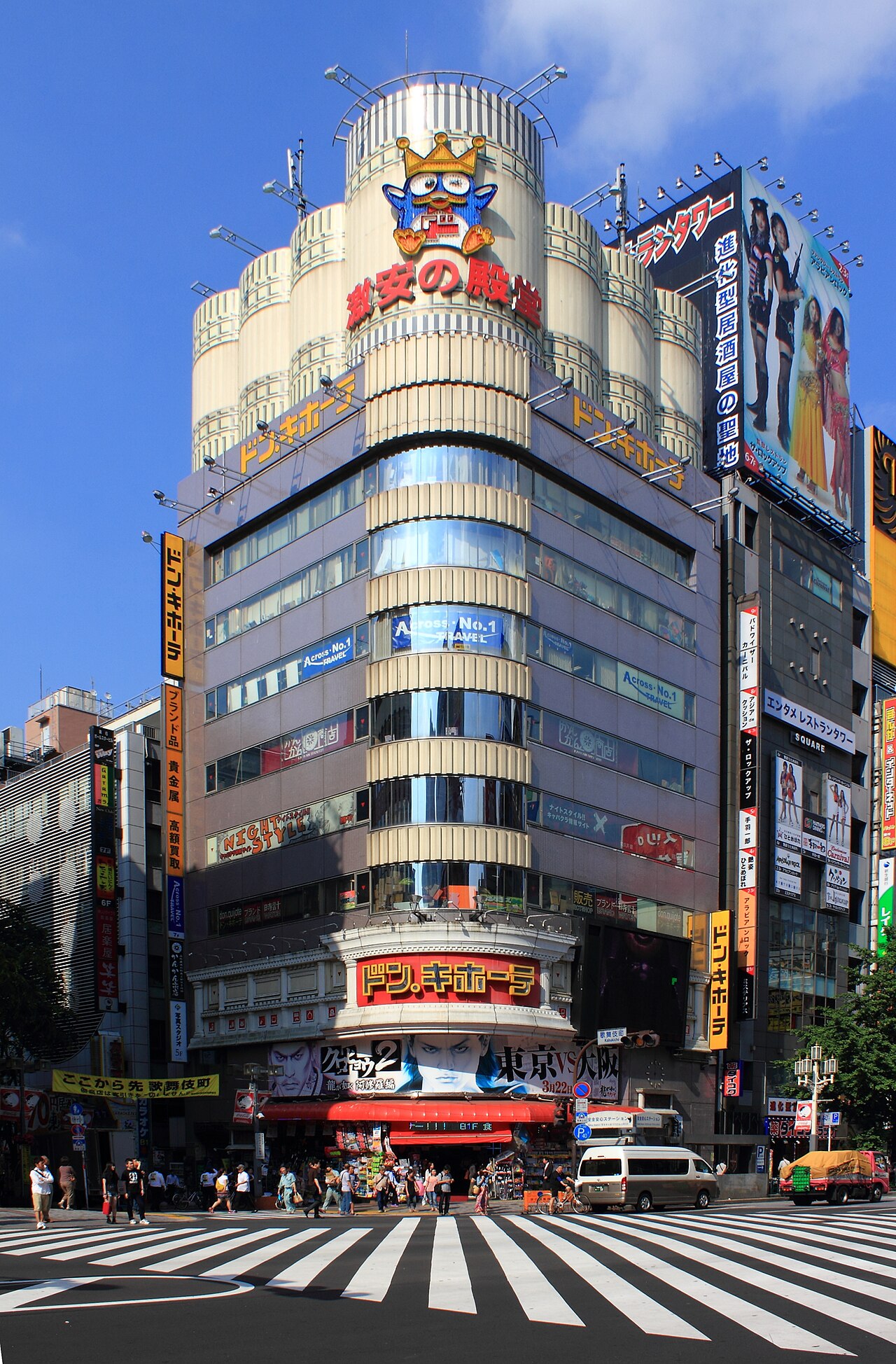
Don Quijote store in Shinjuku, Tokyo. Photo: Kakidai, CC BY-SA 3.0, via Wikimedia Commons.
Walking into a Donki 店 for the first time is a sensory overload. The aisles are deliberately narrow and winding, with 商品 stacked from the floor to the ceiling in towering, dense arrangements. Cardboard boxes jut out at odd angles; products hang from hooks at every height. Finding a specific item feels less like 買い物 and more like a treasure hunt — which is entirely by design.
圧縮陳列 — Compression Display
This famous merchandising philosophy is called 圧縮陳列 (圧縮陳列, asshuku chinretsu, literally "compression display"). By packing merchandise as densely as possible, Donki creates the psychological impression of overwhelming abundance and great value. Customers feel they are uncovering hidden deals amid the organized chaos — and the longer they browse, the more they tend to buy.
The store layout is intentionally labyrinthine, with different sections weaving into each other. Electronics share space with costumes; snacks are stacked beside imported luxury goods. The 値段 tags — bright yellow with bold red text — are impossible to miss. Everything feels 安い.
深夜営業 — Late-Night Hours
One of Donki's defining features is its hours. Most locations are open until midnight or later; many flagship stores operate 24 hours. The chain's willingness to serve 深夜 shoppers helped it carve out a niche that convenience stores couldn't fill — a huge variety of goods at discount prices, around the clock. This makes Donki a beloved destination after a night out, or for night-shift workers and insomniacs who need to buy a costume, a television, and a snack at 3 a.m.
What to Buy
The variety of products at Donki is staggering. Key categories include:
- 化粧品 and skincare — Japanese and imported beauty products, often at steep discounts. This is a major draw for 観光客.
- 電子機器 — Cameras, appliances, cables, and gadgets at competitive prices.
- 食品 — Imported sweets, snacks, Japanese regional foods, and an eclectic mix of foreign groceries.
- Costumes and novelty items — Donki carries an enormous selection of コスチューム for cosplay, Halloween, and school events. The costume section is often a floor to itself.
- お土産 — Popular souvenirs including Japanese snacks, character goods, and beauty products.
- 衣類 and accessories — Budget fashion, underwear, socks, hats, and more.
- Luxury goods — Bizarrely, many Donki locations stock genuine luxury watches, brand-name bags, and jewelry alongside ¥100 impulse buys.
The 割引 prices, combined with the sheer variety, make Donki a one-stop shop for almost any need.
The Jingle and Mascot
One thing visitors cannot escape is the ミラクルショッピング (Miracle Shopping) jingle — a relentlessly upbeat, looping earworm that plays throughout every store. The song was written to be deliberately catchy and slightly maddening, designed to keep shoppers energized and in a buying mood. It was performed by Maimi Tanaka, a former Donki employee, and has become so deeply associated with the brand that many Japanese people hear it involuntarily long after leaving the store.
The chain's マスコット is ドンペン (Donpen), a blue penguin wearing a Santa hat with the katakana character「ド」printed on his belly, introduced in 1998. Donpen has appeared on shopping bags, clothing, keychains, and store signage, becoming a beloved pop-culture icon in his own right. In 2022, the company briefly announced plans to replace Donpen — and was met with such fierce public backlash that it reversed the decision within days, a testament to just how attached Japanese consumers have become to the cheerful penguin.
Cultural Significance
Donki holds a special place in Japanese consumer culture as a democratic, anything-goes space. Unlike the carefully curated department stores (デパート) or the refined boutiques of Ginza, Donki makes no pretensions. It is loud, chaotic, and unapologetically commercial — and that is precisely the appeal.
For many young Japanese people, Donki is where you go late at night with friends, spending hours browsing with no particular goal. The treasure-hunt atmosphere encourages lingering. Finding an unexpected bargain — a designer perfume at half price, or a bizarre imported snack — gives the shopping experience a gamble-like excitement.
For 外国人 visitors, Donki has become an essential stop on any trip to Japan. The chain recognized its tourism appeal early, and most major locations now offer tax-free 観光 shopping services, multilingual staff, and dedicated sections for popular export items like Japanese cosmetics, matcha products, and character goods.
Locations
Don Quijote 営業 locations are spread across Japan, with flagship stores in:
- Tokyo — Shibuya, Shinjuku, Akihabara, Roppongi, Ikebukuro, and dozens more
- Osaka — Namba, Shinsaibashi, Umeda
- Kyoto, Sapporo, Fukuoka, Nagoya, and essentially every major city
International expansion has brought Don Quijote to Singapore, Hong Kong, Taiwan, Thailand, Indonesia, Malaysia, and Hawaii under the name Don Don Donki (ドン ドン ドンキ), adapted for local markets while keeping the same chaotic-abundance format.
In 2019, the parent company rebranded from "Don Quijote Holdings" to Pan Pacific International Holdings (PPIH) to reflect its global ambitions, but the Donki brand name and beloved stores remain unchanged.
Quick Facts
| Detail | Info |
|---|---|
| Japanese name | ドン・キホーテ |
| Nickname | ドンキ (Donki) |
| Founded | 1978 (first Don Quijote store: 1989) |
| Founder | 安田隆夫 (Takao Yasuda) |
| Parent company | Pan Pacific International Holdings |
| Mascot | ドンペン (Donpen), blue penguin |
| Theme song | ミラクルショッピング (Miracle Shopping) |
| Stores | 600+ in Japan; dozens overseas |
| Signature feature | 圧縮陳列 (compression display) |