ドラえもん
doraemonA blue robotic cat sent back from the 22nd century to help a struggling boy, and one of the most beloved, enduring characters in all of Japanese pop culture.
Meaning
ドラえもん (Doraemon) is a robotic 猫 — technically a robot in the shape of a cat, or "猫型[ねこがた]ロボット" — sent back in time from the 22nd century to look after Nobita Nobi, a hapless, lazy, and perpetually unlucky elementary school boy in 1970s Tokyo. Doraemon was manufactured at a factory in the future and dispatched by Nobita's great-great-grandson, who was tired of the family's poor fortunes being traced all the way back to Nobita's childhood struggles. Doraemon's mission is simple: keep Nobita out of trouble long enough that his descendants inherit a better life.
Doraemon's signature feature is the "四次元[よじげん]ポケット" (four-dimensional pocket), a pouch on his belly that connects to a separate pocket dimension and can produce almost any 道具 (tool/gadget) from the future on demand. Doraemon is famously afraid of mice — a nod to the story that mice once chewed off his original ears, turning him from a yellow cat-robot into the earless, blue character audiences know today.
Usage
In everyday Japanese, ドラえもん functions first and foremost as a proper noun — the character's name — but it has also become cultural shorthand for "a device or gadget that solves any problem instantly," much like calling something a genie or magic wand in English.
ドラえもんに出てくるどこでもドアがあったらいいのに。 "I wish the Anywhere Door from Doraemon actually existed."
このアプリ、まるでドラえもんの秘密道具みたいに便利だね。 "This app is as convenient as one of Doraemon's secret gadgets."
Japanese speakers of virtually every generation recognize the character instantly, and casual references to specific gadgets (see below) are understood without any explanation, the way English speakers might reference a "TARDIS" or a "Swiss Army knife."
Cultural Context
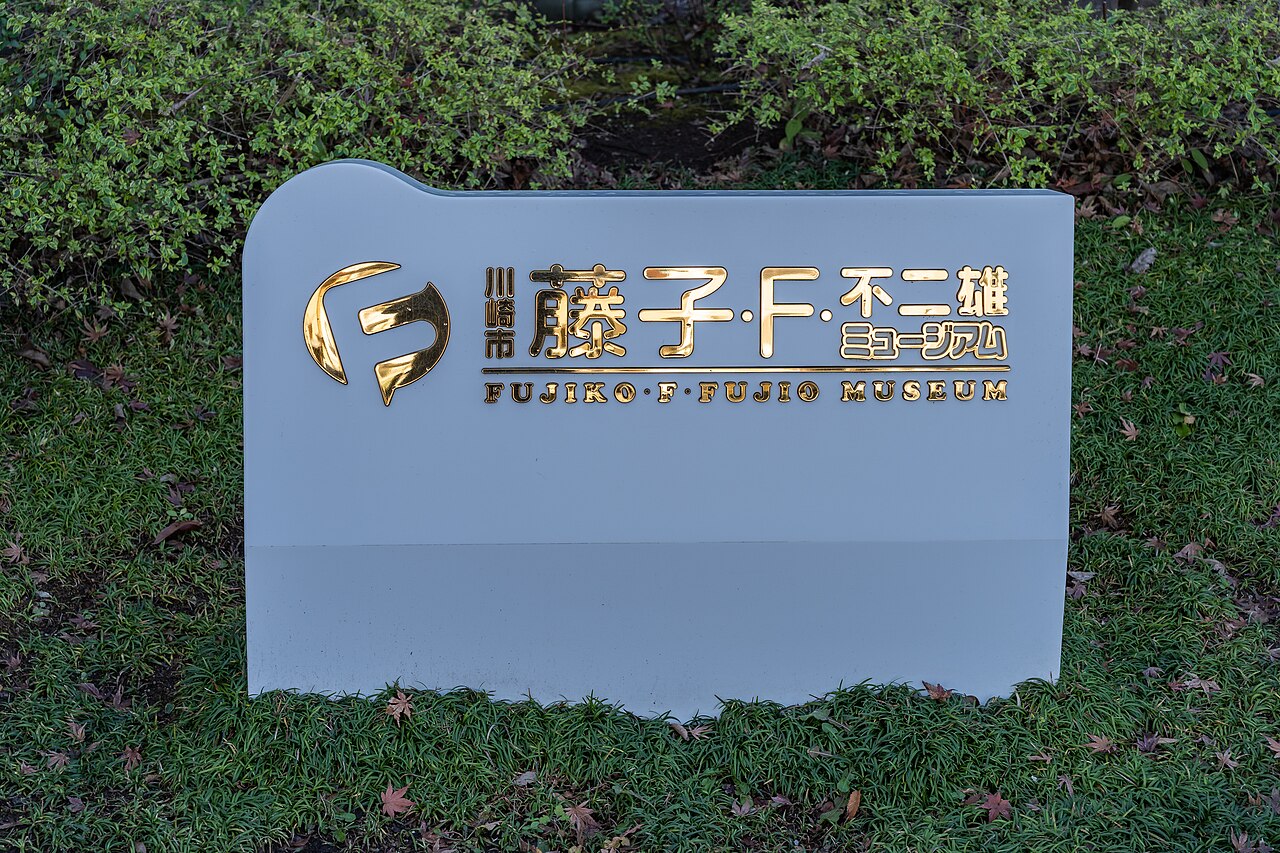 Entrance sign at the Fujiko F. Fujio Museum in Kawasaki, dedicated to the manga artist who created Doraemon. Photo: Wei-Te Wong, CC BY-SA 2.0, via Wikimedia Commons.
Doraemon was created by the writing/art duo known collectively as Fujiko F. Fujio (藤子・F・不二雄), the pen name primarily used by artist Hiroshi Fujimoto. The 漫画 debuted simultaneously across several Japanese children's magazines in December 1969 (with the cover date January 1970), and it ran continuously until Fujimoto's death in 1996. The manga was serialized for over 25 years and collected into 45 tankōbon volumes, selling well over 100 million copies in Japan alone.
The アニメ adaptation has been even more culturally dominant than the manga. After a short-lived 1973 series, a second anime adaptation began on TV Asahi in 1979 and — remarkably — is still producing new weekly episodes today, more than 45 years later, making it one of the longest continuously running animated series in the world. A new Doraemon movie has been released in Japanese theaters almost every spring since 1980, a tradition affectionately nicknamed "ドラ映画" (Dora-movies) that remains a fixture of the Japanese spring calendar.
Doraemon's status goes well beyond entertainment. In 2008, Japan's Ministry of Foreign Affairs named Doraemon the country's first-ever "アニメ大使" (Anime Ambassador), tasking the character with promoting Japanese culture abroad — an honor that reflects how thoroughly Doraemon is treated as a 国民的 (national) symbol rather than merely a commercial mascot. Doraemon has represented Japan at World Expo pavilions, including Expo 2005 in Aichi, and the character's image appears on everything from municipal mascots to public safety posters. The 藤子・F・不二雄博物館 (Fujiko F. Fujio Museum), which opened in Kawasaki in 2011, is devoted to Fujimoto's life and work and draws visitors from across Japan and overseas.
Part of Doraemon's staying power is its setting: an ordinary Shōwa-era Tokyo suburb, populated by an ensemble of relatable 子供 characters — lazy Nobita, bully Gian, sly Suneo, and kind-hearted Shizuka — whose everyday problems (failed tests, bullying, family squabbles) are the real engine of every story, with the futuristic gadgets serving mainly as a way to explore the consequences of taking shortcuts. That combination of nostalgic, humble domestic setting with boundless science-fiction imagination is often credited as the reason the series appeals just as strongly to parents who grew up with it as to their children.
Signature Gadgets
Doraemon has pulled well over a thousand different gadgets from his pocket across the series, but a handful have become genuine icons of Japanese pop culture in their own right:
| Gadget | Japanese | Effect |
|---|---|---|
| Anywhere Door | どこでもドア | A door that opens onto any location the user pictures, anywhere in the world (or beyond) |
| Bamboo Copter | タケコプター | A small propeller worn on the head that grants the power of flight |
| Time Machine | タイムマシン | Built into Nobita's desk drawer; allows travel to any point in time |
| Small Light / Big Light | スモールライト・ビッグライト | Shrinks or enlarges anything it shines on |
| Memory Bread | 暗記パン | Eating a slice memorizes anything printed on the page pressed onto it first |
The どこでもドア in particular has entered everyday Japanese as an idiom for any impossibly convenient shortcut, much as "beam me up" functions in English.
Related Terms
- のび太 — Nobita Nobi, the boy Doraemon is sent to help; his name has become mild slang for someone endearingly clumsy or unlucky
- 国民的アニメ — "national anime," a term applied to only a handful of series (Doraemon, Sazae-san, Chibi Maruko-chan) with truly universal, cross-generational household recognition
- タイムパトロール — "Time Patrol," the future organization from Doraemon lore that regulates time travel, referenced across other Japanese science-fiction works
See Also
Doraemon has been continuously translated and broadcast across Asia, Europe, and Latin America, and an official English-dubbed version has aired internationally since the 2010s. The franchise includes movies, video games, a theme park area, and merchandise spanning stationery to public transit liveries — several Japanese railway and tram operators have run Doraemon-themed cars.
Related Dictionary Words
cat (esp. the domestic cat, Felis catus); feline
robot
(distant) future
4D pocket; magical pocket that can hold any item
hopter (gadget that allows its user to fly; in the Doraemon manga and anime series)
time machine
cartoon; comic; comic strip; manga
animation; animated film; animated cartoon; anime
ambassador
museum
world fair; international exposition
people (of a country); nation; citizen; national
family
child; children
secret; secrecy; confidentiality; privacy
tool; implement; instrument; utensil; apparatus; device
friendship; fellowship; camaraderie
adventure; venture
invention
elementary school student; primary school student; grade school student
national (e.g. hero, pastime, consensus); relevant to all citizens; popular on a national level