風呂敷
furoshikiA square piece of traditional Japanese cloth used for wrapping and carrying items, now experiencing a global revival as an eco-friendly alternative to plastic bags and paper gift wrap.
Meaning
風呂敷 (furoshiki) is a square piece of cloth used to wrap, carry, and store items. The name combines 風呂 (furo, meaning "bath") and 敷 (shiki, meaning "to spread"), referring to its original role on the floor of public bathhouses. Far more than a simple wrapper, furoshiki embodies a philosophy of resourcefulness — a single piece of 布 that transforms itself to fit whatever it needs to hold.
Modern furoshiki come in sizes ranging from roughly 45 cm (small, called 小風呂敷 ko-furoshiki) all the way up to 105 cm or larger (大風呂敷 oo-furoshiki). The most commonly used everyday size is around 70 cm square. Fabrics range from affordable 綿 (cotton) and 麻 (linen) to luxurious 絹 (silk) and modern synthetics such as nylon or polyester.
Cultural Context
Origins: from bathhouse to everyday life
Furoshiki's history stretches back over a thousand years. During the Nara period (710–794 CE), similar cloths called tsutsuminuno (包み布) were used to wrap and protect sacred objects and ceremonial robes. The name furoshiki itself was coined during the Muromachi period (1336–1573), when public bathhouses became common. Patrons would spread a cloth on the floor (shiki) to stand on and to bundle their clothing — a practical way to avoid mixing up garments in the communal bathing space.
By the Edo period (1603–1868), furoshiki had spread far beyond bathhouses and become a fixture of everyday life. Merchants used them to 持ち歩く goods to market; families wrapped 贈り物 for weddings and ceremonies; travelers bundled their belongings for the road. Because plastic and paper bags did not exist, the furoshiki was the shopping bag — every household owned several.
Decline and revival
Usage of furoshiki declined sharply after World War II, when mass-produced plastic bags and paper packaging became cheap and widely available. By the 1980s, furoshiki had acquired an old-fashioned image, associated with grandmothers rather than modern life.
The 21st century brought a remarkable reversal. Growing awareness of plastic pollution and the spirit of mottainai (もったいない — a Japanese concept of avoiding waste) sparked renewed interest. In 2006, Japan's then-Environment Minister Yuriko Koike launched a high-profile campaign promoting furoshiki as a reusable alternative to plastic bags, sparking national attention. The 環境 benefits are straightforward: a single furoshiki can replace thousands of disposable bags over its lifetime.
Today furoshiki are sold in デパート department stores, specialty textile shops, and 100-yen stores alike, and the craft of wrapping has become a popular cultural export — taught in workshops from Paris to New York.
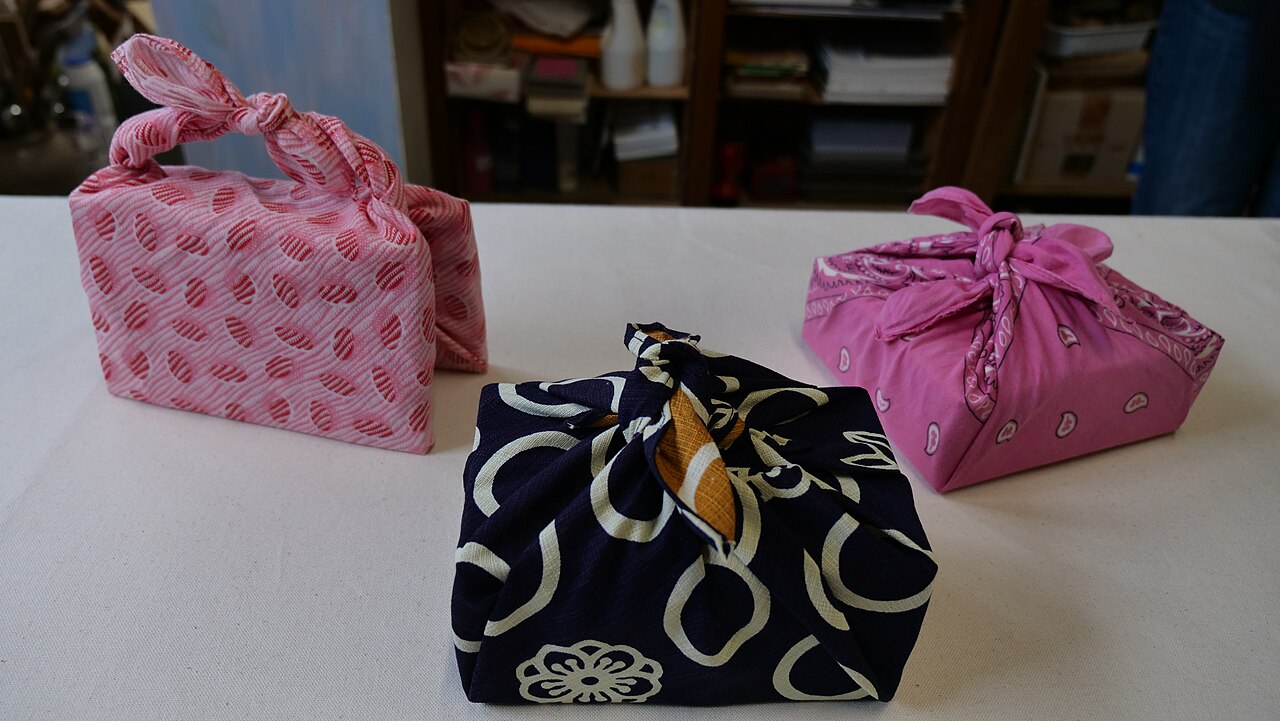
Traditional Japanese furoshiki wrapping technique with patterned cloths. Photo: Culture Japon, CC BY-SA 4.0, via Wikimedia Commons.
Usage
Common wrapping techniques
Furoshiki wrapping relies on folding and knotting rather than adhesives or tape. A few core knots — particularly the hon musubi (本結び, a simple square knot) — anchor most styles. Here are the most widely used techniques:
| Technique | 日本語 | Best for |
|---|---|---|
| Otsukai tsutsumi | お使い包み | Boxes and rectangular gifts |
| Bin tsutsumi | 瓶包み | Single or paired bottles of wine or sake |
| Suika tsutsumi | 西瓜包み | Round or irregular objects (melons, bowls) |
| Yotsu musubi | 四つ結び | Carrying as a tote bag |
| Hira tsutsumi | 平包み | Flat, shallow items like books or trays |
Otsukai tsutsumi (お使い包み, "errand wrap") is the classic all-purpose method for 買い物 or presenting a boxed gift. The box is placed diagonally on the cloth, corners folded up and tied neatly on top.
Bin tsutsumi (瓶包み) wraps a bottle elegantly. For a single bottle, the cloth is folded lengthwise and twisted around the bottle; for two bottles, they are laid at opposite ends and the midpoint is knotted, allowing them to hang together like a lantern.
Suika tsutsumi (西瓜包み, "watermelon wrap") handles round and awkward shapes with four corners pulled up and tied in two separate knots — the resulting carry handle looks cheerful and secure.
Furoshiki as a bag
The yotsu musubi (四つ結び, "four-knot") method transforms any square cloth into a shoulder bag or tote in seconds. Opposite corners are tied together to create two looped handles. Many people carry a 70 cm furoshiki in a coat pocket as a reusable grocery bag — it 節約 reduces waste and compresses to almost nothing when not in use.
Gift wrapping
Presenting a gift wrapped in furoshiki carries its own etiquette. Unlike Western gift wrap, which is discarded, the furoshiki itself is part of the gift — the recipient is expected to return it, or the giver may choose a cloth they are happy for the recipient to keep. Seasonal and celebratory patterns (cranes, pine, chrysanthemums) convey good wishes; simpler geometric patterns suit everyday giving.
Fabrics and Quality
| Material | Character | Typical Use |
|---|---|---|
| 綿 (cotton) | Soft, washable, affordable | Everyday carrying, grocery use |
| 絹 (silk) | Luxurious, lustrous, delicate | Formal gifts, special occasions |
| 麻 (linen/hemp) | Sturdy, breathable | Carrying heavier items |
| 化繊 (synthetic) | Lightweight, wrinkle-resistant | Budget-friendly, travel |
Traditional silk furoshiki often feature chirimen (縮緬, silk crepe) or habutae (羽二重, smooth woven silk) and may be dyed using yuzen (友禅) hand-painting techniques. High-quality cotton furoshiki from textile towns like Nishio in Aichi Prefecture are prized for their vivid indigo-dyed or katazome (paste-resist) patterns.
Where to Buy
- Department stores (such as Takashimaya, Mitsukoshi): dedicated furoshiki sections with curated selections from established makers like Musubi and Miyakoshi
- Specialty stores: shops such as Musubi in Kyoto and Tokyo stock hundreds of patterns and offer wrapping instruction cards
- 100-yen stores: functional cotton furoshiki for everyday use at minimal cost — ideal for beginners
- Online: Japanese platforms like Rakuten and Amazon Japan carry everything from artisan-dyed pieces to bulk cotton squares
- Souvenir shops: furoshiki featuring seasonal motifs or regional designs make excellent gifts
Eco-Friendly Appeal
The sustainability case for furoshiki is compelling. A single well-made cotton cloth can last decades, replacing thousands of single-use plastic bags over its lifetime. 環境保護 campaigns in Japan and abroad have embraced furoshiki as a symbol of conscious consumption — beautiful proof that traditional craft and modern environmental values can align.
The Japanese concept of mottainai — feeling regret at waste, and finding ways to extend the life of materials — fits furoshiki perfectly. Every knot is undoable, every use leaves the cloth ready for the next.