ガチャ
gachaThe Japanese capsule toy vending machine culture and its digital descendant — the randomized loot mechanic that took mobile gaming worldwide by storm.
Meaning
ガチャ (gacha) is an onomatopoeic word derived from the sounds made when operating a capsule toy vending machine: gacha (がちゃ) for the crank turning, and pon (ぽん) for the capsule dropping into the tray — giving the full word ガチャポン (gachapon) or, in Bandai's trademark, ガシャポン (gashapon). Over time, "gacha" became the shorthand used both for the physical machines and for the randomized reward mechanic transplanted into digital games.
At its core, gacha is about paying a small amount for a random prize — you never know exactly what you will get. This blend of anticipation, chance, and collection is central to Japanese popular culture, echoing broader traditions like omikuji (fortune slips at shrines) and the satisfaction of completing a full set.
Physical Gacha Machines (ガシャポン・ガチャポン)
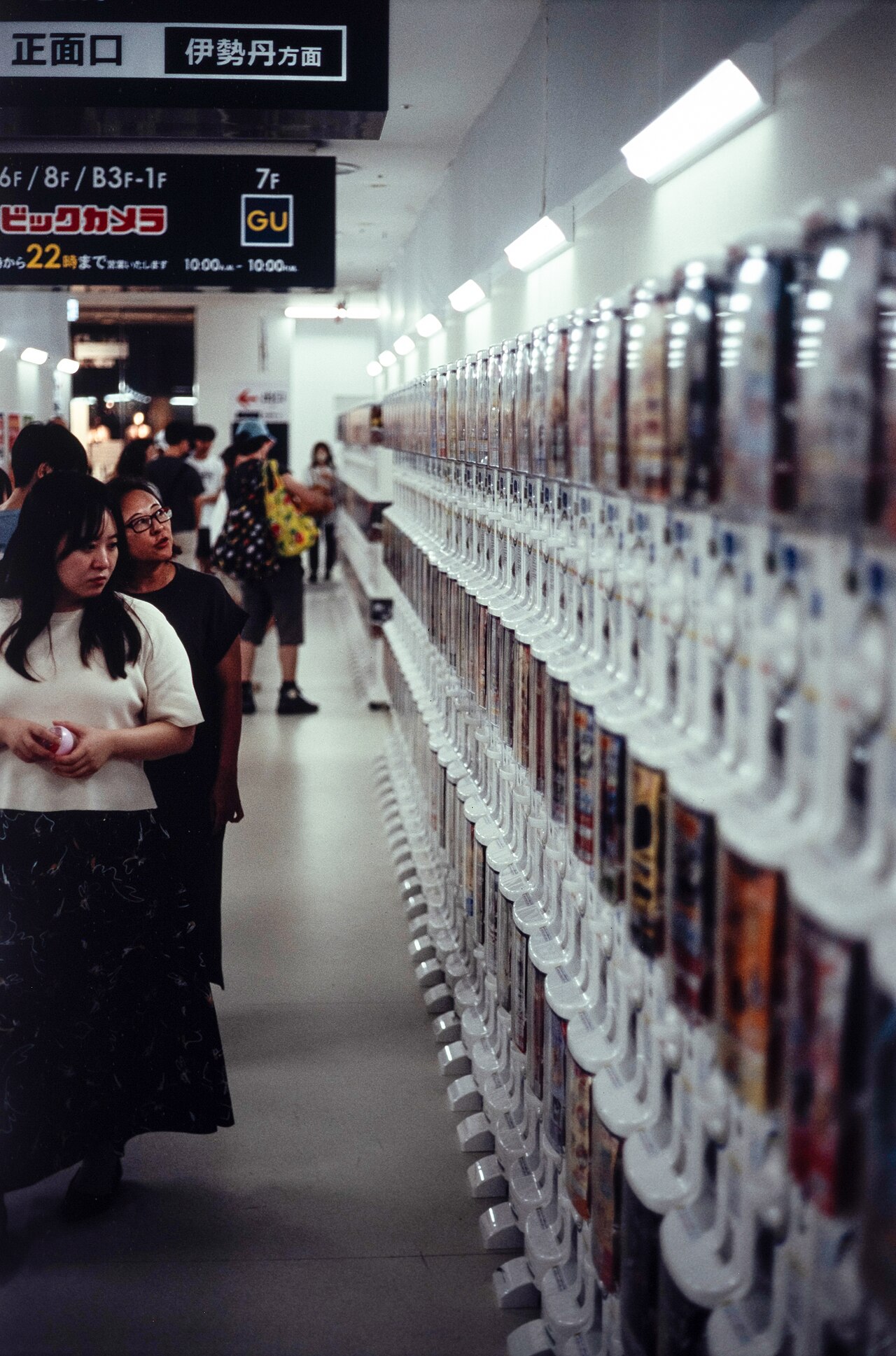
Gachapon machines at Shinjuku BIC Camera, Tokyo. Photo: Itsmejames, CC BY 4.0, via Wikimedia Commons.
Capsule toy machines were introduced to Japan in 1965 by entrepreneur Ryuzo Shigeta, inspired — but dissatisfied — by American gumball machines. He developed a cleaner, more premium version: small plastic capsules containing miniature figurines, keychains, and novelty items, dispensed by inserting coins and turning a crank. By the 1970s, the machines had spread across the country, and Japanese toy makers elevated the contents from cheap trinkets to highly detailed collectibles.
Today, the capsule toy market is worth approximately ¥40 billion annually (around $280 million USD), with roughly 600,000 machines operating across Japan. About 300 new product lines launch every month. Major manufacturers like Bandai (ガシャポン) and Takara Tomy Arts command about 60% of the market. Themes range from beloved anime franchises — Dragon Ball, Evangelion, Pokémon — to hyper-niche items like miniature convenience store food replicas or tiny cats sitting in cardboard boxes.
Gacha machines are a fixture at:
- Toy stores and department stores
- Arcades (ゲームセンター)
- Train stations and airports
- Tourist spots and theme parks
- Dedicated ガチャポンの森 (gacha forest) specialty shops
Part of the cultural appeal is the コレクション (collection) culture — many sets are designed with multiple variants, compelling buyers to keep inserting coins until they complete the full set. The phrase ダブった (doubled up / got a duplicate) is universally understood by anyone who has spent too long at a gacha machine.
Digital Gacha in Mobile Games
The physical gacha mechanic migrated to online and mobile games in the mid-2000s, first appearing in Japanese social games on platforms like GREE and Mobage around 2009–2010. The timing was perfect: smartphone adoption was surging, and the free-to-play (F2P) model needed a monetization engine.
In digital gacha, players spend in-game currency — purchased with real money — to "pull" (引く, hiku) characters, weapons, or items from a randomized pool. The rarity tiers, typically labeled R (Rare), SR (Super Rare), and SSR (Super Super Rare), borrow directly from trading card game culture. SSR characters often appear with flashy animations and dramatic music, amplifying the emotional payoff.
Key terms in digital gacha culture:
| Term | Reading | Meaning |
|---|---|---|
| ガチャを引く | がちゃをひく | To pull the gacha / to roll |
| 確率 | かくりつ | Probability / drop rate |
| SSR | エスエスアール | Super Super Rare — the highest rarity |
| 天井 | てんじょう | "Ceiling" — guaranteed SSR after X pulls |
| 沼 | ぬま | "Swamp" — getting stuck spending on a banner |
| ガチャ沼 | がちゃぬま | The gacha swamp — addictive spiral of spending |
| 課金 | かきん | Paid charges / spending real money |
| 無課金 | むかきん | Free-to-play; spending no real money |
| 爆死 | ばくし | "Explosion death" — spending big and getting nothing |
| 限定 | げんてい | Limited-time; used for event-exclusive characters |
The SSR drop rate is typically below 3%, sometimes as low as 0.3% for featured characters. This near-miss psychology — combined with spectacular animation for rare pulls — keeps players engaged far longer than standard game loops.
Controversy and Regulation
The dark side of gacha became undeniable in 2012, when Japan's Consumer Affairs Agency (消費者庁) declared コンプガチャ (complete gacha) illegal under the Prize Display Act (景品表示法).
Complete gacha worked by requiring players to collect a specific set of multiple items before receiving the actually desirable prize. Getting the final missing item from a large set could become statistically catastrophic — players reported spending hundreds of thousands of yen (thousands of dollars) on a single set. The Consumer Affairs Agency ruled this constituted an illegal lottery combined with a prize scheme.
The ban on complete gacha in May 2012 sent shockwaves through Japan's social gaming industry. Several major game operators saw their stock prices drop sharply. The industry responded with self-regulatory measures, including the Japan Online Game Association (JOGA) establishing guidelines for gacha transparency.
Subsequent regulations and industry practices included:
- 確率表示の義務化 — Mandatory probability disclosure, so players can see the exact drop rate for each rarity tier before spending
- 天井システム (ceiling system) — A guaranteed pull mechanism after a set number of pulls (commonly 100–200)
- ステップアップガチャ — Step-up gacha where earlier steps are cheaper, reducing predatory first-purchase pressure
Despite these improvements, gacha remains controversial globally. Multiple countries, including Belgium and the Netherlands, have classified certain gacha mechanics as gambling and banned them for minors. In Japan, the debate continues, with consumer groups calling for stricter regulation while game companies argue the mechanics are entertainment, not gambling.
ガチャ沼 — The Gacha Swamp
The term ガチャ沼 (gacha swamp) entered common usage on Twitter and gaming forums to describe the experience of being trapped in a cycle of pulls. The kanji 沼 (swamp) is used in internet slang for any deep obsession one cannot escape — 推し沼 (oshi swamp), 沼にハマる (fall into a swamp). Gacha swamp describes spending far more than intended chasing a limited SSR character.
Related slang:
- 爆死する — to "explode and die," meaning spending a lot and getting nothing good
- 天井まで走る — to "run to the ceiling," meaning spending until the guaranteed pull
- 全財産溶かした — "melted all my assets," describing total financial loss to gacha
Contents shared on social media — especially on Twitter/X — often feature screenshots of pull results (ガチャ結果), with reactions ranging from ecstatic (出た! / deta! — "I got it!") to despairing (爆死した / bakushi shita — "I exploded").
Cultural Impact
Gacha culture has profoundly shaped modern Japanese pop culture and, through mobile gaming, the global games industry:
Economy: Games like Fate/Grand Order, Genshin Impact, Monster Strike, and Puzzle & Dragons have each generated billions of dollars in revenue, largely driven by gacha mechanics. Genshin Impact, developed by a Chinese studio but modeled heavily on Japanese gacha conventions, earned over $1 billion in its first two weeks of release.
Anime crossovers: The gacha-game-to-anime pipeline is now a recognized phenomenon — popular gacha games regularly spawn anime adaptations, creating a feedback loop of fan spending.
Vocabulary export: Terms like "gacha" and "pull" have entered English-language gaming discourse globally. Western games from Pokémon GO to Marvel Snap use gacha-adjacent mechanics.
Physical resurgence: Ironically, physical gacha machines are experiencing a global boom — gacha machine corners have appeared in malls across the United States, Europe, and Southeast Asia, introducing a new generation to the original format.
Whether as a childhood memory of turning a crank in a convenience store, a ritual of daily pulls in a favorite mobile game, or a cautionary tale about randomized monetization, ガチャ has become one of Japan's most recognizable cultural exports of the 21st century.