花見
hanamiThe Japanese tradition of gathering with friends and family to appreciate the transient beauty of cherry blossoms, typically accompanied by food, drinks, and outdoor picnics beneath the blooming trees.
Meaning
花見 (hanami) literally means "flower viewing" — 花 (hana, flower) + 見 (mi, viewing). In modern usage the word refers almost exclusively to the springtime custom of gathering beneath blooming 桜 (sakura, cherry trees) to eat, drink, and revel in the brief spectacle of the blossoms.
The practice distills one of Japan's most cherished aesthetic ideals: 物の哀れ (mono no aware), the bittersweet awareness that beautiful things are precious because they are fleeting. Sakura blossoms peak for roughly one to two weeks before 散る (chiru, to fall and scatter) in drifts of pale pink petals. That very impermanence — cherry trees in full bloom for barely a week, then gone — gives hanami its emotional weight.
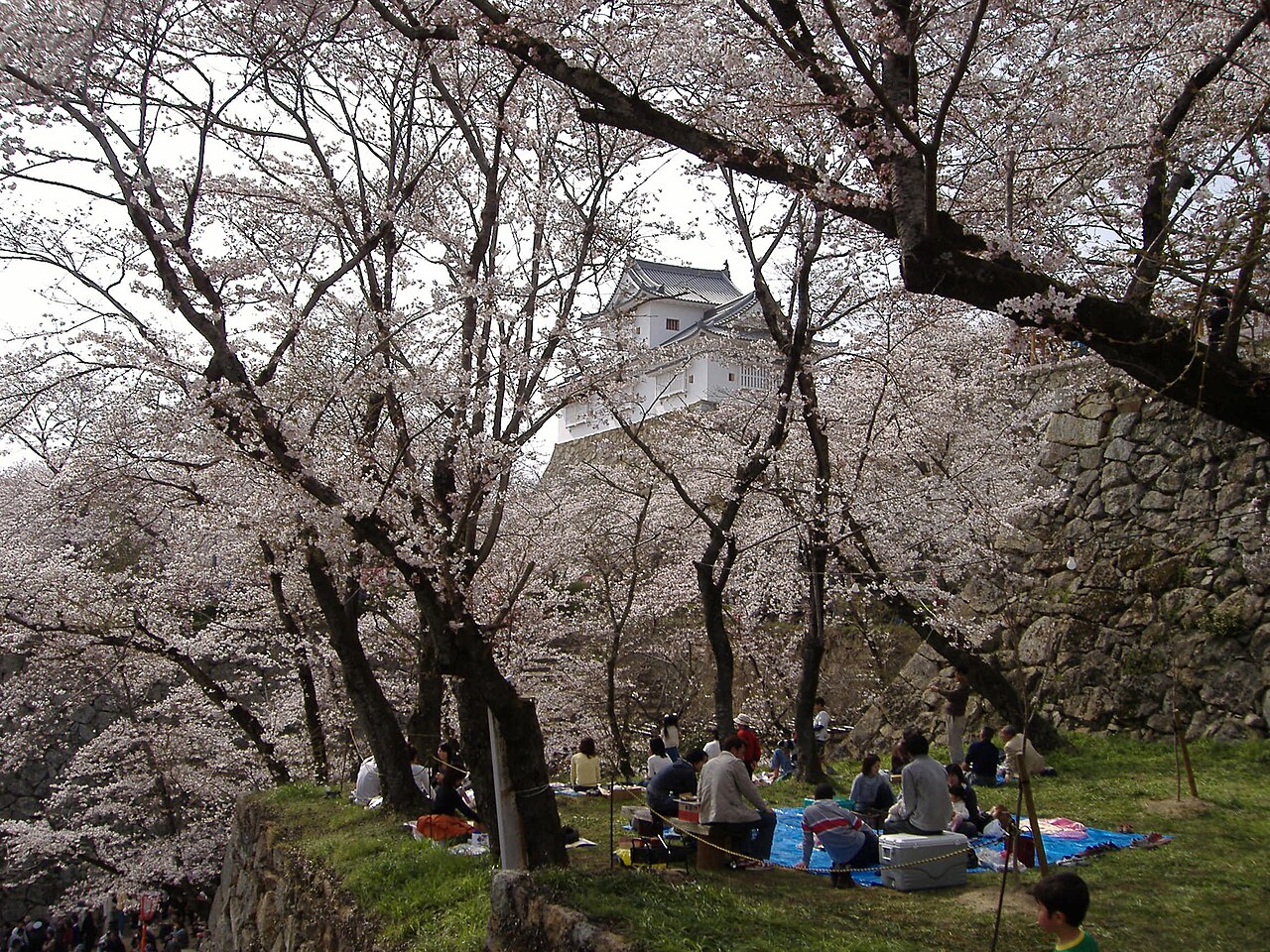
Hanami picnic under cherry blossoms. Public domain, via Wikimedia Commons.
Cultural Context
Ancient Roots
Flower viewing in Japan predates the cherry blossom tradition. During the Nara period (710–794), the aristocracy admired 梅 (ume, plum blossoms), following a practice imported from Tang-dynasty China. The shift to sakura occurred in the 平安時代 (Heian period, 794–1185), when the imperial court at Kyoto began holding elegant garden parties under cherry trees. The word hanami itself appears in The Tale of Genji (源氏物語, c. 1000 CE), where cherry-blossom banquets at the Heian court are described in loving detail.
During the 江戸時代 (Edo period, 1603–1868), hanami spread from the aristocracy to ordinary townspeople. The shogun Tokugawa Yoshimune planted thousands of cherry trees at public sites in Edo (present-day Tokyo) specifically so commoners could enjoy the blossoms. Ueno Park — then the grounds of Kan'ei-ji temple — became one of the most celebrated hanami destinations, a distinction it holds to this day.
The Sakura Season
Japan takes the arrival of cherry blossoms with near-scientific seriousness. The Japan Meteorological Corporation (日本気象株式会社) publishes annual 開花予想 (kaikayosō, bloom forecasts) tracking a "sakura front" (桜前線, sakura zensen) that moves northward from Kyushu in late March, reaching Tokyo in early April, Tohoku in late April, and Hokkaido in early May. Nightly news broadcasts feature bloom-progress maps, and people check smartphone apps for the precise peak day at their nearest park.
The benchmark species is 染井吉野 (Somei Yoshino), a cultivar bred in Edo-period Japan that now accounts for the majority of Japan's park cherry trees. Its blossoms open before the leaves, creating pure clouds of pale pink against bare branches. Other notable varieties include:
| Variety | Japanese | Feature |
|---|---|---|
| Somei Yoshino | 染井吉野 | Pale pink, most widespread, blooms early |
| Yaezakura | 八重桜 | Double-petalled, deep pink, blooms 1–2 weeks later |
| Shidarezakura | 枝垂桜 | Weeping form, long drooping branches |
| Kawazu-zakura | 河津桜 | Deep pink, blooms as early as February |
Usage
Modern Hanami Gatherings
A typical hanami revolves around claiming a spot — sometimes days in advance — beneath the best trees in a 公園 (kōen, park). The ground is covered with ブルーシート (burū shīto, blue tarps), a modern hanami staple. Friends and 仲間 (nakama, companions) arrive with 弁当 (bentō, boxed meals), convenience-store snacks, and — for adults — cans of beer or sakura-flavored 酒 (sake).
Example:
今週末、上野公園で花見しない? Konshūmatsu, Ueno Kōen de hanami shinai? "Want to do hanami at Ueno Park this weekend?"
場所取り、誰がやる? Bashotori, dare ga yaru? "Who's doing the spot-saving?"
場所取り (bashotori, literally "place-taking") is a hanami ritual in itself: a designated person arrives at the park at dawn — or even the night before — to lay down a tarp and guard the prime spot under the best tree.
Company Hanami (花見幹事)
Office hanami is a fixture of corporate Japan. The most junior employee is typically assigned the role of 花見幹事 (hanami kanji, hanami organizer), responsible for scouting locations, reserving the spot, coordinating food and drink orders, and making sure everyone has a good time. It is both a social obligation and an unofficial rite of workplace initiation. Failing to secure a good spot is taken seriously.
Famous Spots
| Location | Notes |
|---|---|
| 上野公園 (Ueno Park, Tokyo) | Tokyo's most famous hanami site; thousands of trees, famously crowded |
| 円山公園 (Maruyama Park, Kyoto) | Home to a celebrated weeping cherry tree (枝垂桜) lit up at night |
| 新宿御苑 (Shinjuku Gyoen, Tokyo) | Manicured gardens with multiple cherry varieties; alcohol-free |
| 弘前城 (Hirosaki Castle, Aomori) | ~2,600 trees; renowned for the "sakura tunnel" when petals carpet the moat |
| 高田公園 (Takada Park, Niigata) | Famous for night hanami (夜桜, yozakura) with lantern illumination |
Yozakura (夜桜)
夜桜 (yozakura, night cherry blossoms) refers to viewing illuminated sakura after dark. Parks and castles set up special lighting rigs during blossom season, turning the trees into glowing pink canopies. Night hanami has its own atmosphere — cooler, quieter, and often considered more romantic than daytime viewing.
Mono no Aware and the Philosophy of Hanami
No account of hanami is complete without 物の哀れ (mono no aware), the cornerstone of Japanese aesthetic philosophy. The phrase is usually translated as "the pathos of things" or "an empathy toward things" — a gentle sadness at the transience of beauty. The term was formalized by the 18th-century scholar Motoori Norinaga, but the feeling it names permeates Japanese culture from the 10th century onward.
Sakura embodies mono no aware perfectly. The blossom's beauty is inseparable from its brevity. A cherry tree in full bloom for a single brilliant week, then stripped bare by wind and rain, captures a truth that the Japanese have long found both melancholy and affirming: beauty passes, and that passage is what makes it beautiful.
This sensibility also echoes the concept of 一期一会 (ichi-go ichi-e, "one time, one meeting") — the idea that each shared moment is unrepeatable and should be treasured fully.
Hanami in Popular Culture
Music
Sakura and hanami have inspired a vast body of Japanese music. Among the most beloved:
- 「さくら(独唱)」 by 森山直太朗 (Naotarō Moriyama, 2003) — a gentle acoustic ballad that became one of the best-selling Japanese singles of the 2000s and is now synonymous with graduation season.
- 「桜」 by FUNKY MONKEY BABYS (2010) — an upbeat J-pop send-off song for departures and new beginnings.
- 「桜坂」 by 福山雅治 (Masaharu Fukuyama, 2000) — a melancholy love song named after a sakura-lined slope in Tokyo.
- 「春よ、来い」 by 松任谷由実 (Yumi Matsutoya, 1994) — a classic waiting-for-spring anthem.
Anime and Manga
Sakura season is a recurring setting in anime, often used to mark emotional turning points — graduations, confessions, farewells. Cherry blossoms falling in the background (a visual trope called 桜吹雪, sakura fubuki) signal both beauty and impending change. Series from Your Lie in April (四月は君の嘘) to March Comes in Like a Lion (3月のライオン) use sakura as emotional shorthand.
Social Media
During peak bloom, Japanese social media fills with sakura photos under hashtags like #花見 and #桜. The sakura season is one of the most photographed events in the country, and the annual bloom forecast inspires near-obsessive engagement — posts comparing this year's peak date with last year's, debating the best viewing spots, and mourning the first petal-fall.
Seasonal Connections
Hanami sits at the intersection of 春 (haru, spring) and renewal. In Japan, the school year and fiscal year both begin in April, so sakura bloom coincides with new beginnings — entrance ceremonies, first days at jobs, and farewells to those moving away. The simultaneous themes of ending and starting, framed by blossoms that are themselves both peak and farewell, make hanami one of the most emotionally resonant annual rituals in Japanese life.