生け花
ikebanaThe traditional Japanese art of flower arrangement, where living plants are composed according to principles of harmony, balance, and the beauty of empty space.
Meaning
生け花 (いけばな, ikebana) literally translates as "living flowers." The word is written with the characters 生 (ike, to keep alive) and 花 (hana, flower), and it describes a centuries-old Japanese discipline of arranging cut plants in vessels. Unlike Western floral design, which prizes abundance and symmetry, ikebana treats each stem, leaf, and empty space as an intentional compositional element.
The practice is also called 華道 (かどう, kadō) — the "way of flowers" — a name that signals its status alongside 禅 arts such as the tea ceremony (茶道, sadō) and calligraphy (書道, shodō).
Philosophy
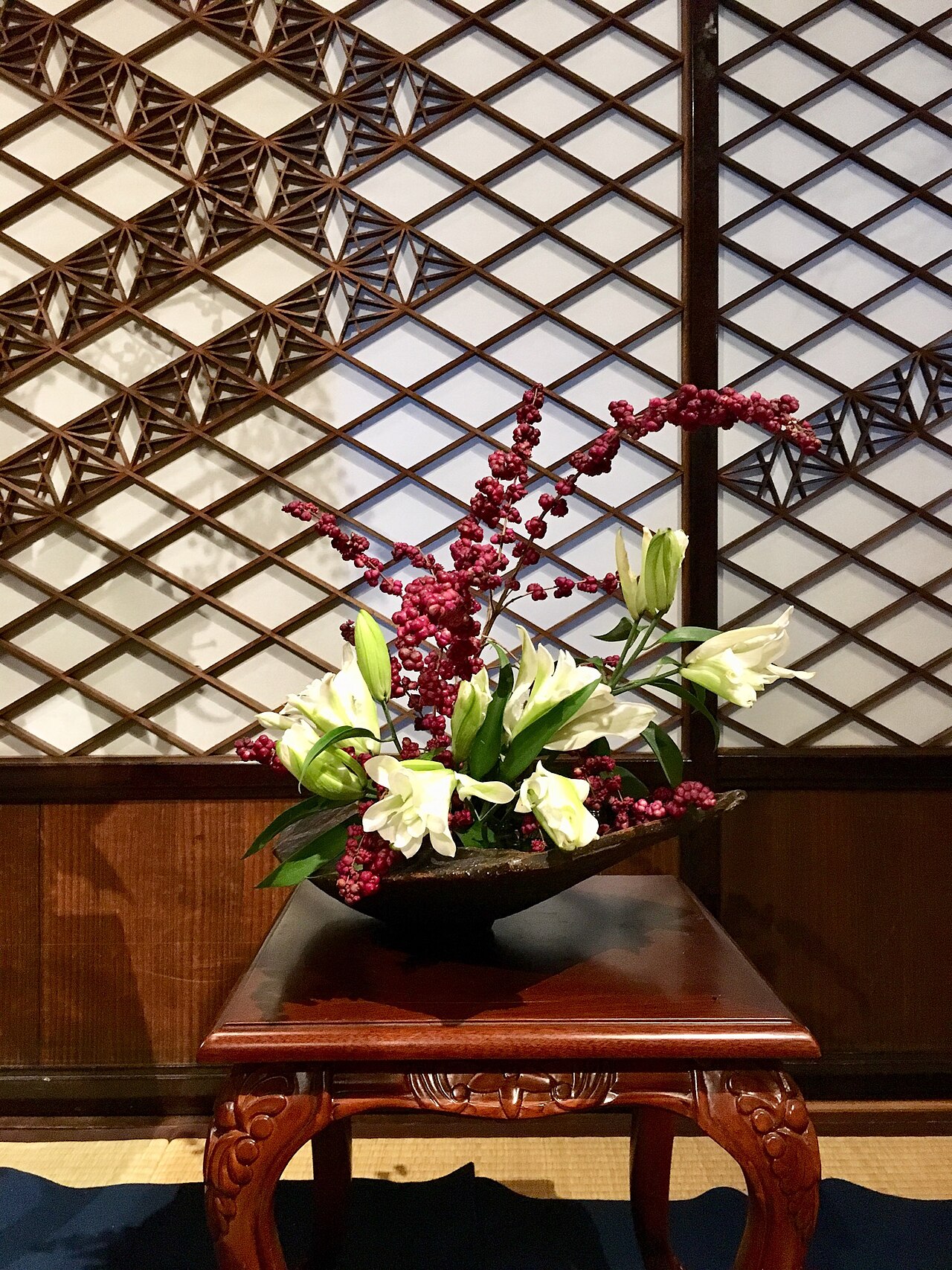
An ikebana arrangement at the Meguro Gajoen exhibition, Tokyo. Public domain (CC0), via Wikimedia Commons.
At the heart of ikebana is the concept of 間 (ma) — the Japanese aesthetic of meaningful negative space. Where a Western bouquet fills a vase to create a lush, full impression, an ikebana arrangement deliberately leaves open space so the eye can rest, breathe, and appreciate each individual element.
Ikebana also embodies the principle of 天地人 (てんちじん, ten-chi-jin): heaven, earth, and humanity. The three primary branches or stems in a classical arrangement represent these three forces:
| Element | Japanese | Role in arrangement |
|---|---|---|
| Heaven (天) | ten | Tallest line, reaching upward |
| Earth (地) | chi | Lowest, grounding the composition |
| Humanity (人) | jin | Middle line, bridging the other two |
This triadic structure gives ikebana a sense of cosmic balance. The arranger is not simply decorating a room — they are enacting a small drama between sky, soil, and human presence.
The connection to 自然 (nature) is central. Ikebana practitioners study seasonal plants carefully, working with what is available in each 季節. A winter arrangement might feature bare branches and a single camellia; a summer piece might use tall grasses and a lotus bloom. The impermanence of the materials — flowers wilt, branches dry — is not a flaw but a reminder of mono no aware (物の哀れ), the bittersweet awareness of transience.
Origins
Ikebana's roots reach back to the 6th century, when 仏教 arrived in Japan from China via Korea. Priests began placing flowers on altar offerings (kuge, 供花), and over time these offerings evolved into a refined art form. By the Muromachi period (1336–1573), a formal school of practice had emerged.
The oldest and most prestigious school, 池坊 (いけのぼう, Ikenobō), traces its lineage to a Buddhist priest named Ono no Imoko, who arranged flowers at Rokkakudō temple in Kyoto. The Ikenobō family has maintained an unbroken head (iemoto) system for over 550 years, making it one of the oldest continuously operating cultural institutions in Japan.
Major Schools
Three schools dominate modern ikebana practice:
池坊 (Ikenobō)
The oldest school, founded in Kyoto in the 15th century. Ikenobō emphasizes classical styles including 立花 (たてはな, tatehana, "standing flowers") and 生花 (せいか, seika, a spare two- or three-element style). Its arrangements tend toward the formal and structured. Today Ikenobō has around 60,000 practitioners worldwide.
小原流 (Ohara)
Founded in the late 19th century by Ohara Unshin, this school introduced Western flowers and low, wide-mouthed containers (moribana, 盛り花) to ikebana. Ohara's innovation made it possible to arrange flowers horizontally rather than only vertically — a major departure that brought ikebana closer to landscape painting in three dimensions.
草月流 (Sogetsu)
Founded in 1927 by Teshigahara Sofu, Sogetsu is the most avant-garde of the major schools. Its philosophy holds that ikebana can be practiced anywhere, by anyone, using any material — not just traditional plants but also metal, wire, glass, stone, and found objects. Sogetsu is popular internationally and is known for large-scale sculptural installations.
Tools
A few essential tools define ikebana practice:
- 剣山 (けんざん, kenzan): A heavy metal pin holder — a dense bed of upward-pointing spikes set in a lead base. Stems are pressed onto the spikes to hold them at precise angles. The kenzan is the practitioner's most important tool.
- 花器 (かき, kaki): The vase or container. Shape and material matter enormously; the container is considered part of the composition, not merely a vessel.
- 花鋏 (はなばさみ, hanabásami): Ikebana scissors, heavier than standard scissors, used to make clean diagonal cuts that allow stems to absorb water.
The Practice Today
Ikebana is taught in a structured, school-based system. Students progress through a series of ranked lessons, learning prescribed 形 (forms) before gaining the freedom to create freestyle arrangements. Most schools award certificates and eventually teaching licenses, which many Japanese women traditionally obtained before marriage as a mark of cultural refinement.
This association with femininity has softened in recent decades. Sogetsu in particular has attracted male practitioners and contemporary artists. Ikebana exhibitions are held regularly at department stores, temples, and cultural centres across Japan, and several schools maintain active international branches.
For foreigners interested in learning, options include:
- One-day workshops (体験レッスン, taiken ressun) offered at Sogetsu Kaikan in Tokyo and at cultural centres throughout Japan — these typically cost ¥3,000–¥6,000 and include materials.
- Ongoing classes through local chapters of Ikenobō, Ohara, or Sogetsu in many countries outside Japan.
- Online courses offered by all three major schools since 2020, though hands-on practice with a kenzan is strongly recommended.
Ikebana and Japanese Aesthetics
Ikebana sits at the intersection of several overlapping Japanese aesthetic values. Its 美 (beauty) is never loud or insistent; it rewards sustained attention. The 空間 between stems is as carefully considered as the stems themselves. A good arrangement looks inevitable — as if the plants chose their own positions — yet represents hours of study and practice.
This paradox of effortless mastery (shibui, 渋い) connects ikebana to the broader Japanese cultural idea that true craft conceals its own effort. Visitors who encounter an ikebana display in a hotel lobby or temple alcove (tokonoma, 床の間) may not consciously register its principles, but they will often feel a sense of calm that is not accidental.