可愛い
kawaiiThe Japanese aesthetic of cuteness that became a global cultural force, encompassing fashion, character design, and a deeply rooted value of innocence and charm.
Meaning
可愛い (kawaii) is one of the most influential Japanese aesthetic concepts in the modern world. Literally translated as "cute" or "adorable," kawaii carries a depth of meaning that English equivalents cannot fully capture. It describes not just visual cuteness but a quality of smallness, vulnerability, and innocence that inspires warmth and a desire to protect. Something kawaii is 丸い (round), 小さい (small), 柔らかい (soft), and 愛らしい — fundamentally unthreatening and endearing.
The word traces its origins to the classical Japanese phrase kao hayushi (顔映ゆし), meaning "(one's) face is glowing/flushed" — a reference to blushing from embarrassment or shame at witnessing someone in a vulnerable state. Over centuries this feeling of tender concern transformed into today's broader aesthetic of charming cuteness.
Usage
Kawaii is used freely across all age groups and genders in everyday Japanese speech:
この子猫、本当に可愛いね。 Kono koneko, hontō ni kawaii ne. "This kitten is really cute, isn't it?"
彼女のファッションスタイルがとても可愛いと思う。 Kanojo no fasshon sutairu ga totemo kawaii to omou. "I think her fashion style is really kawaii."
Beyond describing people and animals, kawaii applies to objects, designs, gestures, voices, and entire lifestyles. A person can intentionally cultivate a kawaii persona through clothing, speech, and mannerisms.
Cultural Context
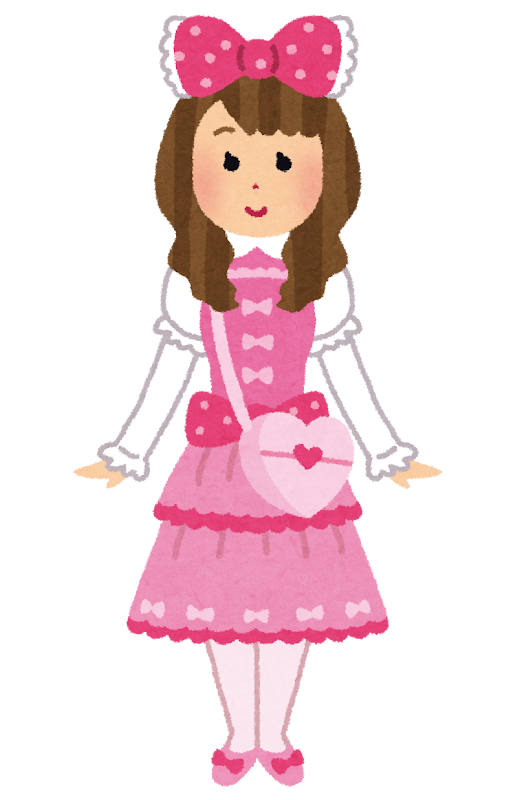
Lolita fashion, one of kawaii's most iconic subcultures. Illustration: いらすとや.
The roots of kawaii aesthetics stretch back centuries. In the early 11th century, Heian court lady Sei Shōnagon wrote of small, 幼い (childlike) things as kawaii in her celebrated Pillow Book (枕草子). Rounded, expressive figurines from Japan's ancient Tumulus period (250–552 CE) are sometimes cited as even earlier examples of a kawaii sensibility in Japanese art.
Modern kawaii culture was born from a collision of youth rebellion and consumer capitalism in the late 1960s and 1970s. Japanese students, pushing back against rigid academic expectations, began deliberately cultivating childlike aesthetics — adopting 丸文字 (bubble handwriting), speaking in high-pitched voices, and dressing in cute, pastel clothing. This was simultaneously an act of resistance and an embrace of innocence in a rigidly hierarchical adult society.
The 1970s also saw Sanrio launch ハローキティ in 1974, a deliberately mouthless character designed to project pure, neutral cuteness onto any owner. Hello Kitty became the single most recognizable symbol of kawaii globally and remains a multi-billion dollar franchise today.
Kawaii Subcultures and Fashion
Kawaii branched into distinct fashion subcultures, many centered on the Harajuku district of Tokyo:
| Style | Japanese | Description |
|---|---|---|
| Lolita | ロリータ | Victorian/Rococo-inspired layered dresses; emphasizes elegance and doll-like appearance |
| Decora | デコラ | Maximalist layering of colorful accessories — clips, toys, jewelry |
| Sweet Lolita | スウィートロリータ | Pastel colors, candy motifs, hyper-feminine and childlike |
| Gothic Lolita | ゴスロリ | Lolita aesthetics combined with dark, gothic color palettes |
| Fairy Kei | フェアリー系 | Soft pastels inspired by 1980s children's toys |
The magazine FRUiTS (1997–2017) and Gothic & Lolita Bible (2001–2017) documented and spread these subcultures internationally, turning Harajuku into a pilgrimage destination for ファッション enthusiasts worldwide.
Kawaii in Anime and Character Culture
アニメ and manga played a central role in codifying kawaii's visual grammar. The archetypal kawaii キャラクター has oversized eyes, a small nose, a round face, pastel coloring, and an expression of innocent surprise or delight. This design philosophy — sometimes called moe (萌え) when applied to human-like characters that inspire strong protective affection — permeates manga, anime, video games, and character merchandise.
The concept of the 女性 idol group, where young performers cultivate an approachable, 無邪気 (innocent) kawaii image, is likewise rooted in this aesthetic. Groups like AKB48 built entire careers on the deliberate performance of kawaii.
Kawaii as Soft Power
The Japanese government formally recognized kawaii as an economic and diplomatic asset in the early 2000s through its "Cool Japan" initiative. In 2008, Japan's Ministry of Foreign Affairs appointed real-life "Kawaii Ambassadors" — young women dressed in Lolita, Harajuku, and school uniform styles — to promote Japanese 文化 abroad.
Hello Kitty was named Japan's Tourism Ambassador to China and Hong Kong in 2008, and Pikachu has served similar roles internationally. The kawaii 美学 has become inseparable from Japan's global brand identity, driving 消費 of anime, fashion, 商品 (merchandise), and tourism.
Kawaii Beyond Japan
Kawaii aesthetics have been adopted and adapted worldwide. South Korean pop culture (K-pop) heavily incorporates kawaii-influenced aesthetics. Western fashion brands regularly collaborate with kawaii intellectual properties. Online communities celebrate kawaii-inspired art, crafts, and room décor globally.
Critically, kawaii has also been analyzed as a complex 表現 (expression) of gender dynamics — some scholars argue its emphasis on childlike 純粋 (purity) and helplessness reinforces restrictive expectations placed on 女性 (women). Others see it as a female-controlled aesthetic space that subverts adult norms entirely on its own terms. Both readings reflect the genuine tension within kawaii between innocence and agency, vulnerability and power.
Related Terms
- キモかわいい (kimo-kawaii) — creepy-cute; something that is unsettling yet endearing
- ブサかわいい (busa-kawaii) — ugly-cute; charming precisely because of unconventional features
- かわいそう (kawaisō) — pitiful, unfortunate (shares the same etymological root as kawaii)
- かわいがる (kawaigaru) — to dote on; to treat with affection