金継ぎ
kintsugiThe Japanese art of repairing broken pottery with lacquer mixed with gold, silver, or platinum dust, treating damage as part of an object's beauty rather than something to hide.
What is Kintsugi?
金継ぎ (kintsugi, literally "golden joinery") is the centuries-old Japanese craft of mending broken 陶器 — bowls, plates, vases, and 茶碗 — by filling the cracks with lacquer dusted or mixed with powdered gold, silver, or platinum. The result is not a hidden repair but a visible one: a web of glittering seams that traces every fracture and chip, turning the history of damage into the most striking feature of the piece.
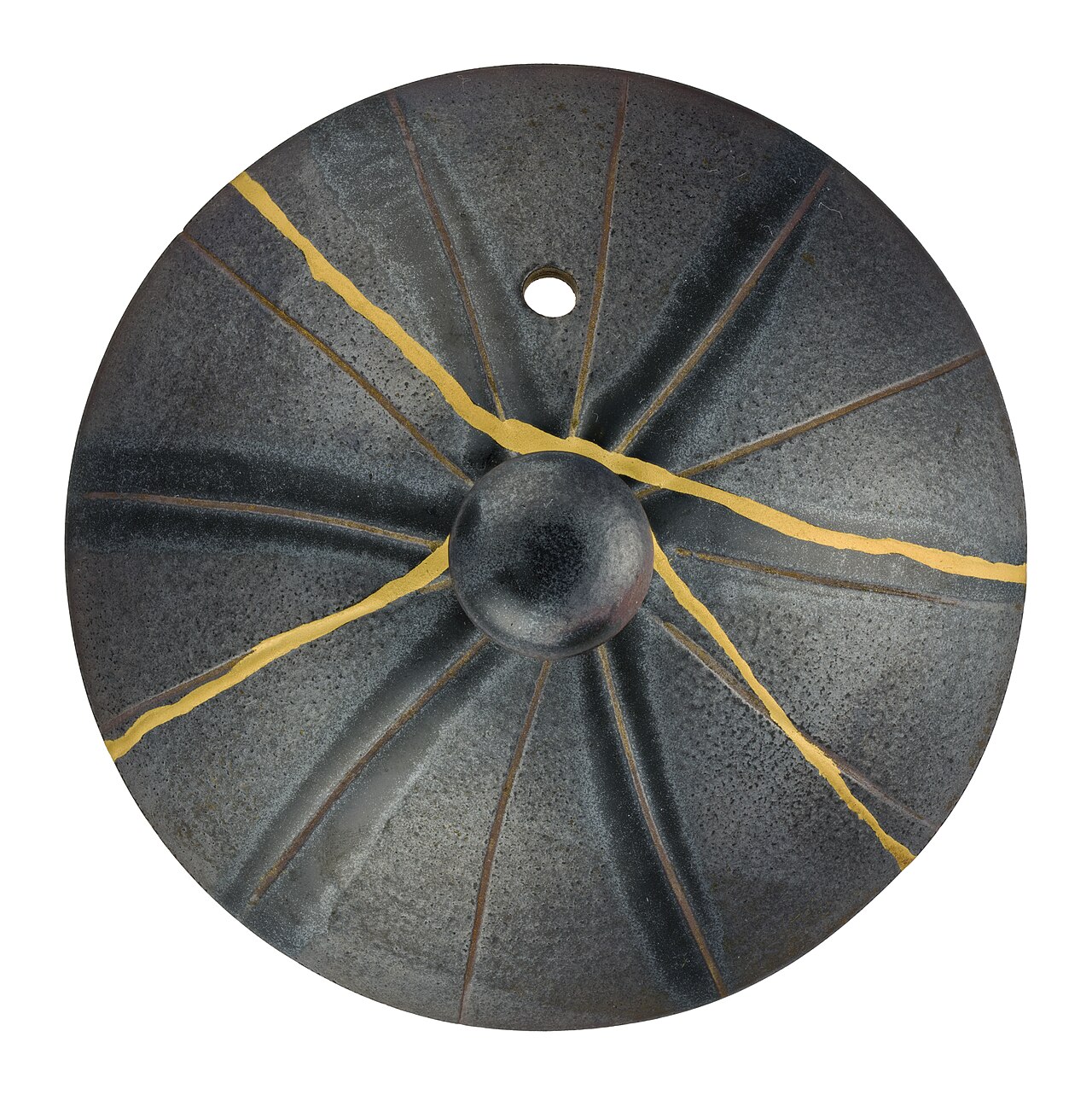
A kyusu lid restored with kintsugi — the gold-filled cracks become the defining feature of the piece. Photo: D-Kuru, CC BY-SA 4.0, via Wikimedia Commons.
The philosophy behind this approach is simple but profound: breakage and repair are part of an object's life. Concealing them with invisible glue or painting over them denies that history. 金継ぎ says the opposite — show the scars, and make them beautiful.
The Process
Authentic kintsugi uses urushi (漆), the sap of the Toxicodendron vernicifluum lacquer tree, which is one of the most durable natural adhesives known. A full kintsugi repair follows several stages over weeks or months:
- Collecting the pieces — 欠片 are gathered and cleaned of old adhesive or dirt.
- Joining — 漆 mixed with wheat flour or rice powder is applied to the broken edges. The pieces are pressed together and left to cure in a humid environment (lacquer cures through moisture, not air-drying).
- Filling gaps — Missing chips are filled with a mixture of lacquer and a fine powder (traditionally tonoko, a powdered whetstone). The filler is built up in thin layers, each cured and sanded before the next.
- Surface preparation — Seams are smoothed and levelled, then coated with progressively finer layers of lacquer.
- Gilding — The final step applies powdered 金 (gold), 銀 (silver), or platinum over a still-tacky layer of lacquer. Once cured, the excess is brushed away, leaving gleaming metalised lines.
A complete repair can take anywhere from a few weeks to several months, depending on the number of breaks and the depth of the fills. Shorter "simplified" methods using modern adhesives and gold paint exist for hobbyists, but traditional urushi kintsugi is considered the authentic form.
| Material | Japanese | Effect |
|---|---|---|
| Gold powder | 金粉 (きんぷん) | Warm, luminous yellow seams |
| Silver powder | 銀粉 (ぎんぷん) | Cool, bright metallic lines |
| Platinum powder | 白金粉 (はっきんぷん) | Near-white, understated finish |
Philosophy and Wabi-Sabi
Kintsugi is inseparable from wabi-sabi (侘び寂び), the Japanese aesthetic that finds 美 in imperfection, impermanence, and incompleteness. Wabi-sabi resists the Western impulse to make things look new, preferring the worn, the asymmetric, and the marked by time.
In this framework, a 壊れる object does not lose its value — it gains a layer of meaning. The cracks become a record of everything the object has lived through. Rather than 不完全 being a flaw, it becomes the proof of an authentic life.
This philosophy extends beyond ceramics. In Japanese thought, the idea that something broken and repaired is more valuable than something intact or replaced touches on mono no aware (物の哀れ), a bittersweet awareness of transience, and mushin (無心), an acceptance of change. Kintsugi has become a widely cited metaphor for human resilience — the idea that our wounds, when integrated rather than hidden, are what make us interesting.
壊れたものを金で繋ぐと、より美しくなる。 When you join broken things with gold, they become more beautiful.
History
Kintsugi's origins are traced to the Muromachi period (室町時代, 1336–1573). The most commonly told origin story involves Ashikaga Yoshimasa (足利義政), the eighth Ashikaga shogun, who broke a prized Chinese celadon 茶碗 and sent it to China for 修理. It was returned held together with unsightly iron staples — functional but ugly. This apparently prompted Japanese craftsmen to develop a more elegant alternative that used the existing tradition of maki-e (蒔絵), the art of decorating lacquerware with gold and silver, and applied it to repair.
The technique flourished under the influence of Sen no Rikyū (千利休, 1522–1591), the towering figure of the Japanese 茶道 tradition. Rikyū codified wabicha (侘び茶), a stripped-down, austere form of the tea ceremony that championed humble, rustic objects over expensive Chinese imports. In this aesthetic climate, a visibly repaired 器 with gold seams was not merely acceptable — it was the ideal. A cracked and mended bowl bore a history; a perfect one did not.
By the late Edo period, kintsugi had become so fashionable that some collectors deliberately 割れる pieces — or had them broken — to have them repaired with gold, increasing their perceived value and aesthetic character.
Modern Revival
Kintsugi largely faded from everyday practice in the 20th century as cheap replacements made repair economically irrational. But from the late 1990s onward it experienced a significant international revival, driven by several forces:
- Craft and slow-living movements — A growing reaction against disposable consumer culture found in kintsugi a perfect emblem. The idea of repairing what you love rather than discarding it resonates with sustainability thinking.
- Therapeutic applications — Psychologists and art therapists began using kintsugi as both a literal and metaphorical practice for processing trauma, grief, and personal hardship. The act of mending a broken object while sitting with what is broken inside has proven genuinely therapeutic for many people.
- Global media attention — Kintsugi frequently appears in design, philosophy, and wellness contexts internationally. TED Talks, best-selling books, and design exhibitions have brought the concept to audiences far beyond Japan.
- Contemporary artists — Japanese and international ceramicists have integrated kintsugi into their practice, sometimes repairing found objects with gold as an intentional artistic statement rather than a functional fix.
In Japan itself, kintsugi workshops (金継ぎ教室, kintsugi kyōshitsu) have proliferated in major cities, attracting both young Japanese practitioners rediscovering the craft and foreign visitors seeking a hands-on cultural experience.
Related Concepts
- Wabi-sabi (侘び寂び) — The overarching aesthetic philosophy of beauty in imperfection and transience that kintsugi embodies.
- Maki-e (蒔絵) — The lacquerware decoration technique (dusting gold/silver over wet lacquer) that kintsugi adapts for repair.
- Mono no aware (物の哀れ) — "The pathos of things," a sensitivity to impermanence that shares kintsugi's appreciation for the marks time leaves behind.
- Wabi-cha (侘び茶) — Sen no Rikyū's austere tea aesthetic, in which repaired and imperfect vessels were prized over pristine ones.
- Urushi (漆) — Japanese lacquer, the core material of kintsugi. Derived from tree sap, it is extraordinarily durable, waterproof, and — before curing — a potent allergen.