コンビニ
konbiniShort for コンビニエンスストア (convenience store), konbini refers to Japan's uniquely comprehensive 24-hour shops that function as a social lifeline for millions of people.
Meaning
コンビニ is an abbreviated form of コンビニエンスストア (konbiniensu sutoa), borrowed from the English "convenience store." In Japan, however, the word describes something far beyond what a convenience store means in most other countries. A Japanese コンビニ is a meticulously organized, 24-hour institution offering hot food, banking, printing, ticketing, bill payment, and enough grocery staples to live on — all from a shop roughly the size of a large living room.
The concept arrived in Japan in 1974, when the first 7-Eleven opened in Kōtō, Tokyo, under a franchise agreement with the American chain. Within a decade Japanese operators had transformed the format into something distinctly their own, and today Japan is home to roughly 55,000 konbini — one for every 2,300 people.
The Big Three Chains
| Chain | Japanese name | Founded | Stores (Japan) |
|---|---|---|---|
| 7-Eleven Japan | セブン-イレブン | 1974 | ~21,000 |
| Lawson | ローソン | 1975 | ~14,600 |
| FamilyMart | ファミリーマート | 1981 | ~16,600 |
Each chain cultivates a distinct brand personality. 7-Eleven is known for the breadth of its private-label products and its consistently top-rated onigiri. Lawson leans into premium and health-conscious lines — its "Natural Lawson" sub-brand targets urban shoppers who want organic options alongside the usual hot snacks. FamilyMart is beloved for its FamiChiki (ファミチキ), a flagship fried chicken piece that has achieved near-meme status among fans.
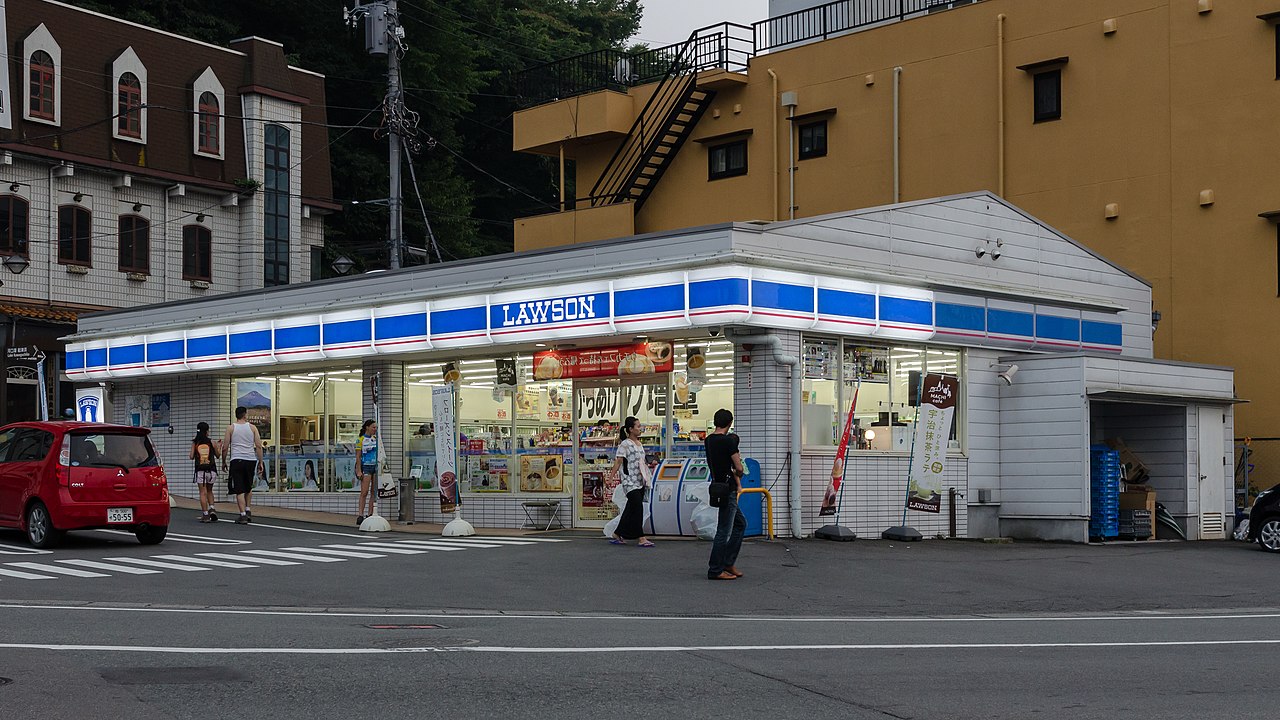
A Lawson store in Fujikawaguchiko, Yamanashi — one of the most photographed konbini in Japan thanks to its view of Mount Fuji. Photo: DXR, CC BY-SA 4.0, via Wikimedia Commons.
What You Can Do at a Konbini
The range of services available under one roof is a source of genuine astonishment for foreign visitors.
Food and drink
- Freshly made 弁当 (boxed meals), heated on request
- Onigiri in dozens of flavors, restocked multiple times daily
- Hot snacks: 肉まん (steamed buns), fried chicken, pizza puffs
- Soft-serve ice cream, スイーツ (sweets), and seasonal desserts
- Freshly brewed drip coffee from self-serve machines (typically ¥100)
- Hot soups and oden in winter
Utilities and services
- Pay electricity, gas, water, and NHK fees at the レジ (cash register)
- Withdraw cash or use international cards at Seven Bank or Lawson Bank ATMs
- Print documents, photos, or boarding passes on multifunction copiers
- Buy concert, bus, and theme-park tickets via Loppi (Lawson) or Famiport (FamilyMart) terminals
- Receive parcel deliveries when you are not home (takkyubin pickup)
- Send fax and scan documents
Everyday essentials
- Over-the-counter medicines, basic cosmetics, and sanitary items
- Phone chargers, umbrellas, and stationery
- Seasonal clothing items (cheap socks, compression stockings, etc.)
- Alcohol, tobacco, and lottery tickets
This density of services means many Japanese people — especially those 働く long hours — can handle much of their daily administration during a late-night konbini run without visiting a bank or post office at all.
Iconic Products
Onigiri
The triangular rice ball wrapped in crisp nori is perhaps the defining konbini food. Major chains release new flavors monthly, and limited regional varieties reflect local ingredients. Popular fillings include tuna mayo, salmon, kombu, spicy cod roe (明太子), and — in prestige lines — wagyu beef or premium uni.
Hot Snacks
A heated display case near the register holds rotating items. 肉まん (steamed pork buns) are a winter staple; fried chicken (most famously FamiChiki) is available year-round. These snacks are eaten standing in the parking lot or perched on a narrow ledge — konbini etiquette is relaxed.
Seasonal and Collaboration Items
Japanese konbini excel at limited-time offerings (期間限定, kigen gentei). Autumn brings sweet potato and chestnut sweets; Christmas sees premium cake rolls. IP collaborations are common — major anime, games, and pop groups regularly partner with konbini chains for special packaging, exclusive merchandise, or unique food items tied to character imagery. These collabs drive social media activity and bring fans into 店 specifically to hunt for limited stock.
Coffee
Self-serve konbini coffee, introduced by 7-Eleven in 2013 and quickly adopted by all chains, transformed the Japanese café landscape. At roughly ¥100 per cup — freshly ground and brewed — it undercut cafés and vending machines alike. Annual konbini coffee sales now exceed hundreds of millions of cups.
Cultural Significance
Sociologists sometimes describe the konbini as Japan's true "third place" — not home, not work, but a semi-public space where people spend time without pressure to buy or leave. Late at night, a 深夜 konbini becomes a refuge: students cramming for exams, shift workers on break, solo diners eating hot food they heated themselves, and tourists figuring out their next move all coexist under fluorescent lights.
For the many Japanese who live alone — a proportion that has risen steadily in recent decades — the konbini fills gaps that families might otherwise cover. It provides a warm meal, a human face at the register, and the small social interaction of a brief exchange. For 旅行者 and 外国人 visiting Japan, the konbini is often the first encounter with the country's famous hospitality (omotenashi): the staff greeting on entry, the precise packaging, the product organized to the millimeter.
The konbini also plays a structural role in 社会. During natural disasters — earthquakes, typhoons, floods — konbini chains activate emergency restocking protocols, coordinate with local governments, and often reopen before supermarkets. Their dense network makes them de facto emergency supply depots. The 2011 Tōhoku earthquake response demonstrated just how central konbini 生活 infrastructure had become.
Premium and Recent Trends
Since the mid-2010s, konbini chains have pushed steadily upmarket. Lawson's "Uchi Café" dessert line routinely features multi-layer cakes, Belgian chocolate items, and seasonal fruit tarts at ¥200–400 — quality that rivals dedicated pâtisseries. 7-Eleven's premium "Gold" onigiri use restaurant-grade ingredients.
Rewards apps (7-Eleven's 7Pay successor, Lawson's Ponta, FamilyMart's FamiPay) have made cashless payment and loyalty points central to the shopping experience, with targeted coupons pushing frequent visits.
Self-checkout registers are being introduced at scale to offset a chronic staff shortage, while some experimental stores use camera-based AI inventory tracking — a sign that the konbini, already one of the world's most optimized retail formats, continues to evolve.
Usage
コンビニでおにぎりとコーヒーを買うのが毎日の楽しみだ。 Buying onigiri and coffee at the konbini is my daily pleasure.
電気代はコンビニで払うと便利ですよ。 Paying your electricity bill at the konbini is really convenient.
深夜に食べ物が食べたいときはコンビニしかないよね。 When you want something to eat late at night, the konbini is the only option.
Related Terms
| Term | Reading | Meaning |
|---|---|---|
| コンビニ弁当 | こんびにべんとう | Konbini boxed meal |
| 期間限定 | きかんげんてい | Limited-time offer |
| セルフレジ | せるふれじ | Self-checkout register |
| 温める | あたためる | To heat up (asked of staff) |
| ポイントカード | ぽいんとかーど | Loyalty points card |
| Loppi / Famiport | — | In-store ticket terminals |