漫画喫茶
manga kissaA uniquely Japanese hybrid cafe where customers pay by the hour to read from vast manga libraries, browse the internet, and relax in private booths — sometimes sleeping overnight.
What is a Manga Kissa?
漫画喫茶 (まんがきっさ, manga kissa) — literally "漫画 喫茶" (comic tea 店) — is a type of establishment that first appeared in Japan during the 1980s and became a widespread urban fixture by the 1990s. Customers pay an hourly 席料 (seat charge) in exchange for unlimited access to a library of 漫画本 (manga volumes), a personal computer terminal, and a steady flow of drinks from a ドリンクバー (drink bar).
The core appeal is simple: a private or semi-private space — typically a booth or enclosed cubicle — where you can lose yourself in manga for as long as you like. Collections at larger establishments run to tens of thousands of volumes, covering every genre from shonen action to seinen drama to shojo romance.
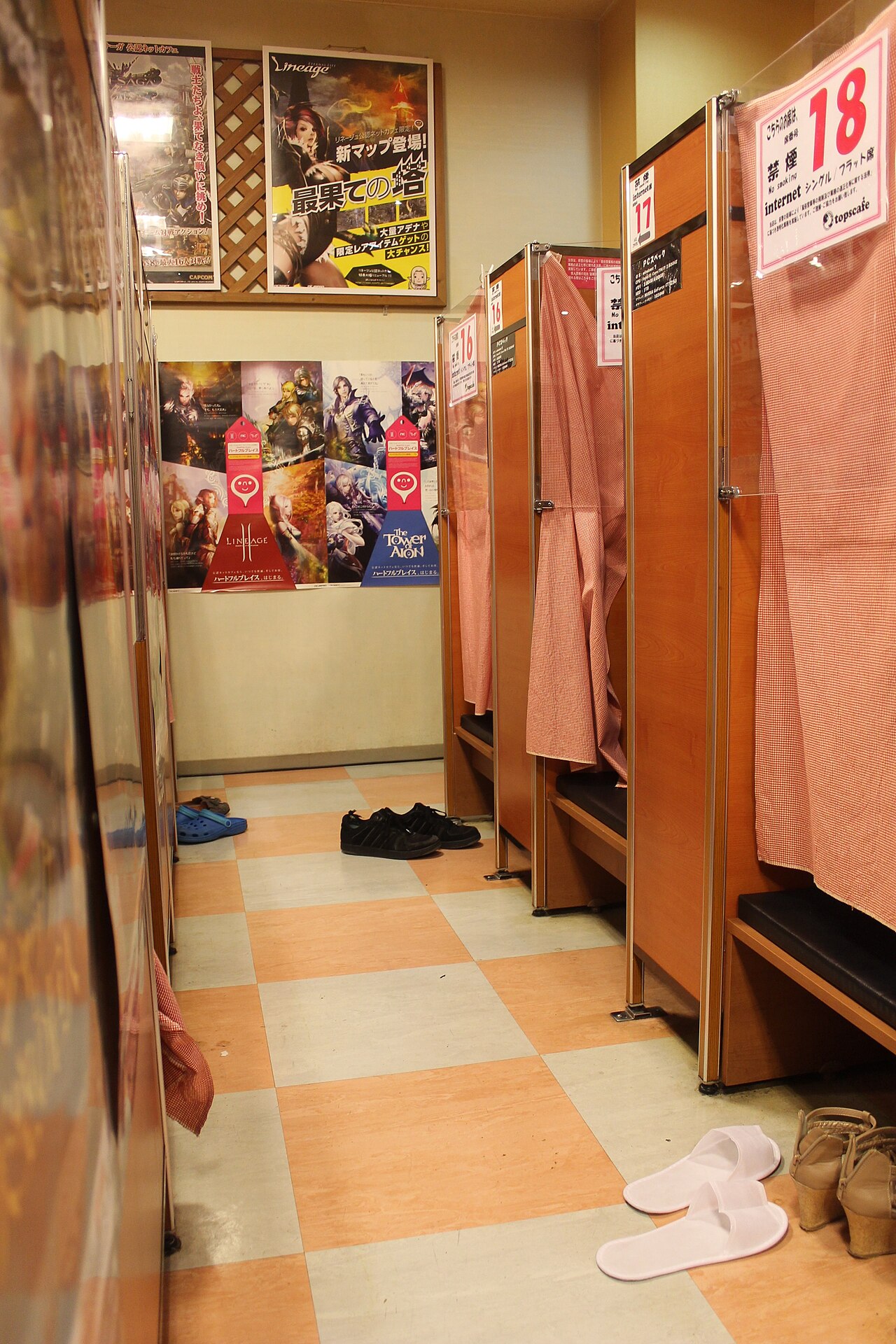
Individual booths at a Japanese net cafe. Photo: Connie Ma, CC BY-SA 2.0, via Wikimedia Commons.
Services and Amenities
Modern manga kissas have evolved far beyond simple reading rooms. A typical visit might include:
- Manga library — walls of shelves stacked floor-to-ceiling with 本 spanning every genre imaginable
- Private booths — reclining chairs, flat 席 (floor seats), or fully enclosed rooms with a futon
- パソコン terminals — high-speed internet access, often with gaming software and streaming services pre-installed
- ドリンクバー — unlimited self-serve soft drinks, coffee, and sometimes instant noodles or light snacks
- シャワー rooms — available at many locations for an extra fee, invaluable for overnight stays
- Printing and scanning — making them a go-to for travelers needing paperwork done
- Magazines and newspapers — alongside the manga, broader reading material is usually on offer
Some premium chains also offer semi-private karaoke booths, massage chairs, and billiard tables, blurring the line between a cafe and an entertainment complex.
Pricing and Packages
Pricing is usually structured around time blocks:
| Package | Typical Price | Notes |
|---|---|---|
| 30 minutes | ¥200–¥300 | Drop-in minimum |
| 3 hours | ¥600–¥900 | Most popular daytime option |
| Night pack (6–10 hrs) | ¥1,200–¥1,800 | Overnight stay, often with shower |
| Open membership | ¥3,000+ | Unlimited monthly access |
Prices vary by chain and 都会 (city); branches in central Tokyo tend to charge more than suburban or regional locations. Most stores have membership cards that unlock lower 料金 (fees) and allow customers to log in without re-registering. Members may also accumulate points redeemable for free 時間 (time).
「3時間パックにしますか、それとも夜パックにしますか?」 "Would you like the 3-hour pack, or the night pack?"
The 席料 typically includes ドリンクバー access, so the cost per hour is substantially lower than a standard coffee shop — one reason manga kissas are popular study spots and remote-work locations for freelancers.
Manga Kissa as Overnight Shelter
One of the more striking social dimensions of the manga kissa is its role as affordable overnight accommodation. A night pack (夜間パック, yakan pakku) — typically running from around 11 p.m. to 7 a.m. — can cost as little as ¥1,500, making it competitive with even budget hostels in major cities.
This attracts a wide range of overnight users:
- Commuters who miss the last train — Japan's train networks largely shut down between midnight and 5 a.m., leaving stranded workers with limited options
- Travelers seeking a cheap and central place to 宿泊 (stay overnight) between sightseeing days
- Young people after late-night parties or concerts who prefer a booth to a pricey taxi home
- Manga kissa refugees (漫画喫茶難民, manga kissa nanmin) — a term coined in the mid-2000s for economically precarious workers who lack stable housing and effectively live in manga kissas long-term
The last category drew significant media attention and government concern in the late 2000s. Reports highlighted working-poor individuals — often temporary or day laborers — who could not afford a deposit on an apartment and rotated between manga kissas, カプセルホテルs, and 24-hour fast-food restaurants. The term "net cafe refugee" (ネットカフェ難民) entered public discourse alongside debates about 貧困 (poverty) and precarious employment in Japan's post-bubble economy.
The Netto Cafe (ネットカフェ) Variant
ネットカフェ (netto cafe, internet cafe) is closely related to — and often used interchangeably with — manga kissa, but the emphasis differs slightly. While manga kissas foreground their comic libraries, netto cafes lead with internet access and personal computer workstations. In practice, most establishments offer both, and the two terms now largely overlap.
Distinctions that sometimes hold:
| Feature | 漫画喫茶 (Manga Kissa) | ネットカフェ (Netto Cafe) |
|---|---|---|
| Primary draw | Manga collection | Internet / PC gaming |
| Booth type | Often open shelves | More enclosed cubicles |
| Typical clientele | Readers, families | Gamers, remote workers |
| Online gaming | Secondary | Often primary |
Major chains like Aprecio (アプレシオ), Selfnet (セルフネット), and Gran Cyber Cafe Bagus blur these distinctions, offering massive manga collections alongside gaming PCs with VR headsets. The combined netto cafe / manga kissa format is now the industry standard.
Cultural Significance
The manga kissa occupies an interesting place in Japanese 社会 (society). It is simultaneously:
- A leisure institution celebrating Japan's rich manga culture — the sheer density of volumes available in a single location is a testament to how central 漫画 is to everyday life
- A practical urban utility, offering affordable internet access, printing, and a quiet workspace at a time when many Japanese apartments are small and home broadband was not always reliable
- A social safety valve, providing a warm, private, 24-hour space in a country where public overnight spaces are rare and ホームレス individuals face strict enforcement
- A pop-culture setting, featured in countless anime, manga, and drama scenes where characters hide out, study for exams, or have chance encounters in private booths
For international visitors, a manga kissa offers a unique window into daily Japanese life: the meticulous organization, the 客 (customer) registration process, the courtesy of the 店員 (staff), and the comfortable solitude of a booth stacked high with volumes. Many travelers deliberately plan an overnight stay in one — not out of necessity, but as an experience in itself.
「漫画喫茶で夜を明かすのは、日本らしい経験だよ。」 "Spending the night in a manga cafe is a very Japanese experience."
As streaming and digital manga have grown, some analysts have predicted the decline of the manga kissa. Yet the chains continue to operate — the combination of private space, unlimited reading, cheap overnight lodging, and 格安 drink access proves difficult to replicate digitally. The manga kissa endures as one of Japan's most characterful third spaces.