飲み会
nomikaiA Japanese drinking party, especially with coworkers, that traditionally builds workplace bonds outside the hierarchy of the office.
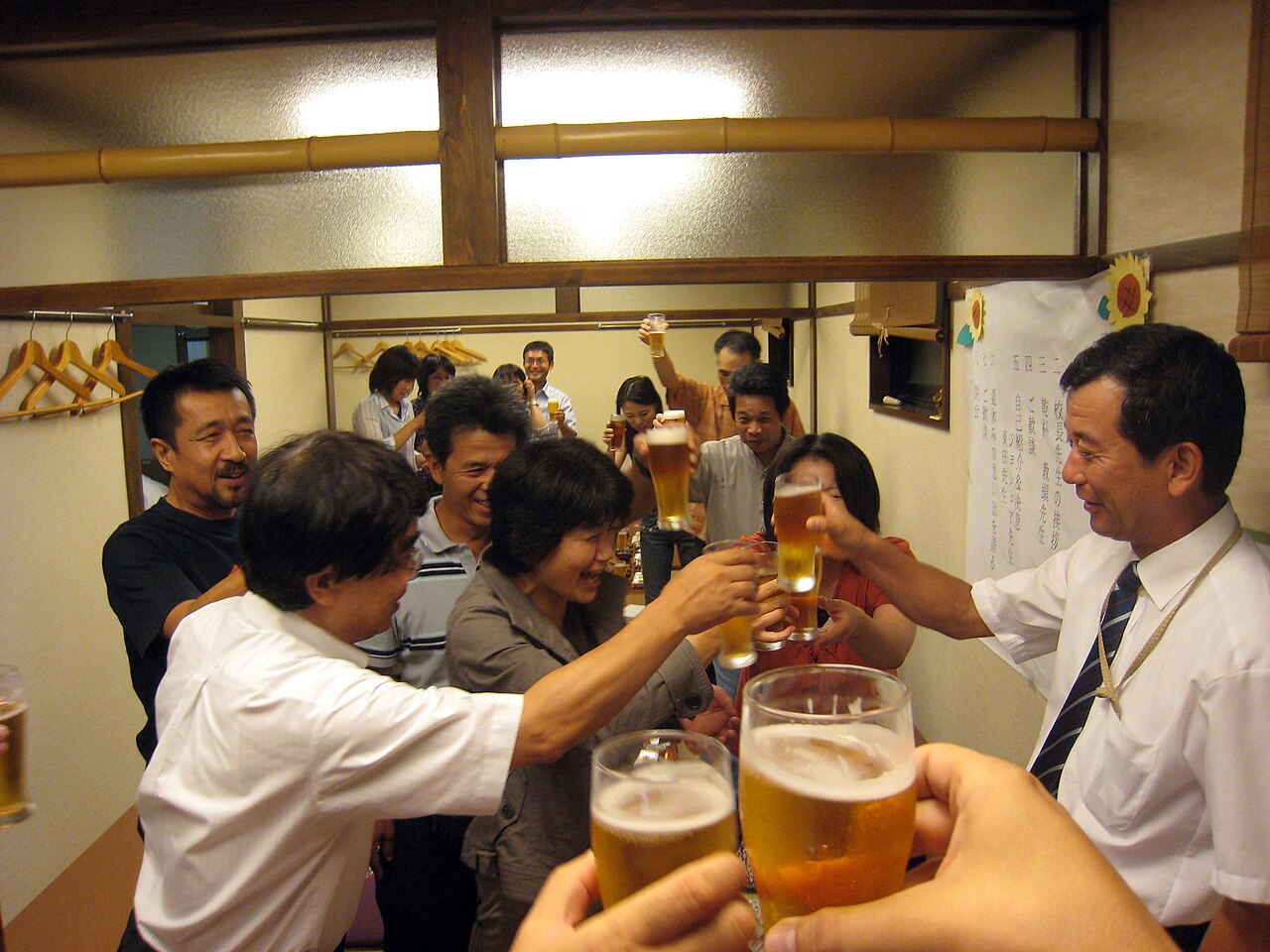
A workplace kanpai (cheers) moment at an enkai in Kumamoto. Photo: Josh Berglund, CC BY 2.0, via Wikimedia Commons.
Meaning
飲み会 (nomikai) literally means "drinking meeting" — a social gathering centered on alcohol, most often organized around a workplace. It is a broad umbrella term covering everything from an impromptu after-work drink between two colleagues to a formally organized company-wide banquet. Related, more specific words include 忘年会 (bōnenkai, "forget-the-year party" held in December), 新年会 (shinnenkai, New Year party), 歓迎会 (kangeikai, welcome party for new staff), and 送別会 (sōbetsukai, farewell party). A more formal synonym used in polite or written contexts is 宴会 (enkai).
Unlike a casual night out with friends, a nomikai in its classic office form carries a mild sense of social obligation: it is where a lot of unspoken workplace communication happens, and attendance — while nominally optional — has historically been treated as something close to a duty, especially for junior employees.
Structure of a Nomikai
A typical company nomikai follows a predictable script:
- Everyone gathers, drinks are ordered, and no one drinks until the whole 会 (party) is ready.
- A senior figure (often not the most senior person in the room, who is saved for the closing words) gives a short opening toast — the kanpai no aisatsu — ending in a shout of 乾杯! ("Kanpai!" — Cheers!).
- Glasses are raised and clinked, and only then does drinking formally begin.
- Food and drinks are shared over one to two hours of conversation.
- Near the end, another senior person gives closing remarks, sometimes with a formal clap (三本締め, sanbon-jime) to mark the event's end.
今日は無礼講だから、遠慮せずに飲んでください。 Kyō wa bureiko dakara, enryo sezu ni nonde kudasai. "Today rank doesn't matter, so drink freely without holding back."
Nijikai — the second party
When the main event ends, a subset of the group often moves on to a 二次会 (nijikai, "second gathering") — typically a different, more casual venue such as a bar, karaoke box, or ramen shop. Attendance at the nijikai is genuinely optional and self-selecting, so it tends to be looser and more candid than the first party. Large groups sometimes continue to a sanjikai (third party) in the small hours, though this is increasingly rare on weeknights.
Etiquette: Pouring, Not Self-Serving
The single most distinctive rule of nomikai etiquette concerns お酌 (oshaku), the custom of pouring drinks for others rather than for oneself.
- When someone's glass runs low, it is polite to notice and refill it for them, holding the bottle with both hands (or supporting the base with the non-pouring hand) as a mark of respect.
- Junior staff typically make a point of keeping their 上司 (superiors) and 先輩 (senpai)'s glasses full, moving around the table to greet and pour for people they may not otherwise get facetime with.
- 注ぐ is the verb "to pour"; receiving a pour, one lifts the glass slightly with both hands as a small gesture of thanks.
- Pouring your own drink (手酌, tejaku) is traditionally seen as a bit gauche — a sign that no one is looking after you, or that you're not paying attention to others' glasses either.
This constant cross-table pouring is also the social mechanism of the party: it gives everyone, regardless of rank, a natural reason to approach and briefly speak with anyone else in the room.
Bureiko: Hierarchy on Pause
Japanese workplaces run on a fairly rigid 上下関係 (jōge kankei, senior–junior hierarchy), and ordinary office life is full of honorific language and deference toward superiors. The nomikai is culturally understood as a space where that hierarchy loosens — a state referred to as 無礼講 (bureiko), literally "no-rudeness-formality," often announced explicitly by a boss at the start of the party ("today, let's skip the formalities").
In practice, bureiko is only ever partial. Junior staff still generally defer to seniors, still pour their drinks first, and still watch what they say. But the atmosphere is genuinely different: it's the one setting where a 部下 (subordinate) might voice a complaint about a project, tease a manager gently, or have an unusually candid conversation that would be unthinkable at a desk during business hours. Because of this, nomikai have long functioned as an informal pressure valve and a real channel of feedback inside Japanese organizations — sometimes more honest information travels at a nomikai than in a meeting room.
Who Pays: Warikan vs. Hierarchy
How the bill is settled depends heavily on the type of gathering:
| Situation | Typical payment norm |
|---|---|
| Friends, coworkers of similar rank | 割り勘 (warikan) — split evenly, sometimes with a flat fee per person |
| Company-organized nomikai (bōnenkai, kangeikai, etc.) | Company or department budget covers part or all of the cost |
| Boss and subordinates out together | The boss often pays more, or the whole bill, as a gesture of seniority |
| Farewell party for a departing colleague | The person leaving is usually not asked to pay, or pays less |
Warikan is the default among peers and is common enough that many izakaya print a flat "nomihōdai" (all-you-can-drink) course price per head specifically to make even splitting simple. Among mixed-rank groups, however, an unspoken norm still often has senior staff quietly cover a larger share, reinforcing their status even while the bureiko atmosphere pretends rank doesn't matter for the evening.
Venues: The Izakaya
The classic venue for a nomikai is the 居酒屋 (izakaya), a casual Japanese pub serving small shareable dishes alongside beer, sake, shōchū, and highballs. Izakaya are built for group drinking: private tatami-floored rooms with low tables (座敷, zashiki), all-you-can-drink courses (飲み放題, nomihōdai), and set banquet menus (コース料理) designed for parties of six, eight, or more make them the natural default booking for a company gathering. Red paper lanterns (赤提灯, aka-chōchin) outside an izakaya's entrance are a near-universal visual signal that group drinking and food are inside.
Karaoke boxes, yakitori grill counters, and standing bars (立ち飲み, tachinomi) are common alternatives, particularly for a nijikai.
Nomunication and the Decline Among Younger Generations
The portmanteau ノミュニケーション (nomyunikēshon — "nomi" + "communication") captures the traditional justification for nomikai: that drinking together builds trust and smooths communication in a workplace where people otherwise speak carefully and formally. For decades, showing up to nomikai, even reluctantly, was treated as part of being a good employee.
That expectation has weakened considerably. Surveys of younger Japanese workers repeatedly show falling enthusiasm for mandatory-feeling nomikai, driven by several factors:
- Work-life balance attitudes — younger employees are less willing to spend unpaid personal time on work-adjacent socializing.
- Cost — nomikai are an ongoing expense, especially for early-career staff on modest salaries.
- Changing views on alcohol — rising numbers of people who drink less or not at all (an trend sometimes called 若者の酒離れ, wakamono no sakebanare, "young people's turning away from alcohol").
- Power-harassment awareness — increased scrutiny of "アルハラ" (aruhara, alcohol harassment, i.e. pressuring people to drink) and パワハラ (power harassment) has made forcing attendance or forcing drinks on people much less acceptable than it once was.
- Remote and hybrid work — fewer shared physical evenings after a day in a shared office.
Many companies have responded by making nomikai explicitly optional, shortening them, offering non-alcoholic options without stigma, or replacing some gatherings with lunch events (ランチ会) instead. The custom hasn't disappeared — kangeikai and bōnenkai remain common seasonal fixtures, and many workers still value the informal bonding it provides — but the assumption that nomikai are compulsory has largely faded, especially among the generation now entering the workforce.
Related Terms
| Term | Reading | Meaning |
|---|---|---|
| 忘年会 | bōnenkai | Year-end party |
| 新年会 | shinnenkai | New Year party |
| 歓迎会 | kangeikai | Welcome party (new hires/transfers) |
| 送別会 | sōbetsukai | Farewell party |
| 二次会 | nijikai | Second party (afterparty) |
| 無礼講 | bureiko | Hierarchy set aside for the occasion |
| 割り勘 | warikan | Splitting the bill evenly |
| 飲み放題 | nomihōdai | All-you-can-drink course |
Related Dictionary Words
drinking party; get-together (usu. involving alcoholic drinks)
after-party; second party (of the night)
unceremonious party; free and easy gathering; party with no regard for formal etiquette or status
splitting the cost; splitting the bill; Dutch treat
izakaya; tavern, bar, etc. that also serves various dishes and snacks
(one's) superior; (one's) boss; the higher-ups
subordinate person
senior (at work or school); superior; elder; older graduate; progenitor; old-timer
junior (at work, school, etc.); younger people; younger student
year-end party; "forget-the-year" party; bōnenkai
New Year's party (held in the beginning of the year, i.e. usually in January)
welcome party
farewell party
pouring alcohol