温泉
onsenGeothermally heated natural hot springs at the heart of Japanese bathing culture, spanning spirituality, health, tourism, and everyday relaxation.
Meaning
温泉 (onsen) literally means "warm spring" — water heated by geothermal activity that rises naturally from the earth. Under Japanese law (the Hot Spring Act of 1948), water can only be designated as onsen if it emerges at 25°C or above, or contains at least one of nineteen defined minerals at qualifying concentrations. This legal distinction matters: true onsen water is not simply heated, but geologically active, and facilities marketing themselves as onsen must meet these standards.
Japan has over 27,000 registered hot spring sources across the country — more than almost any other nation on earth — a consequence of its location on the Pacific Ring of Fire. These feed more than 3,000 onsen facilities, from humble roadside bathhouses to sprawling luxury resort towns.
Types of Onsen
By setting
The most celebrated type is the 露天風呂 (rotenburo), an outdoor bath open to the sky. Rotenburo are prized for their scenery: bathers soak surrounded by mountain forest, ocean cliffs, bamboo groves, or snow-covered gardens. The contrast of steaming water against cold winter air is considered one of Japan's signature sensory experiences.
内湯 (uchiyufu or uchiBuro) are indoor baths, typically found inside a 旅館 (ryokan, traditional inn) or a dedicated bathhouse. Many facilities offer both, connected by a changing room, so guests can move between the outdoor and indoor pools at will.
Facilities may also include kashikiri-buro (貸切風呂), private baths booked by a single group — popular with couples or families who prefer privacy, or with visitors who have tattoos that bar them from the communal baths.
By access
- Tomariyoku (泊まり浴): Overnight stay, typically at a ryokan or hotel; the classical way to experience onsen
- 日帰り onsen (日帰り温泉): Day-trip bathing facilities that admit visitors without an overnight stay; increasingly popular with urban residents making short escapes
- 足湯 (ashiyu): Free foot-bath pools, common in onsen towns; a low-commitment introduction to onsen culture, open to anyone in street clothes
By mineral type
Onsen waters are classified into ten major spring types (泉質, senshitsu) based on dissolved minerals:
| Type | Japanese | Notes |
|---|---|---|
| Simple | 単純温泉 | Low mineral content; gentle, widely recommended |
| Sodium chloride | 塩化物泉 | Warms the body; good for cuts and joint pain |
| Bicarbonate | 炭酸水素塩泉 | Alkaline; softens skin, nicknamed "美人の湯" (beauty spring) |
| Sulfate | 硫酸塩泉 | Promotes wound healing and arterial health |
| Carbon dioxide | 炭酸泉 | Tiny bubbles; lowers blood pressure, gentle on the heart |
| Sulfur | 硫黄泉 | Distinctive egg smell; skin conditions and hypertension |
| Iron | 含鉄泉 | Orange/red water; anemia and menstrual disorders |
| Acidic | 酸性泉 | Strongly acidic; antimicrobial; Kusatsu is a famous example |
| Radioactive | 放射能泉 | Low-level radon; claimed benefits for gout and neuralgia |
| Iodine | 含よう素泉 | Rare; found in coastal sedimentary regions |
Etiquette
Onsen etiquette (マナー) is taken seriously and violations cause genuine social discomfort. The rules exist partly for hygiene and partly to preserve the shared, contemplative atmosphere of the bath.
Before entering the water
Upon entering the bathing area, bathers must wash thoroughly at the individual shower stations (かけ湯, kakeyu). Each station has a small stool, a handheld showerhead, and usually soap and shampoo. Wash the entire body and rinse completely before stepping into the communal pool. Introducing soap residue or sweat into the shared water is considered highly disrespectful.
Inside the bath
- Enter nude. Swimwear is not permitted in traditional onsen.
- The small modesty towel (手ぬぐい, tenugui) provided by facilities should not be put in the water. It is placed folded on top of the head or set aside at the pool edge.
- Keep hair and head above the water line. Long hair must be tied up.
- Do not splash, swim, or behave boisterously. Onsen are contemplative spaces.
- Do not bring drinks, food, or phones into the bathing area.
- Most facilities separate bathing areas by sex (男湯 otoko-yu for men, 女湯 onna-yu for women), though konyoku (混浴, mixed bathing) baths still exist at some traditional and rural facilities.
The tattoo rule
The vast majority of onsen — particularly public and resort facilities — prohibit guests with tattoos (刺青, irezumi) from entering communal baths. This rule dates to an association between tattoos and organised crime (yakuza). In recent years, the policy has become contentious as international tourism has grown: many foreign visitors have decorative tattoos with no criminal association. Some facilities now offer tattoo-covering patches, private baths as alternatives, or have quietly relaxed the ban. Visitors should always check a facility's policy in advance.
Cultural and Spiritual Significance
Onsen are woven into Japanese spiritual life. In Shinto belief, water possesses 浄化 (jouka, purifying) power, and ritual bathing (禊, misogi) cleanses both physical and spiritual impurity. Hot spring water, emerging from deep within the earth, was understood as a gift from the kami (gods), and many ancient onsen were first discovered by Buddhist monks or associated with imperial healing retreats.
The practice of 湯治 (tōji) — extended therapeutic sojourns at a hot spring, lasting from a week to several months — became widespread among ordinary people during the Edo period (1603–1868). Tōji was both medical practice and spiritual journey: patients with chronic illnesses, injured samurai, or exhausted farmers would relocate to an onsen town and bathe multiple times daily, following careful routines about when and how long to bathe each session. The traditional full course lasted twenty-one days.
Today, tōji is less common as a formal long-term cure, but the underlying belief that onsen bathing supports physical and mental health remains deeply held. The concept of 湯あたり (yu-atari, "hot spring intoxication") — a pleasant fatigue and sense of dissolution after prolonged bathing — is treated almost as a physiological state, not mere relaxation.
The seasonal and aesthetic dimensions of onsen are also significant. 雪見風呂 (yukimi-buro, snow-viewing bath) — soaking in an outdoor rotenburo while snow falls — is celebrated in poetry and photography as a quintessentially Japanese experience.
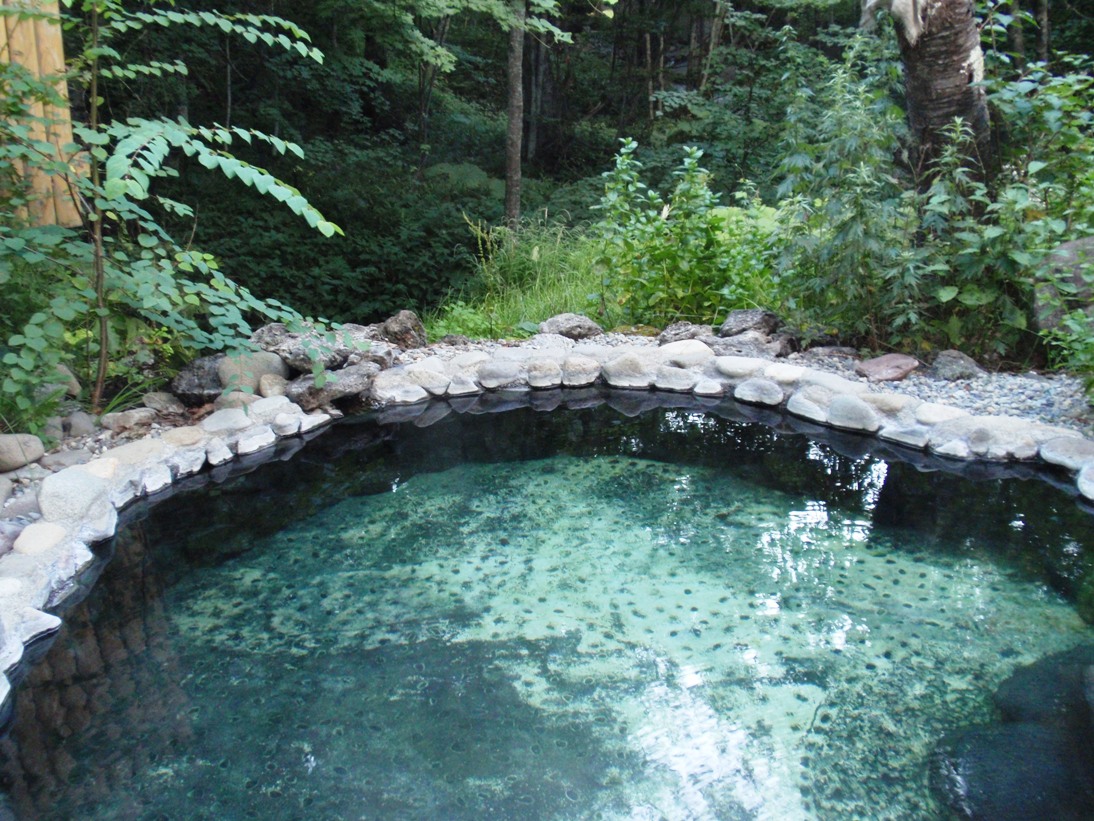
A women's outdoor bath (rotenburo) at Nukabira Spa, Hokkaido. Public domain, via Wikimedia Commons.
Famous Onsen Regions
Japan's 温泉地 (onsenchi, onsen towns) are major tourism destinations, each with a distinct character shaped by their water type and geography.
Hakone (箱根), Kanagawa Prefecture — Just 90 minutes from Tokyo, Hakone is Japan's most accessible onsen destination. Many ryokan offer private baths with views of Mount Fuji. The volcanic region spans multiple spring types.
Beppu (別府), Ōita Prefecture — Claims the second-highest volume of hot spring discharge in the world (after Yellowstone). Beppu is famous for its Jigoku Meguri (地獄巡り, "Hell Tour"), a circuit of seven dramatically coloured geothermal pools too hot and mineral-rich for bathing but spectacular to view — vivid red, cobalt blue, and boiling grey waters.
Kusatsu (草津), Gunma Prefecture — One of Japan's most prestigious onsen, known for highly acidic 硫黄 (sulfur) springs. Kusatsu features the famous 湯畑 (yubatake, hot spring field), a large outdoor wooden frame where the mineral-rich water cools. The acidity is so high that traditional Kusatsu bathing includes 湯もみ (yumomi), a ritual paddle-stirring to lower the temperature to a safe level.
Kinosaki (城崎), Hyōgo Prefecture — A classic onsen town preserved in an Edo-period streetscape of willow-lined canals and wooden inns. Kinosaki is famous for its sotoyu meguri (外湯巡り) culture: guests put on 浴衣 (yukata, cotton kimono) and stroll between seven distinct public bathhouses each with a different spring type.
Noboribetsu (登別), Hokkaido — Home to Jigokudani (地獄谷, Hell Valley), a volcanic crater that supplies nine different spring types in a single location.
Dogo Onsen (道後温泉), Ehime Prefecture — One of Japan's oldest documented hot springs, with over 3,000 years of recorded history. The Victorian-era Dogo Onsen Honkan bathhouse (1894) is a designated Important Cultural Property and is widely credited as an inspiration for the spirit bathhouse in Hayao Miyazaki's film Spirited Away (2001).
Onsen Towns and Tourism
Japanese onsen towns (温泉地, onsenchi, or 温泉街, onsen-gai) are a distinct form of tourism destination. A typical onsen-gai features a central bathing facility, a shopping arcade selling local snacks and souvenirs, traditional 旅館 with in-house baths, and a communal atmosphere built around collective bathing and evening strolls in yukata.
The onsen ryokan package — arriving in late afternoon, bathing before dinner, eating a kaiseki meal in one's room, bathing again in the morning — is a deeply ingrained Japanese holiday format. Domestic tourism statistics consistently show onsen stays as one of the most popular forms of Japanese leisure travel.
Onsen manju (温泉まんじゅう), steamed sweet bean buns cooked over onsen steam, are Japan's most ubiquitous regional souvenir, found at virtually every onsen town.
Onsen vs. Sentō
銭湯 (sentō) are urban public bathhouses that use ordinary heated tap water, not geothermal spring water. Before widespread home bathing facilities, sentō were the neighbourhood bathhouses where ordinary city dwellers washed. Though sentō numbers have declined dramatically since the 1970s, they retain a devoted following and a distinct cultural identity — working-class, urban, neighbourhood-rooted. Some modern sentō have rebranded as スーパー銭湯 (sūpā sentō, super sentō), large leisure facilities with multiple themed baths and saunas that blur the line between sentō and onsen resort.
The key distinction: onsen water is legally certified geothermal spring water. Sentō water is not.
Related Concepts
- 湯治 (tōji): Multi-day therapeutic bathing, traditionally 21 days for a full course
- 足湯 (ashiyu): Public foot baths, often free, in onsen towns and even some train stations
- 家族風呂 (kazoku-buro): Private family bath, rented by the hour
- 温泉卵 (onsen tamago): Eggs slow-cooked in hot spring water, producing a custard-like texture; a staple onsen-town snack
- 湯上り (yuagari): The pleasantly relaxed state after bathing; the onsen afterglow
Related Dictionary Words
hot spring
open-air bath; rotenburo; rotemburo
indoor bath using water from a hot-spring
hot-spring cure; taking the baths
public bath; bathhouse
footbath; hot spring bath designed for soaking one's feet
ryokan; traditional Japanese inn
yukata; light cotton kimono worn in the summer or used as a bathrobe
day trip