折り紙
origamiThe Japanese art of paper folding, creating intricate forms from a single sheet without cutting or glue.
Meaning
折り紙 literally combines 折る (to fold) and 紙 (paper). The art consists of transforming a flat, square sheet of paper into a finished sculpture through a sequence of folds alone — no cutting, no glue. A completed piece is called an orikami or, more commonly in English, simply an origami figure.
The word entered English and most European languages directly from Japanese, a mark of how thoroughly the practice became identified with Japan worldwide.
Traditional Models
Certain figures have been folded for centuries and carry cultural weight beyond their visual appeal.
鶴 (Tsuru — Crane)
The 鶴 is the single most iconic origami subject. In Japanese tradition the crane is a symbol of longevity and good fortune, said to live a thousand years. Legend holds that anyone who folds one thousand cranes will be granted a wish. The standard crane model requires roughly 35 steps and is considered an intermediate design, but it is taught to Japanese children early enough that most adults can fold one from memory.
兜 (Kabuto — Samurai Helmet)
The 兜 is folded from a single large sheet and traditionally made on Kodomo no Hi (Children's Day, 5 May). Newspaper-sized sheets produce wearable helmets for small children. The model requires only about a dozen folds and is one of the first pieces taught in Japanese primary schools.
手裏剣 (Shuriken — Throwing Star)
Unlike most origami, the 手裏剣 model uses two square sheets interleaved — a form called modular origami. Each sheet is folded into an identical parallelogram unit; the two units slot together at right angles to form the distinctive eight-pointed star. Because it involves no glue or tape yet holds together under mild stress, it demonstrates elegantly how interlocking geometry can replace adhesive.
Cultural Context
Origins
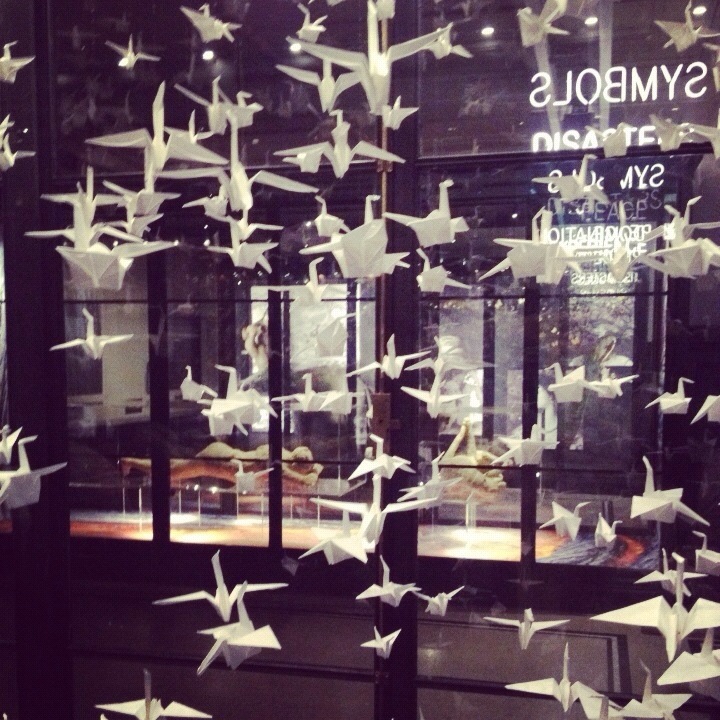
Folded paper cranes in assorted colors — among the most widely recognized origami forms. Public domain (CC0), via Wikimedia Commons.
Paper arrived in Japan from China around the 6th century CE, and ceremonial folding followed shortly after. The earliest documented use was in Shinto ritual: folded paper streamers (noshi) were attached to gifts as symbols of sincerity. These decorative folds appear in court records from the Heian period (794–1185).
During the Edo period (1603–1868), papermaking became inexpensive enough for recreational folding to spread beyond the aristocracy. The first printed guide to paper folding, Sembazuru Orikata (How to Fold One Thousand Cranes), appeared in 1797 — the oldest known origami instruction book. A second manual, Kan no mado, documented roughly 150 figures and established a canon of classical models still folded today.
Washi — Traditional Paper
Classical origami uses 和紙 (washi), handmade Japanese paper crafted from the bark fibres of the kozo (mulberry), mitsumata, or gampi plant. Washi is stronger and more flexible than wood-pulp paper of the same weight: it can absorb moisture and be gently reshaped (wet-folding) without tearing, and it ages to a warm cream tone rather than yellowing brittlely. UNESCO inscribed washi craftsmanship on its Intangible Cultural Heritage list in 2014.
Senbazuru — A Thousand Cranes
千羽鶴 (senbazuru, literally "thousand-feathered cranes") is the practice of folding 1,000 paper cranes as an act of 祈り or earnest 願い. The strings of cranes are often presented at shrines, hospitals, or memorials.
The most famous senbazuru story is that of Sadako Sasaki, a girl from Hiroshima who developed leukemia as a result of radiation exposure from the 1945 atomic bomb. During her illness she began folding cranes, holding to the legend that completing one thousand would grant her wish for recovery. She died in 1955 before reaching her goal; her classmates completed the remaining cranes and buried them with her. A statue of Sadako holding a golden crane stands in Hiroshima's Peace Memorial Park, and the site receives donated crane strings from around the world every year.
Primary-School Tradition
Origami is part of the Japanese elementary-school curriculum. Teachers use it to develop fine motor skills, spatial reasoning, and the concept of following sequential instructions. Children typically learn the crane, the kabuto, a simple boat (fune), and a tulip (churippu) before graduating from primary school. The practice also appears in kindergarten as an accessible introduction to geometry and symmetry.
Modern Origami
Mathematical and Computational Complexity
In the late 20th century, mathematicians discovered that origami is not merely decorative craft but a branch of applied geometry. Robert Lang's TreeMaker algorithm (1990s) and the Huzita–Hatori axioms established that any fold sequence can be described algebraically, and that origami can solve cubic equations that are impossible with compass and straightedge alone.
Lang's work produced figures of extraordinary detail — insects with individual leg joints, arachnids with eight articulated legs, faces with realistic folds — from a single uncut square. Erik and Martin Demaine proved in 1999 that any polygonal shape can be folded from a single sheet, a result known as the Fold-and-Cut Theorem.
Wet-Folding
Japanese master Akira Yoshizawa (1911–2005), widely regarded as the grandfather of modern origami, invented wet-folding: dampening 和紙 before folding allows curved, sculpted surfaces that dry rigid. This technique enabled naturalistic animal figures with rounded contours rather than the sharp-edged geometric forms of classical models. Yoshizawa is also credited with inventing the universal system of dotted-line and dashed-line fold diagrams now used in all origami publications.
Modular Origami
Modular origami assembles many identical units (called sonobe units or PHiZZ units depending on the system) into geometric polyhedra. A standard soccer-ball icosahedron requires 30 units; elaborate kusudama spheres may use hundreds. No glue is needed — the units lock through pocket-and-tab interlocking. Modular origami is popular in schools because the individual units are easy to fold; the structural challenge comes from the final assembly.
Real-World Applications
Origami principles have migrated into engineering and medicine:
| Field | Application | Origami Principle |
|---|---|---|
| Space | NASA's Miura-ori solar array panels | Parallelogram fold pattern compresses large surfaces to compact bundles |
| Medicine | Self-expanding cardiovascular stents | Tube collapsed for catheter insertion, unfolds after placement |
| Robotics | Soft actuators and deployable structures | Compliant folding replaces rigid hinges |
| Consumer goods | Flat-pack furniture, maps, airbags | Repeated crease patterns for reliable compact folding |
NASA's James Webb Space Telescope sunshield and several satellite solar-panel arrays use Miura-ori fold geometry developed by astrophysicist Koryo Miura in 1970.
Kirigami — The Related Art
切り紙 (kirigami) combines folding with cutting (kiri = cut). The classic Western paper snowflake is kirigami. In Japan the term covers everything from simple window decorations to elaborate architectural paper-cut art. Because cutting is involved, kirigami is considered a distinct discipline from origami proper, though the two share paper-selection and folding technique.
Key Vocabulary
Related Dictionary Words
origami; art of paper folding
crane (any bird of the family Gruidae, esp. the red-crowned crane, Grus japonensis)
(string of) many (traditionally 1000) paper cranes
washi; Japanese paper
helmet (of a warrior); headpiece
shuriken; small throwing blade; throwing star
kirigami; the art of cutting paper (in contrast to origami); cut paper; paper cut in half; paper scrap