パチンコ
pachinkoJapan's iconic vertical pinball gambling machine and the massive entertainment industry built around it, operating in a legal grey area through the三店方式 (three-shop system).
Meaning
パチンコ refers both to a type of upright pinball machine and to the enormous entertainment industry built around it. The name is thought to derive from the sound of a pachinko ball striking metal — pachi (ぱち) — combined with ko (こ), a diminutive suffix. A single pachinko machine is called a パチンコ台.
In gameplay, a player sits before a tall, glass-fronted machine packed with hundreds of tiny brass pegs. Using a spring-loaded dial, they launch small steel 鉄球 (steel balls) one by one into the top of the machine. The balls cascade down through the pegs, and if they fall into certain pockets, more balls are released. The aim is to accumulate as many balls as possible to exchange later for prizes or — through a legally murky secondary step — for cash.
Gameplay and the Machines
Modern pachinko machines are a world away from their simple mechanical ancestors. Contemporary models are enormous multimedia productions, featuring large LCD screens that play licensed anime or television footage, surround-sound speakers, vibrating seats, and elaborate bonus round animations. Licensed tie-ins with franchises like Evangelion, Dragon Ball, AKB48, and Lupin III are common and have become a significant part of the pachinko ecosystem.
Balls are rented from the parlor — typically for ¥1–4 per ball — and players try to trigger jackpot sequences. Skilled players (上手い players) study machine patterns and ball behavior, though outcomes are overwhelmingly determined by probability.
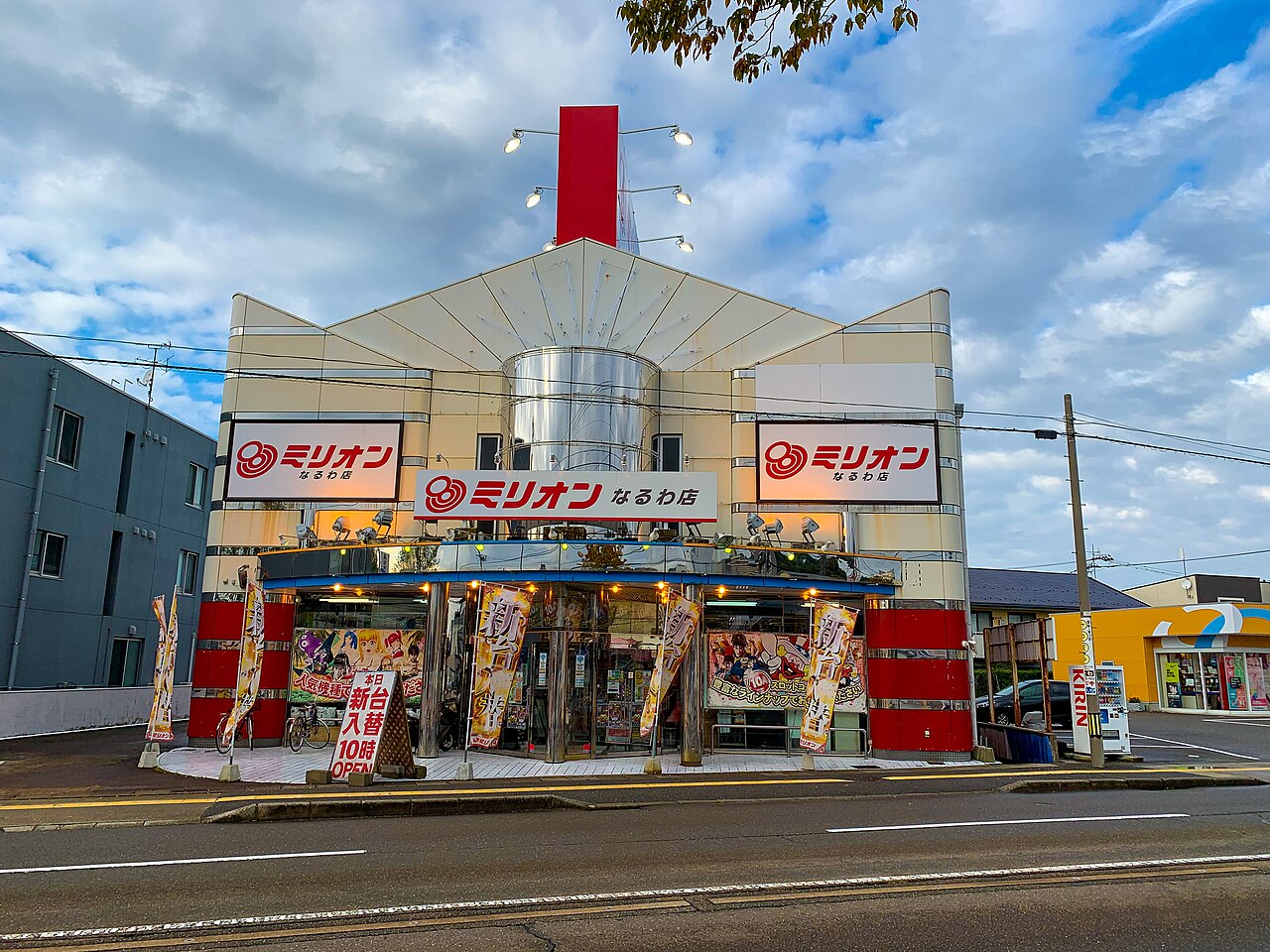
Exterior of a pachinko parlor in Kanazawa. Photo: Stephan Ridgway, CC BY 2.0, via Wikimedia Commons.
The Legal Grey Area: 三店方式
Japanese law prohibits direct cash 換金 (cash exchange) for gambling winnings. Pachinko parlors navigate this through a system called 三店方式 (sanstenhoushiki — the three-shop system):
- The Parlor (遊技場) — The player wins balls and exchanges them for small 景品 (prizes): typically a special token, a lighter, or a pen, with a posted monetary value.
- The Prize Exchange Booth — A tiny, separate kiosk, legally unaffiliated with the parlor and often located around the corner, buys those tokens for cash.
- A Wholesale Buyer — A third company purchases the tokens back from the kiosk, completing the cycle.
Because no single transaction constitutes gambling for cash, each step is individually legal — or at least, tolerated. This arrangement is an open secret in Japan; police are fully aware of it, and courts have declined to shut it down. Critics call it institutionalized 賭博 (gambling); supporters argue it is a regulated 娯楽 (entertainment) industry subject to strict oversight by local public safety commissions.
パチンコは合法とも違法とも言えない、グレーゾーンにある遊びです。 (Pachinko exists in a grey zone that is neither clearly legal nor clearly illegal.)
Cultural Context
Origins: From Childrens Toy to National Pastime
Pachinko traces its roots to a childrens toy that arrived in Nagoya in the 1920s, inspired by a US tabletop game called the Corinthian Bagatelle. By the 1930s, it had spread to adult parlors in cities across Japan. Most parlors were shuttered during World War II, but the game made a dramatic comeback in the late 1940s as a cheap, accessible escape for war-weary urban populations. By the 1980s and 1990s, pachinko had become one of Japans most popular leisure activities, with nearly one in ten Japanese visiting a parlor regularly.
The Industry at its Peak
At its apex around 2005, the pachinko industry generated revenues of roughly ¥35 trillion (~$300 billion USD) per year — dwarfing the entire Las Vegas gambling industry and making it one of the largest entertainment markets in the world. Parlor numbers peaked at over 18,000 in the late 1990s. The sensory environment of a パチンコ屋 (pachinko parlor) became iconic: clouds of cigarette smoke (煙草 was long permitted inside), walls of deafening machine noise, fluorescent lights, and rivers of cascading steel balls.
The Zainichi Korean Connection
Packinko has deep historical ties to 在日 Koreans (Zainichi Koreans — ethnic Koreans living in 日本). In the immediate postwar period, 朝鮮人 (Korean people) who had come to Japan during colonial rule found themselves stripped of citizenship and barred from many formal employment sectors. Pachinko parlor operation was one of the few industries accessible to them, and Korean entrepreneurs dominated its founding era. Today, it is estimated that a significant portion of pachinko parlors are still owned or operated by families of Korean descent, though exact figures are contested and the industrys demographics have diversified considerably.
This history became the basis of the acclaimed 2017 novel Pachinko by Min Jin Lee, which traces four generations of a Zainichi Korean family across the 20th century. The novel was adapted into an Apple TV+ series that premiered in 2022 (with a second season in 2024), bringing the history of Zainichi Koreans and their complicated relationship with Japan to a global audience. The titles double meaning — both the game and a life governed by chance and systemic forces — is central to the work.
パチスロ: The Sibling Machine
Inseparable from pachinko parlors is パチスロ (pachislot) — a hybrid slot machine designed specifically for the Japanese market. Pachislot machines occupy the same parlors as pachinko machines and use the same three-shop prize-exchange system. Where pachinko rewards ball-launching skill and timing (to a degree), pachislot is closer to a conventional slot machine with spinning reels. Together, pachinko and pachislot define the 遊技 (遊技 — amusement) industry.
Decline and Modern Landscape
The pachinko industry has contracted sharply since its peak. By 2022, market revenues had fallen to around ¥14.6 trillion — less than half the 2005 figure — and the number of parlors had dropped below 8,000. Several forces drove the decline:
- Stricter regulations: Government tightening of machine payout rates made machines less profitable for players.
- Smoking bans: Indoor smoking restrictions, fully implemented by 2020, drove away many veteran customers.
- Demographic shift: Japans aging and shrinking population, combined with younger generations preference for digital entertainment and mobile games, reduced the player base.
- Social stigma: Growing awareness of ギャンブル addiction — pachinko is one of Japans leading sources of problem gambling — led to public health campaigns and regulatory crackdowns.
Parachico parlors have responded by redesigning interiors (smoke-free, brighter, quieter zones), introducing loyalty programs, and heavily emphasizing licensed entertainment content to attract new demographics.
Quick Reference
| Term | Japanese | Meaning |
|---|---|---|
| Pachinko | パチンコ | The machine and the game |
| Pachislot | パチスロ | Japanese slot machine |
| Pachinko parlor | パチンコ屋 / 遊技場 | The arcade-like venue |
| Steel ball | 鉄球 / 玉 | The playing ball |
| Prize | 景品 | Item exchanged for balls |
| Three-shop system | 三店方式 | The cash-exchange loophole |
| Zainichi Korean | 在日コリアン | Ethnic Koreans in Japan |
Related Dictionary Words
pachinko; mechanical gambling game superficially resembling pinball
slot machine in a pachinko parlor
gambling
ball; sphere; globe; orb
realization (of goods into money); conversion (into money); liquidation
gift; premium; freebie; giveaway; something additional; an extra
gambling
amusement; entertainment; recreation; pleasure; pastime; hobby
amusement center (centre); game arcade; gambling hall
pachinko machine
illegal; illicit; unlawful
legal; lawful; legitimate
resident in Japan (of a foreigner); situated in Japan (e.g. of an embassy)