プリクラ
purikuraJapan's iconic coin-operated photo booth that prints sheets of tiny sticker photos, beloved since 1995 as a friendship ritual and cornerstone of kawaii and gyaru culture.
Meaning
プリクラ is a shortened form of プリントクラブ (purinto kurabu, "Print Club"), the brand name of a coin-operated 撮影 booth that takes a burst of photos and prints them as a sheet of peel-and-stick mini stickers. The word プリクラ functions today as the generic term for all such machines, regardless of manufacturer, much like "Xerox" became a synonym for photocopying.
A typical sheet contains ten to twenty thumbnail-sized photos, each roughly the size of a postage stamp, arranged in a grid on adhesive paper. Users decorate the digital images on a touchscreen before printing — adding 文字, graphic frames, sparkles, hearts, and emoji-style stamps — then split the finished sheet among friends.
The Booth Experience
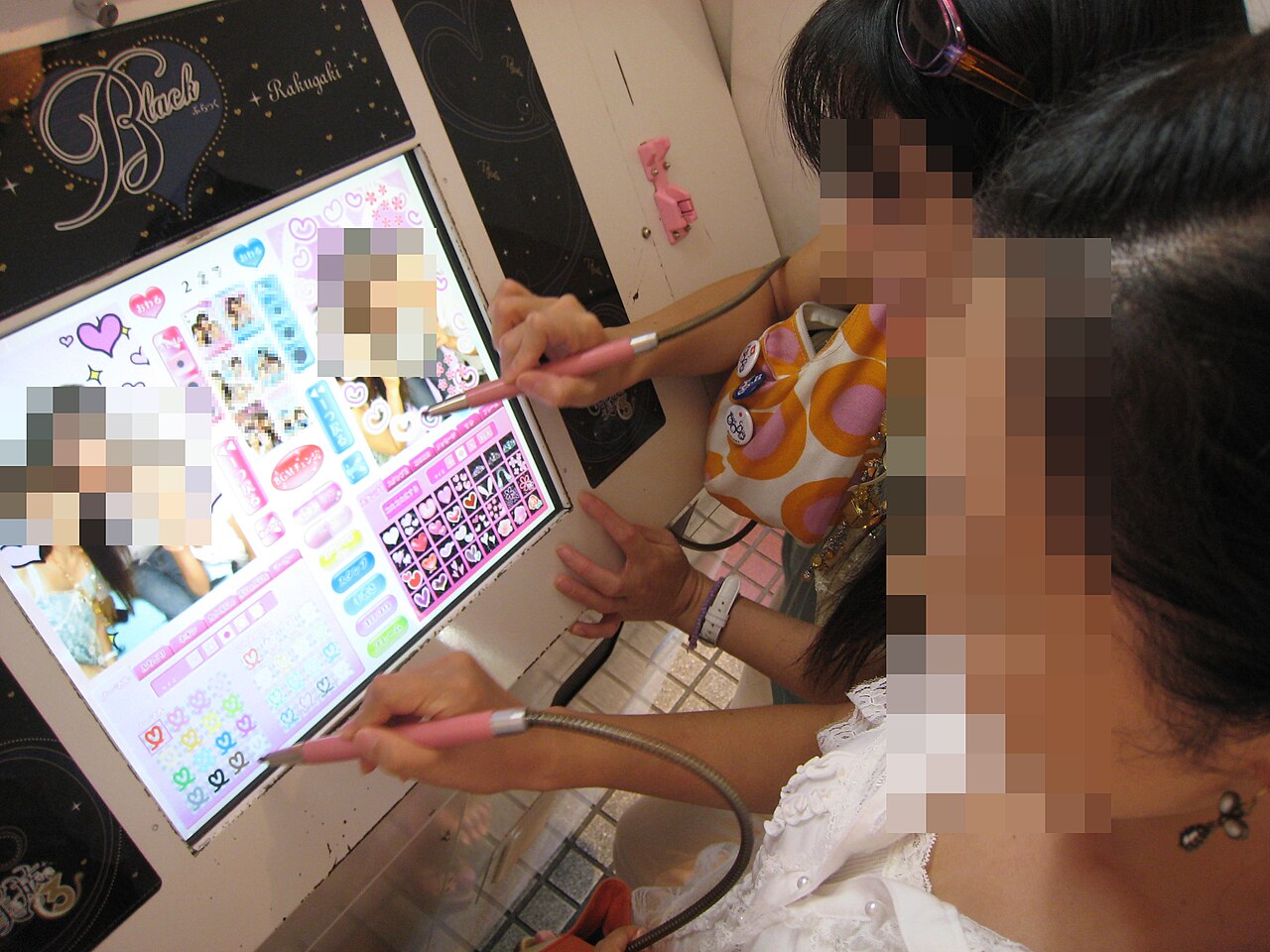
Women use the decoration touchscreen inside a purikura booth, Osaka, 2007. Photo: Syced, CC0, via Wikimedia Commons.
The experience unfolds in two stages.
Stage 1 — Shooting: A group (two to five people is ideal) steps inside a curtained cabinet, feeds coins or a card into the slot, and chooses a background: plain white, pastel gradients, seasonal themes, or elaborate fantasy sets. The machine counts down and fires several shots in quick succession while a cheerful voice offers pose suggestions.
Stage 2 — Deko (デコ): After shooting, participants move to an external デコ station — a large touchscreen — and spend a timed window (usually sixty to ninety seconds) decorating each image. Tools include:
- Handwritten 文字 and doodles using a stylus
- Pre-made stamp graphics (stars, flowers, crowns, lace borders)
- Sparkle and glow effects
- Speech bubbles and catchphrases
The result is printed in under thirty seconds on glossy adhesive paper.
Cultural Context
Print Club (プリントクラブ) was co-developed by Atlus and Sega and launched in July 1995 at a Shibuya game center. The machines sold out within days and a nationwide 流行 erupted. By 1997 there were an estimated 95,000 machines across Japan, with lines forming outside ゲームセンター and shopping-mall arcades every weekend.
The craze was driven largely by teenage girls, and プリクラ became inseparable from two major youth subcultures of the late 1990s:
- ギャル (gyaru) culture — sun-tanned skin, bleached hair, and lavish makeup. プリクラ booths were meeting points, social proof, and fashion documentation.
- コギャル (kogal) culture — the younger school-uniform variant of ギャル, for whom filling a dedicated sticker album was a rite of passage.
Sticker albums became prized possessions. 友達 traded individual stickers from their sheets; covering your album with the 写真 of your social circle signalled popularity and belonging. Swapping プリクラ with a new acquaintance was a fast-track form of bonding.
Beauty Technology and the Moriko Effect
Early booths simply enlarged and printed the raw photo. By the early 2000s manufacturers began adding automatic image processing that smoothed 肌, enlarged 目, slimmed 顔, and brightened the entire image. The effect was dramatic enough to attract the nickname moriko (盛りこ) — from 盛る (moru), meaning "to pile up" or "to embellish." A heavily filtered purikura version of a person became known colloquially as their moriko appearance.
Modern machines (2020s) offer real-time AI skin analysis, automatic eye-enlargement sliders, nose-slimming, and full background replacement. The gap between the raw photo and the finished sticker can be substantial — a feature embraced rather than hidden. プリクラ explicitly occupies a fantasy space distinct from "realistic" selfie photography, which is part of its enduring appeal.
Social Media and the Modern Era
Rather than being displaced by smartphone cameras, プリクラ adapted. Current high-end machines by manufacturers such as Furyu and the Atlus-derived Arii offer:
- Bluetooth and QR code transfer of digital image files directly to smartphones
- Instagram-optimised crop ratios and aspect-ratio presets
- "Cinematic" video strips for TikTok and Instagram Reels
- Themed seasonal booths tied to anime, idol groups, and fashion brands
The physical sticker sheet remains the product — the novelty of holding a printed object that your phone cannot replicate is part of the ritual's staying power.
Where to Find Them
プリクラ machines are primarily found in:
| Venue | Notes |
|---|---|
| ゲームセンター (game centers) | Largest selection, multiple competing machines |
| Aeon and mall arcades | Family-friendly environment, popular after school |
| Karaoke boxes | One or two machines near the reception area |
| Theme parks and tourist spots | Souvenir-oriented, often seasonally themed |
| Shibuya / Harajuku / Akihabara | Dense clusters, current-season machines |
Tokyo's Shibuya and Harajuku districts remain the cultural center of プリクラ, with multi-floor dedicated プリクラ parlors operating alongside clothing boutiques.
Comparison With Selfie Culture
プリクラ and smartphone selfies coexist because they serve different social functions:
| プリクラ | Smartphone selfie | |
|---|---|---|
| Output | Physical sticker sheet | Digital file |
| Setting | Dedicated booth, group ritual | Anywhere, any time |
| Editing | Real-time in-booth decoration | Post-app filters |
| Sharing | Trade, stick in album, display | Social media upload |
| Cost | ¥400–¥700 per session | Effectively free |
The physicality of プリクラ — the act of tearing the sheet, handing a strip to a 友人, sticking one on your phone case or notebook — creates a tangible memory object that a digital photo cannot fully replicate.
Legacy
Print Club invented a new category of social photography. Similar machines spread across East and Southeast Asia (known as 大頭貼 in Taiwan, 貼紙相 in Hong Kong), and the aesthetic of heavily decorated, skin-smoothed, big-eyed portrait stickers influenced the visual grammar of kawaii worldwide. Over thirty years after the first machine appeared in Shibuya, プリクラ retains a uniquely Japanese identity as a ritual, a technology, and a cultural touchstone.
Related Dictionary Words
photo booth that prints out cards and stickers of the resulting photograph, which are then traded among friends
photograph; photo; picture; photography
seal
game arcade; video arcade; penny arcade
gyaru; (young) woman adhering to a fashion style usually characterized by dyed hair and gaudy clothing
decoration; ornamental item