刺し子
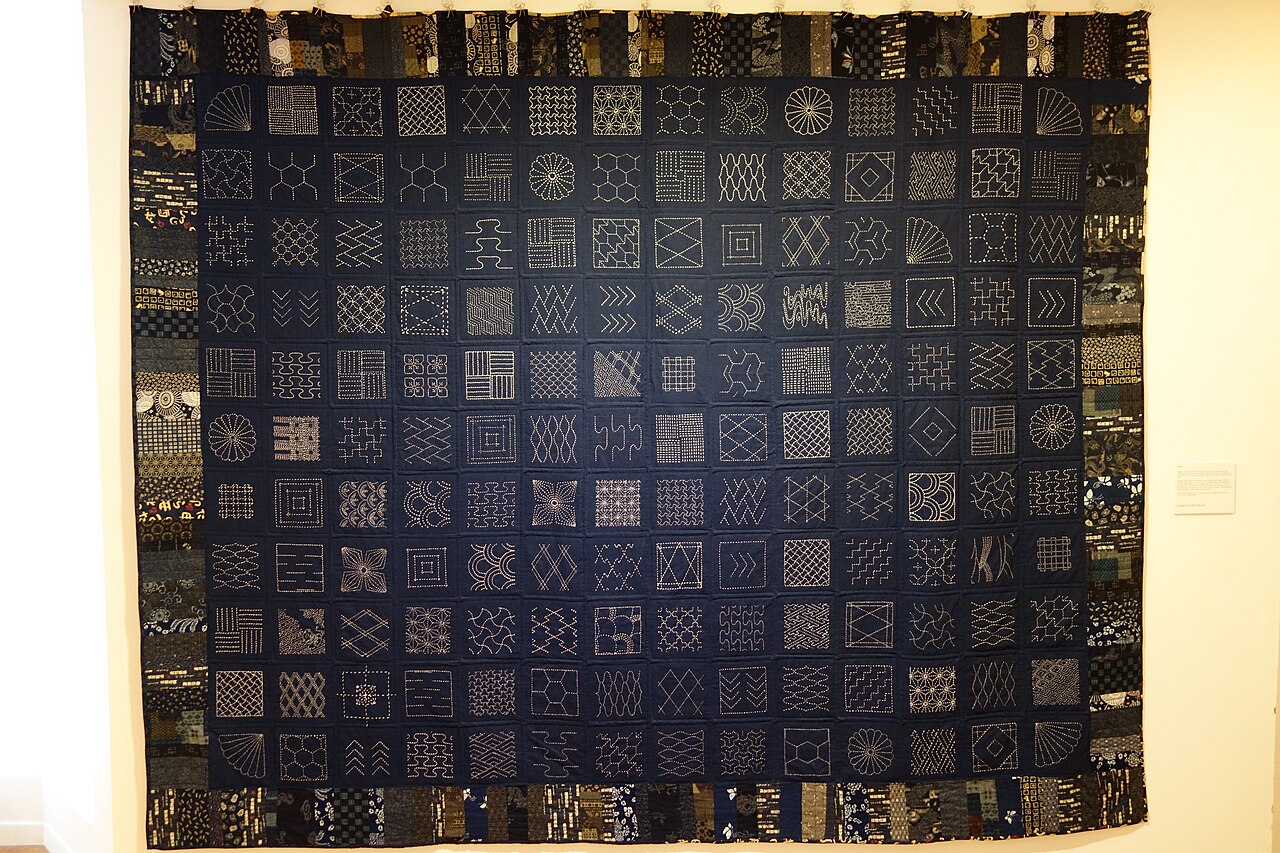
sashikoA traditional Japanese folk embroidery technique using white running stitches on indigo fabric to create geometric patterns, originally developed to reinforce and repair textiles.
Meaning
刺し子 (さしこ, sashiko) literally means "little stabs" or "little piercings" — a name that captures the technique perfectly. It refers to a form of 刺繍 (embroidery) in which the needle is stabbed in and out of 布地 (fabric) in repeating running stitches, building up dense geometric 模様 (patterns) across the cloth.
Traditionally, sashiko uses thick white 糸 (thread) stitched onto deep indigo-dyed 綿 (cotton) or 麻 (linen) fabric, creating a striking visual contrast. The 針 (needle) used is longer and slightly thicker than a standard sewing needle, allowing the crafter to load multiple stitches at once before pulling through — a flowing, meditative rhythm that distinguishes sashiko from Western embroidery.
Cultural Context
Sashiko stitching demonstrated by volunteers, Textile Museum of Canada, 2012. Photo: Daderot, CC0, via Wikimedia Commons.
Sashiko emerged among rural farming and fishing communities during Japan's Edo period (1603–1868), born not from artistic ambition but from practical necessity. Winters in northern Honshu — particularly in the Tōhoku region and Noto Peninsula — were brutal, and 布 (cloth) was precious. Farm families stitched layers of worn fabric together with dense running stitches to trap warmth and extend the life of work clothing. The result was heavier, more insulating, and far more durable garments.
By the Meiji era (1868–1912), sashiko had developed into a recognized craft 伝統 (tradition) with named regional schools. Northeastern Japan produced bold, angular geometric designs; southwestern coastal communities favored flowing, wave-like repetition. Women passed patterns down through families the way recipes are passed — orally, by demonstration, and through treasured paper templates.
The 藍 (indigo) background is not merely aesthetic. Indigo dyeing (ai-zome) was widespread in premodern Japan, and indigo-dyed cloth was thought to repel insects and have mild antiseptic properties — practical advantages for work clothes worn in the fields.
Patterns
Sashiko patterns carry names drawn from nature, auspicious symbols, and everyday objects. Many are considered good-luck motifs, making sashiko stitched items meaningful gifts.
| Pattern Name | Japanese | Meaning / Association |
|---|---|---|
| Asanoha | 麻の葉 | Hemp leaf — growth and resilience |
| Sayagata | 紗綾形 | Swastika meander — longevity and prosperity |
| Shippo | 七宝 | Seven treasures / interlocking circles — harmony |
| Seigaiha | 青海波 | Blue ocean wave — good fortune, peaceful seas |
| Kagome | 籠目 | Woven bamboo basket — protective ward |
| Hishi | 菱 | Diamond / water chestnut — warding off evil |
| Nowaki | 野分 | Autumn grasses in wind — seasonal beauty |
Patterns are typically worked on a grid, with a single 縫う (sewing) pass completing entire rows of a motif before the direction changes. Unlike most Western embroidery, sashiko patterns are designed so that a single continuous thread travels across the full work, doubling back in a precise sequence. Maintaining even stitch length — ideally 3–4 mm on the front, slightly shorter on the back — is the central skill developed over years of practice.
Boro: Sashiko's Companion Craft
Intimately related is boro (ぼろ), from the word meaning "rags" or "tatters." Boro garments are the result of decades of patching and mending, with layers of fabric held together by sashiko stitching. For centuries boro textiles were a sign of poverty; their owners were too poor to buy new cloth. Today, boro pieces are collected as folk-art masterpieces, their dense layers of mended fabric now read as records of labor, care, and survival. Boro aesthetics have had a notable influence on high fashion, with designers like Kapital and Visvim making indigo-and-stitched garments internationally recognized.
The Modern Revival
Sashiko experienced a quiet renaissance beginning in the 1970s as Japanese craft revival movements sought to document disappearing folk techniques. The 工芸 (craft) spread internationally through the slow food and slow living movements of the 2000s and accelerated sharply in the 2010s with the rise of mindfulness culture and social media.
On Instagram and Pinterest, sashiko's high-contrast aesthetic photographs beautifully. Hashtags like #sashiko and #刺し子 collectively carry millions of posts. Tutorials proliferated on YouTube; dedicated supply shops opened in the United States, Europe, and Australia. During the COVID-19 pandemic lockdowns of 2020–2021, sashiko became one of the fastest-growing craft hobbies globally as people sought quiet, repetitive activities to manage anxiety.
The craft's appeal to modern practitioners runs deeper than aesthetics. Sashiko exemplifies the Japanese philosophy of mottainai (もったいない) — the ethic of not wasting anything — and the satisfaction of repairing rather than discarding. In an era of fast fashion, stitching a visible mend onto a worn pair of jeans using sashiko-style stitches has become a deliberate counter-cultural act.
How to Get Started
Sashiko requires minimal equipment, which is part of its global appeal.
Essential materials:
- Sashiko thread — Tightly twisted, slightly thicker than standard embroidery floss; traditionally white, now available in many colors
- Sashiko needle — Longer (about 5–6 cm) with a large eye to accommodate thick thread
- Fabric — Any woven cotton works for beginners; traditionally indigo or dark solid colors
- Thimble — A Japanese thimble (yubinuki, 指貫) worn on the middle finger to push the needle through multiple fabric layers
- Tracing paper or a light box — For transferring patterns onto dark fabric
Basic technique:
- Transfer the pattern lightly onto the fabric using chalk or a water-soluble marker.
- Thread the needle without knotting the end — instead, take two or three anchor stitches at the start.
- Load three to five stitches onto the needle at once by rocking it through the fabric, then pull through. This "loading" technique creates even, flowing stitches.
- Follow the pattern's prescribed stitching order — sashiko patterns have a right sequence to minimize thread crossings on the back.
- Finish without knotting; weave the thread back under four or five stitches.
Beginners often start with a simple grid (hitomezashi, 一目刺し) — single-stitch patterns formed by rows of vertical and horizontal stitches that interlock to create geometric designs without needing to follow complex diagonal paths.
Related Concepts
- Boro (ぼろ) — The patched textile tradition that sashiko stitching made possible
- Kogin-zashi (こぎん刺し) — A related Aomori embroidery tradition using counted-thread patterns on fine linen
- Hishizashi (菱刺し) — Diamond-pattern embroidery from Yamagata, closely related to sashiko
- Mottainai (もったいない) — Japanese concept of zero waste, the philosophical underpinning of sashiko culture
- Wabi-sabi (侘び寂び) — Aesthetic of imperfection and transience, relevant to the repaired-textile aesthetic
Related Dictionary Words
quilting; quilted coat; quilted clothes
embroidery
dyer's knotweed (Persicaria tinctoria, used to produce indigo dye)
cotton
cannabis (Cannabis sativa); hemp (plant)
needle; pin
thread; yarn; string
pattern; figure; design
industrial arts; craft
tradition; convention