銭湯
sentoJapan's traditional neighbourhood public bathhouses, where heated communal baths have served as a social and cultural cornerstone of urban life for centuries.
Meaning
銭湯 (せんとう, sento) literally combines 銭 (zeni, coins/money) and 湯 (yu, hot water), meaning a bathhouse you pay to enter. These are communal public bathing facilities where visitors wash and soak in large shared tubs — distinct from 温泉 (onsen), which use geothermally heated natural spring water. Sento use ordinary tap water, typically heated to around 42–44°C, sometimes enriched with minerals, herbs (よもぎ), citrus (ゆず), or medicinal salts.
The symbol for sento is the hiragana ゆ (yu), meaning hot water, which hangs on a fabric curtain (のれん) over the entrance.
The Classic Sento Experience
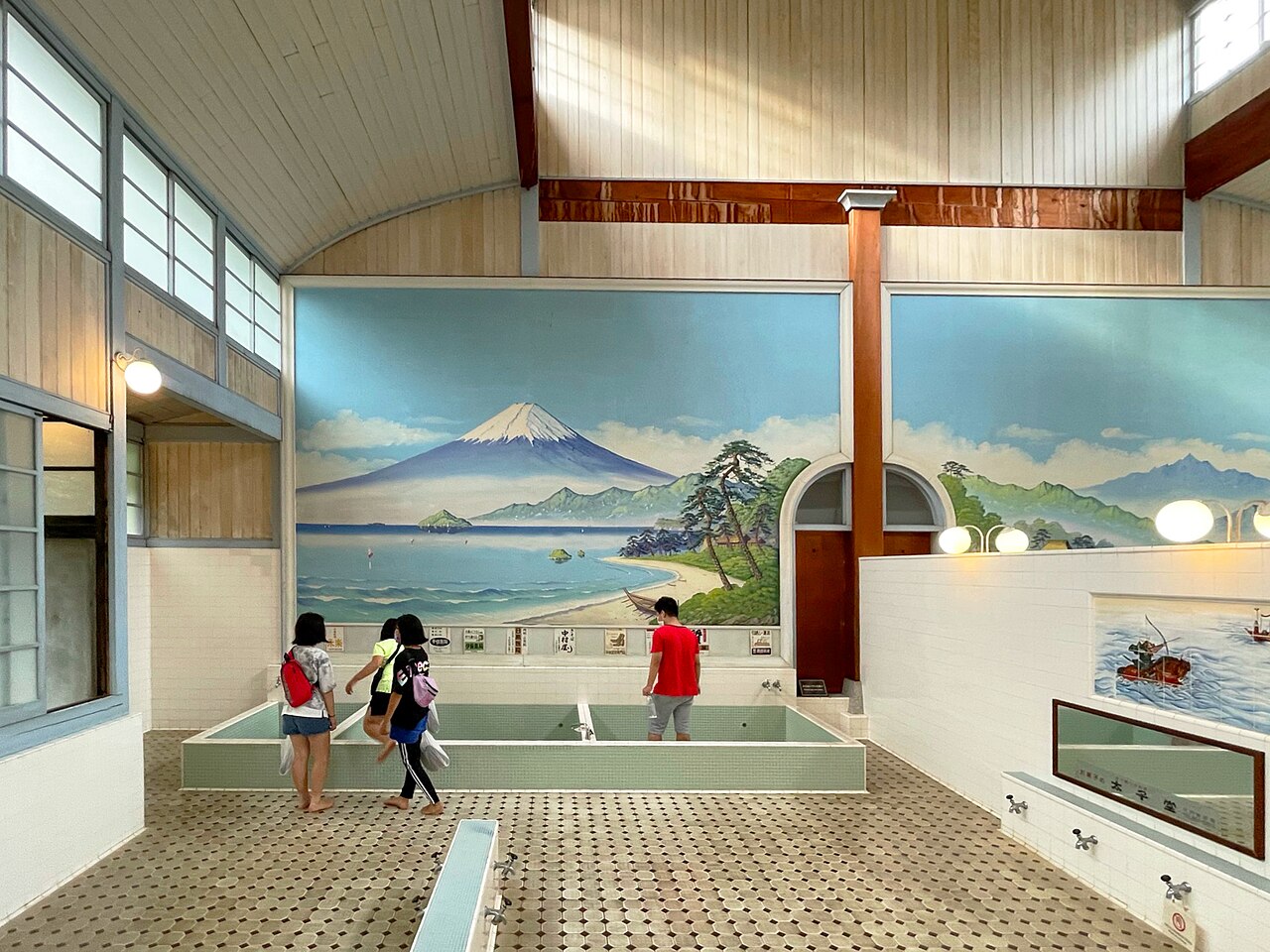
Interior of a traditional Japanese sento showing the communal bathing area. Public domain, via Wikimedia Commons (ウィキ太郎/WikiTaro).
Stepping into a sento follows a well-established ritual:
- Split entry — The entrance divides into 男湯 (otoko-yu, men's bath) and 女湯 (onna-yu, women's bath), marked by blue and red noren curtains respectively.
- The 番台 — Just inside sits the 番台 (bandai), a raised wooden platform from which a single attendant — once positioned at the centre of the dividing wall — could oversee both sides. Modern sento have often replaced this with a front-desk counter, but many preserve the classic bandai as a cherished fixture.
- The changing room — Visitors undress and store their clothes in wooden or basket lockers. Most sento rent タオル and sell small bottles of 石鹸 (sekken, soap) for those who arrive empty-handed.
- The washing area — Before entering any tub, bathers are seated at low tiled stations, filling their wooden 桶 (oke, bucket), scrubbing down thoroughly. This step is non-negotiable etiquette: you enter the communal water already clean.
- The baths — A main hot tub (あつ湯), sometimes a cooler tub (ぬる湯), a cold-water plunge pool (水風呂), and often a jet bath or electric bath (電気風呂) round out the lineup.
The Fuji Mural
Perhaps the most iconic feature of a classic sento is the enormous mural of 富士山 painted across the wall behind the bathing area. The tradition began in Tokyo in 1912 when bathhouse owner Kida Tsunejiro commissioned the first mural to make his customers feel as if they were bathing outdoors beneath Japan's sacred mountain. The practice spread nationwide and is now inseparable from the sento image. Only a handful of specialist mural painters (sento eshi) still practise this craft, making surviving originals particularly prized.
Cultural Context
Sento trace their history to the Nara period (710–794 CE), when Buddhist temples built communal bathing halls for monks as a form of ritual purification. The first documented commercial bathhouse appears in records from 1266. By the Edo period (1603–1868), sento had become the social heart of Tokyo (then Edo) commoner life — a place where merchants, labourers, and craftspeople mingled daily regardless of rank.
At their 1960s peak, Tokyo alone had over 2,600 sento. Nationwide there were approximately 18,000. As postwar prosperity brought private bathrooms into ordinary homes, the numbers fell sharply. Today fewer than 4,000 sento remain across Japan, down from that historic high.
Yet sento were never merely functional. They were the original "third place" — somewhere between home and workplace where 近所 (kinjo, neighbourhood) ties formed and gossip, advice, and laughter flowed as freely as the hot water. The atmosphere has always been one of easy informality: 裸 (hadaka, nakedness) is a social leveller.
銭湯は地域のコミュニティの中心でした。 Sento wa 地域 no コミュニティ no chūshin deshita. "Sento used to be the heart of the neighbourhood community."
Sento vs Onsen
| Feature | 銭湯 (Sento) | 温泉 (Onsen) |
|---|---|---|
| Water source | Heated tap water | Natural geothermal spring |
| Location | Urban neighbourhoods | Resorts, ryokan, hot-spring towns |
| Price | ¥500–¥700 | ¥1,000–several thousand yen |
| Atmosphere | Casual, everyday | Relaxation retreat |
| Additives | Herbs, minerals (optional) | Natural minerals |
Japanese law distinguishes the two: onsen water must meet specific mineral or temperature thresholds at source.
Usage and Etiquette
Key rules every first-time visitor should know:
- Shower and 洗う (arau, wash) thoroughly before entering any tub — always.
- Do not bring large towels into the bathing area. The small modesty towel goes on your head or beside you, not in the water.
- Keep your voice low. It is a shared space for relaxation.
- Do not swim, splash, or dunk your head.
- Tattoos (タトゥー) have historically been prohibited at most sento due to their association with organised crime. This policy is changing — many sento now explicitly welcome tattooed guests.
体を洗ってからお風呂に入ってください。 Karada wo 洗う kara o-風呂 ni haitte kudasai. "Please wash your body before getting into the bath."
Modern Revival
Far from disappearing, sento are reinventing themselves as cultural institutions for the 21st century. A wave of younger owners and designers has produced what the media calls dezainā sento (デザイナー銭湯, designer sento):
- Koganeyu (東京・錦糸町) was renovated in 2020 with a craft beer taproom, DJ booth, and a new Mount Fuji mural by artist Yoriko Hoshi — tattoos welcome.
- Art installations, projection mapping, and themed bath nights (ゆず湯 on the winter solstice, 菖蒲湯 in May) draw younger crowds.
- Many sento now offer sauna (sauna) facilities, riding the boom in Finnish-style sauna culture that swept Japan after 2019.
- Community events, yoga classes, and film screenings have found homes in renovated changing rooms.
Local governments have begun subsidising sento preservation, recognising them as living cultural assets (mukei bunka isan, 無形文化遺産). The 入浴 (nyūyoku, bathing) 習慣 (shūkan, habit/custom) they represent is increasingly framed not as old-fashioned but as a uniquely Japanese form of mindful communal living.
Related Terms
- スーパー銭湯 (sūpā sentō, super sento) — Large-scale commercial bath complexes with multiple themed pools, saunas, restaurants, and lounges; closer in price and scale to a resort.
- 家風呂 (ie-buro) — Private home bath, the convenience that began sento's decline.
- 湯屋 (yuya) — Historical term for bathhouse, common in the Edo period.
- ゆ — The hiragana symbol ゆ displayed on the noren curtain; the universal shorthand for a sento.
- サウナ (sauna) — Sauna, now a key draw at many revived sento.
Related Dictionary Words
public bath; bathhouse
hot spring
attendant's booth (in a bathhouse changing room); door-keeper's stand; watcher's seat
Mount Fuji; Mt. Fuji; Fujiyama; Fuji-san
hot water
bath; bathing; bathtub; bathroom
bathing; going in the bath
neighbourhood; neighborhood; vicinity