東急ハンズ
Toukyuu HanzuThe legendary Japanese lifestyle and DIY department store chain famous for its overwhelming variety of goods, now rebranded simply as 'Hands.'
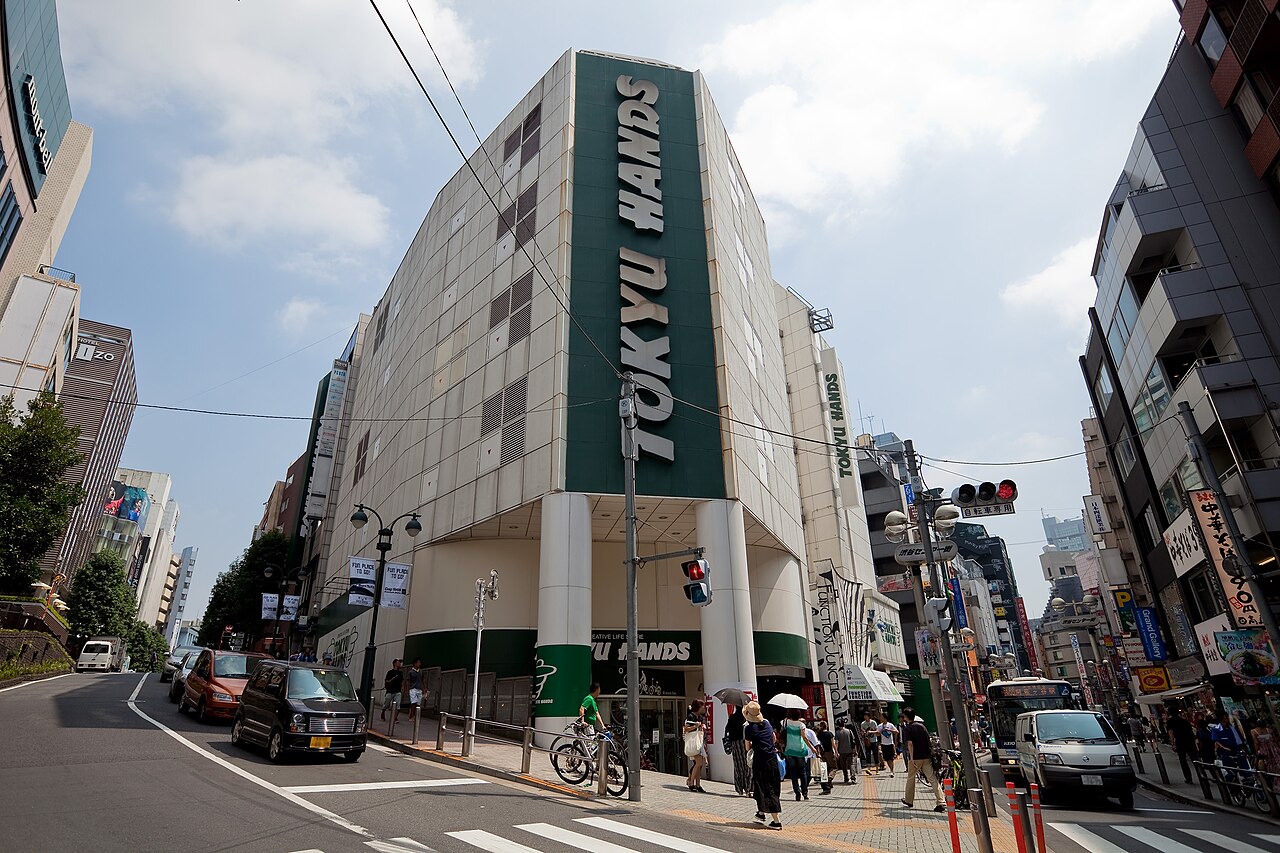
A Hands storefront in Shibuya. Photo: DeepSkyBlue, CC BY-SA 3.0, via Wikimedia Commons.
Meaning
Tokyu Hands (東急ハンズ, Toukyuu Hanzu) is a Japanese chain of multi-floor lifestyle, 雑貨 (variety-goods), and do-it-yourself department stores, now operating simply as Hands (ハンズ) since a 2022–2023 rebrand. It is not a specialty shop but a sprawling, meticulously stocked emporium spanning categories that would normally require a dozen separate stores: 文房具 (stationery), 手芸 (handicrafts and needlework), 日曜大工 (home DIY/hardware), kitchenware, travel goods, cosmetics and health items, hobby and craft supplies, bicycles, party novelties, and shelves of small, oddly specific problem-solving gadgets that Japanese shoppers jokingly say exist nowhere else.
The name itself encodes its philosophy: the two-hand logo represents tsukuru (作る, "to make") — the idea that ordinary people, using their own 手 (hands), can build, repair, fix, and improve their own lives. Where a typical 百貨店 (department store) sells finished, packaged consumer goods, Tokyu Hands built its identity around selling the raw materials and tools of creativity itself — paints, screws, fabric, resin, wire, beads — alongside the finished products, treating shopping as an extension of making.
Usage
In everyday conversation, Tokyu Hands/Hands functions as shorthand for "the place that will have that weird thing you can't find anywhere else." It has become a verb-adjacent phrase in casual speech among Tokyoites and long-term foreign residents alike.
東急ハンズに行けば、絶対にあるよ。 Toukyuu Hanzu ni ikeba, zettai ni aru yo. "If you go to Tokyu Hands, they'll definitely have it."
この変な工具、ハンズで買った。 Kono hen na kougu, Hanzu de katta. "I bought this weird tool at Hands."
Travel guides and lifestyle blogs commonly describe a trip to the flagship Shibuya or Shinjuku stores as an activity in itself — not a targeted shopping errand but an afternoon of open-ended browsing (探検, tanken, "exploration") through floor after floor of categorized wonder, from a Hobby floor with model-making and resin-craft supplies to a Health & Beauty floor to a rooftop garden section.
Cultural Context
Origins as a DIY pioneer
Hands Inc. was established in August 1976 as part of the Tokyu Group keiretsu (hence the original name, combining the parent company's name with the English word "hands"). Its flagship store opened in 渋谷 (Shibuya), 東京, on September 9, 1978, at a moment when Japan's postwar DIY and hobbyist culture was expanding rapidly alongside rising disposable income and denser urban apartment living, which created demand for compact, resourceful home-improvement and craft solutions rather than the large workshops and sheds common in the West.
The store's founding philosophy borrowed from the Japanese concept of continuous, incremental self-improvement — improving daily life not through big purchases but through small, thoughtful, well-made tools and materials. Staff were (and still are) trained specialists on their floors, able to advise a customer building a birdhouse, repairing a kimono, or mixing a custom paint color, a level of hands-on expertise unusual for large-format retail.
"You can find literally anything here"
Tokyu Hands' defining cultural reputation, both domestically and among the millions of tourists who visit Japan, is the sense that its inventory is functionally limitless. Flagship stores historically stocked upward of 100,000 distinct items across seven or more floors, organized into idiosyncratic lettered/numbered zones connected by half-flights of stairs and mezzanines — a layout so labyrinthine it became part of the store's charm, encouraging aimless wandering and serendipitous discovery over efficient point-A-to-B shopping.
This reputation made it a fixture of Japanese "life hack" culture: a first stop for anyone with an unusual problem, from cosplayers needing specific craft resins to salarymen needing a travel pillow shaped exactly right, to students needing a novelty pen shaped like a vegetable. Foreign visitors in particular have long cited Tokyu Hands as proof of a distinctly Japanese retail obsession with variety, quality, and precision even in the smallest household object — a contrast to big-box stores elsewhere that stock fewer, more generic SKUs.
The 2022 sale and rebrand to "Hands"
In December 2021, Tokyu Fudosan Holdings (the real-estate arm of the Tokyu Group) announced the sale of Tokyu Hands, Inc. to Cainz Corporation, Japan's largest home-improvement ("home center") chain and part of the Beisia retail group. The acquisition was completed on March 31, 2022, formally severing the store's decades-long tie to the Tokyu conglomerate. On October 26, 2022, the company unveiled a redesigned identity by the celebrated design studio nendo: the store would drop "Tokyu" and operate simply as Hands, with a new minimalist logo built from a single continuous brushstroke evoking the kanji for "hand" (手), while retaining the brand's signature deep green color. Individual stores transitioned to the new name and signage through 2023.
The rebrand preserved the original store philosophy — "life through your own hands" — while modernizing the identity for a company now competing more directly in Cainz's home-improvement and lifestyle retail ecosystem rather than under a real-estate parent.
The end of an era: Shibuya flagship closure
In May 2026, Hands announced that its original Shibuya flagship — the very store that launched the chain in 1978 — would close in November after the expiration of its building lease, ending nearly 48 years in the same location. The seven-floor, roughly 5,500-square-meter store, still carrying around 100,000 items, had long been one of Shibuya's most recognizable retail landmarks. Its closure, alongside other high-profile departures from the district, was widely covered in Japanese and international press as a symbol of shifting commercial real estate priorities in central Tokyo, even as the broader Hands chain continues to operate dozens of stores nationwide (and formerly abroad, including a period of overseas expansion to Taiwan, Singapore, and elsewhere in Asia).
Legacy
Whatever its corporate ownership or name on the sign, the store remains shorthand in Japan for a particular kind of retail experience: encyclopedic variety, hands-on craftsmanship culture, and the pleasure of browsing without an agenda. It has influenced and coexists with other Japanese variety retailers such as Loft and Don Quijote, but remains distinctively associated with the maker/DIY spirit its name has always announced.
Related Concepts
| Term | Meaning |
|---|---|
| 雑貨 | Miscellaneous variety goods/sundries — the broader retail category Hands epitomizes |
| 日曜大工 | "Sunday carpentry," i.e. home DIY, one of the store's founding categories |
| 手芸 | Handicrafts/needlework, a major product department |
| 100円ショップ (hyaku-en shoppu) | 100-yen shops — a cheaper, narrower cousin of the variety-store concept |
| ドン・キホーテ (Don Quijote) | Another famously chaotic, everything-under-one-roof Japanese retailer |
Related Dictionary Words
hand; arm
miscellaneous goods; general goods; sundries
stationery
handicrafts
weekend carpentry; do-it-yourself; DIY; weekend carpenter; do-it-yourselfer
hobby; pastime
shopping; purchased goods
Shibuya City (special ward of Tokyo); Shibuya
department store
Tokyo
Tokyu Hands (Japanese department store chain)