ヴィジュアル系
bijuaru keiA distinctly Japanese rock music movement combining heavy, theatrical sound with elaborate gender-bending fashion, dramatic makeup, and androgynous costumes.
Meaning
ヴィジュアル系 (bijuaru kei), literally "visual style" or "visual type," refers to a Japanese rock music subculture defined as much by its theatrical visual aesthetic as by its sound. Bands in this genre are distinguished by dramatic 衣装 (costumes), elaborate 化粧 (makeup), gravity-defying hairstyles, and an androgynous or gender-fluid appearance that challenges conventional masculine norms in Japanese society.
The name derives from the slogan of X Japan — one of its founding acts — which declared themselves a "psychedelic violence crime of visual shock." The phrase was eventually condensed by music journalists and fans into the shorthand bijuaru kei, a label that stuck across the entire movement.
Cultural Context
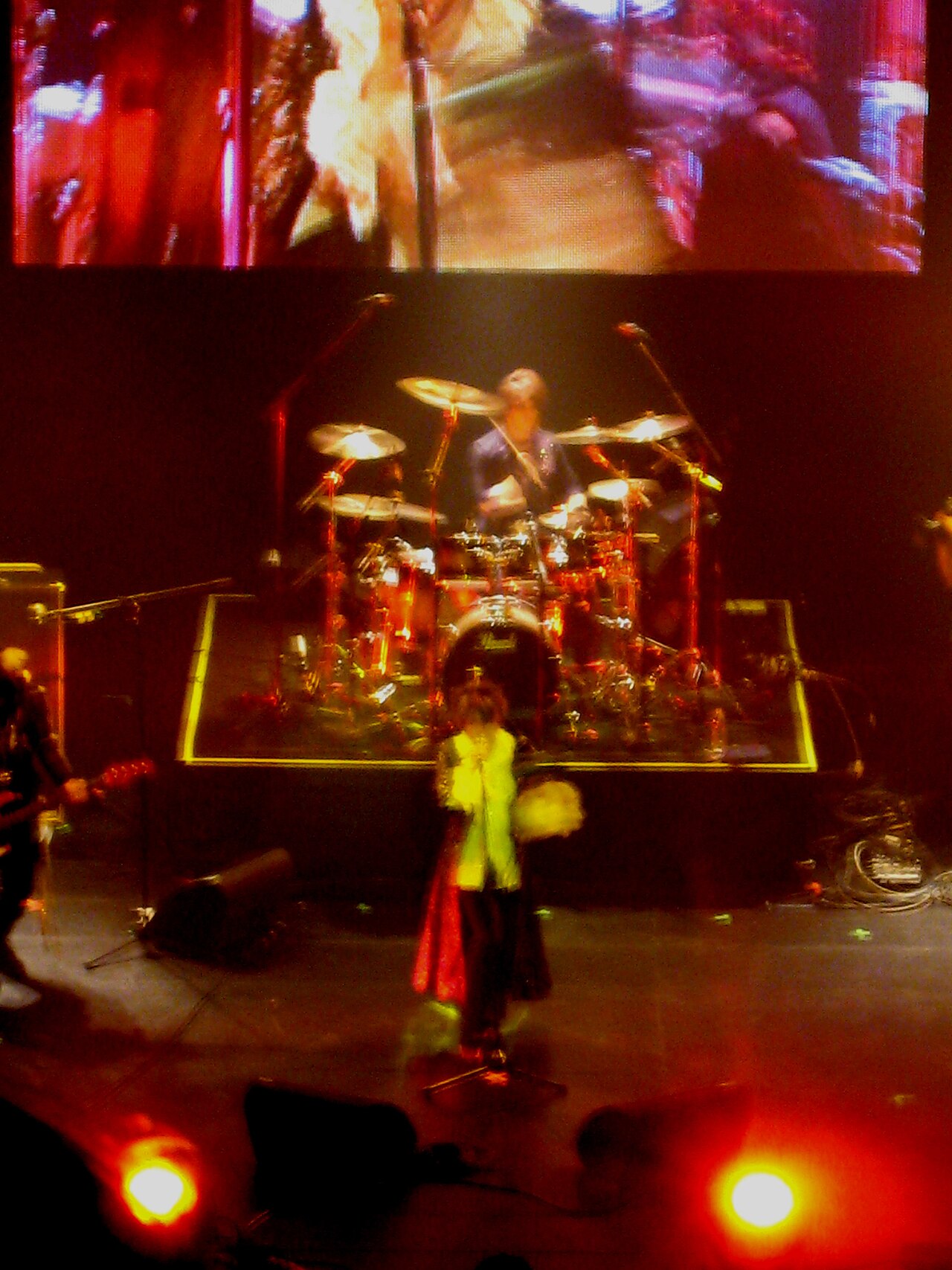
DuelJewel performing live, Japan Rocks and Raves 2007. Photo: Erica Kline, CC BY 2.0, via Wikimedia Commons.
Origins (1980s–1990s)
Visual Kei emerged from the Japanese underground rock scene in the early-to-mid 1980s. Its pioneers — X Japan, Buck-Tick, Dead End, D'erlanger, and Color — drew heavily from Western glam rock, heavy metal, punk, and gothic rock. Acts like KISS, Hanoi Rocks, Mötley Crüe, and David Bowie were major stylistic touchstones: the American and British tradition of theatrical rock performance, gender-bending fashion, and face paint found fertile ground in Japan's idol-culture infrastructure.
X Japan, formed in 1982 by guitarist hide and drummer/vocalist Yoshiki, is widely considered the founding band of the movement. Their operatic mix of speed metal and power ballads, combined with their sky-high teased hair and kabuki-like stage makeup, defined the template. Buck-Tick brought a darker, more gothic post-punk sensibility.
By 1988–1989, both bands had crossed over into mainstream Japanese 音楽 charts, and the early 1990s saw an explosion of major-label Visual Kei acts. The peak commercial era lasted roughly from 1995 to 1999, when バンドs like Luna Sea, GLAY, L'Arc-en-Ciel, and Malice Mizer dominated Japanese rock. Malice Mizer in particular became iconic for their ornate Baroque-European 衣装, theatrical storytelling, and the contributions of vocalist Gackt and guitarist/designer Mana, who pioneered the Gothic Lolita fashion that would become its own subculture.
Defining Aesthetic
While 音楽 styles within Visual Kei vary enormously — from melodic ballads to death metal — the defining thread is a commitment to visual spectacle. Key elements include:
- Androgyny and gender performance: Male musicians routinely adopt feminine 衣装, wear full 化粧, and style themselves in ways that blur or transgress conventional gender. This is not necessarily a statement about sexuality, but rather an embrace of beauty and theatrical self-presentation.
- Elaborate hairstyles: Towering, backcombed, brightly dyed, and structurally complex hair is a hallmark. In the 1990s, enormous teased-out manes were common; later eras favored sharper, more sculptural cuts.
- 舞台 costumes: From Victorian-era frock coats and corsets to bondage gear and traditional Japanese garments, costumes are designed for impact on 舞台.
- Concept-driven imagery: Many bands develop distinct visual identities around a narrative or aesthetic concept — vampires, aristocrats, dark fairy tales, Meiji-era Japan, or post-apocalyptic horror.
Musical Range
Visual Kei is a visual and cultural category, not a strict musical genre. The spectrum is wide:
- X Japan, Luna Sea: Heavy metal and power ballads with classical influences
- Malice Mizer: Gothic rock with baroque orchestration
- Dir en grey: Evolved from melodic VK to extreme metal and avant-garde; one of the few VK bands to break internationally
- the GazettE: Dark, heavy, industrial-influenced rock
- Alice Nine, SuG: More pop-leaning, glossy sound
- Kagrra: Traditional Japanese instruments (shamisen, taiko) fused with rock
Sub-genres
Over the decades, fans and critics have identified several sub-styles within Visual Kei:
| Sub-genre | Japanese | Characteristics |
|---|---|---|
| Kote-kei | コテ系 | The "classic" 1990s style — dark, gothic, grotesque; leather, vinyl, lace; aggressive music |
| Oshare-kei | おしゃれ系 | "Fashionable style" — bright colors, pop-punk sound; emerged in the 2000s |
| Angura-kei | アングラ系 | Underground; draws on avant-garde theater, traditional Japanese imagery, and taboo themes |
| Eroguro | エログロ | "Erotic grotesque" — horror imagery, body horror aesthetics; rooted in pre-war Japanese art |
| Neo Visual Kei | ネオヴィジュアル系 | Post-2010 revival blending modern production with classic VK aesthetics |
Fan Culture: バンギャ (Bangya)
The dedicated ファン base of Visual Kei is one of the subculture's most distinctive features. Female fans are called バンギャ (bangya), a contraction of bando gyaru ("band girl"). Male fans of the scene are sometimes called ban-otoko (バン男) or bangya-ou (バンギャ王, "king of bangyas").
Bangya culture involves a level of dedication comparable to idol fandom: attending numerous shows per month, collecting band goods (photosets, towels, limited CDs), following bands on tour, and sometimes forming parasocial connections with individual members.
Furitsuke (振り付け): Concert Choreography
One of the most striking aspects of Visual Kei live shows is 振り付け (furitsuke) — synchronized fan choreography. Every song typically has an established set of movements that all fans perform together. This is not improvised; new fans learn the 振り付け by watching veteran bangya or studying guides posted online.
Common furi movements include:
- Headbanging (ヘドバン, hedoban): Vigorous head-shaking, often in unison
- テセンス (tesensu): Arms spread alternately left and right above the head, like a fan
- ソロ咲き (soro-zaki): During guitar solos, arms raised and crossed, then "blossoming" outward
- 拳 (kobushi): Fist raised on beat
This choreography creates an extraordinary visual effect from the 舞台 — the band looks out at an audience moving as one synchronized body. ライブ etiquette is strict: fans do not sing along during songs, do not scream during MC segments unless invited to, and maintain awareness of the furi expected for each track.
Global Spread
Visual Kei reached 世界-wide audiences largely through the early internet. In the late 1990s and early 2000s, fan communities on LiveJournal, early file-sharing networks, and Japanese-fan-operated fansites spread music, scans, and translated interviews to audiences in Europe, Latin America, and North America who had no access to Japanese record shops.
European anime conventions — particularly Japan Expo in Paris and similar events — became early stages for VK bands touring outside Japan. Dir en grey's 2005–2008 international tours, including support slots with western metal acts, demonstrated that the 音楽 itself could find an audience completely independent of understanding Japanese 文化. Latin American countries (Brazil, Mexico) developed some of the largest overseas VK fan bases.
This transnational fandom created a feedback loop: Western fans adopted VK fashion, formed their own VK-influenced bands, and created localized scenes in cities from São Paulo to Paris. The term bangya and 振り付け culture spread along with the 音楽.
Current Scene
After the late-1990s commercial peak, Visual Kei contracted significantly through the 2000s. Many major acts disbanded (Malice Mizer in 2001; X Japan went on indefinite hiatus from 1997 to 2007). However, the subculture never disappeared.
The 2010s saw both legacy acts returning to ライブ and a new wave of independent bands on the Osaka "indie VK" circuit. Today the scene is smaller but resilient: the GazettE, Dir en grey, and Alice Nine (rebranded as A9) continue to 演奏; Yoshiki of X Japan remains a prominent cultural figure in Japan. Younger bands continue to debut through the network of small live houses that sustain the independent VK ecosystem.
Visual Kei's aesthetic influence has also diffused into broader Japanese pop 文化 — the gender-fluid fashion, theatrical makeup, and concept-driven 芸術 presentation visible in contemporary J-pop, anime character design, and Harajuku street fashion all bear its fingerprints.