妖怪
yokaiSupernatural creatures, spirits, and monsters from Japanese folklore that embody the fears, wonders, and moral lessons of the natural world.
Meaning
The word 妖怪 refers to a broad category of supernatural beings, spirits, and monsters rooted in Japanese folklore. The characters that make up the word — 妖 (mysterious, bewitching) and 怪 (strange, suspicious) — together convey something uncanny and beyond ordinary explanation. Unlike the Western concept of "monster," which is primarily fearsome, yokai spans a vast spectrum: from terrifying demons and vengeful ghosts to mischievous tricksters and benevolent protectors.
Related terms include 幽霊 (yurei, a ghost or spirit of the dead), 化け物 (bakemono, a shape-shifting creature), and 怪物 (kaibutsu, a monster or freak). While yurei specifically refers to the spirits of deceased humans, yokai is a broader category encompassing all manner of supernatural entities — animate objects, nature spirits, demons, and 妖精-like beings.
Cultural Context
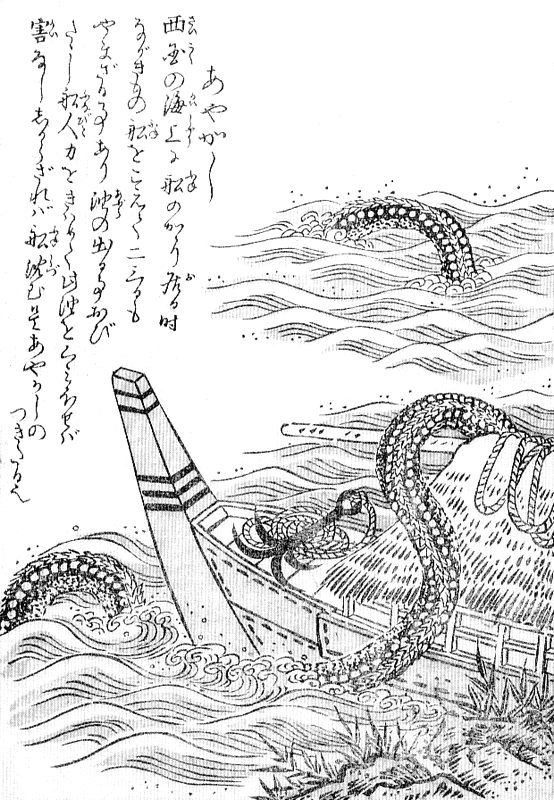
Ayakashi, a sea yokai, from Toriyama Sekien's Gazu Hyakki Yako, c. 1776. Public domain, via Wikimedia Commons.
Belief in yokai is deeply woven into Japanese 神道 and folk religion. In the Shinto worldview, 自然 — nature itself — is animated by spiritual forces. 山 (mountains), 川 (rivers), and the 海 (sea) all harbor presences that must be respected. Yokai emerged from this animistic worldview as personifications of natural phenomena, inexplicable events, and the anxieties of daily life.
The earliest systematic catalogues of yokai appeared during the Edo period (1603–1868), when woodblock print artists began illustrating them in encyclopedic collections. The most influential of these was Toriyama Sekien (鳥山石燕, 1712–1788), whose four-volume series Gazu Hyakki Yako depicted hundreds of creatures drawn from folklore, classical literature, and his own imagination. His 浮世絵-style illustrations established the visual canon that most Japanese people still recognize today.
The concept of the Hyakki Yako — a procession of yokai roaming through the streets at night — appears in 絵巻 (picture scrolls) as early as the 12th century. These scrolls reinforced the idea that the boundary between the human and supernatural worlds was thin, especially at night and during liminal periods.
Famous Yokai
Japanese folklore features hundreds of distinct yokai types. Some of the most widely known include:
| Yokai | Japanese | Description |
|---|---|---|
| Oni | 鬼 | Fearsome ogre-demons; symbols of evil, disease, and misfortune. Repelled with beans during the Setsubun festival. |
| Kappa | 河童 | River-dwelling creatures with a dish of water on their heads; said to drag people underwater, but also known to make deals with humans. |
| Tengu | 天狗 | Mountain spirits with long noses or bird-like features; associated with martial arts and pride. |
| Kitsune | 狐 | Shape-shifting foxes that can be tricksters or divine messengers of Inari, the god of rice and prosperity. |
| Tanuki | 狸 | Raccoon dogs renowned for their magical shape-shifting; symbols of good luck and merriment. |
| Yuki-onna | 雪女 | The "snow woman," a beautiful spirit who appears in blizzards and may freeze travelers to death — or show mercy. |
| Bakeneko | 化け猫 | Shape-shifting cats that acquire supernatural powers with age; associated with grudges and the recently deceased. |
| Kuchisake-onna | 口裂け女 | The "slit-mouthed woman," a modern urban legend yokai who asks victims if she is beautiful. |
The 鬼 (oni) is perhaps the most culturally pervasive yokai in Japan, appearing in proverbs, festivals, おとぎ話 (fairy tales), and children's games like 鬼ごっこ (tag, literally "oni game"). Its image — red or blue-skinned, horned, wielding a spiked club — is instantly recognizable to every Japanese person from childhood.
河童 (kappa) have an especially rich folklore tradition. Etiquette manuals once advised bowing to rivers, since kappa — being polite creatures — would reciprocate the bow, spilling the water from their head-dish and rendering them powerless. This 伝説 conveniently reinforced the lesson that children should bow respectfully.
狐 (kitsune) occupy a unique dual role: as dangerous tricksters who bewitch humans and lead them astray, and as sacred messengers of Inari shrines. A kitsune with nine tails represents the pinnacle of fox power and wisdom.
In Modern Culture
Yokai have never been more popular. In the postwar era, manga artist Shigeru Mizuki (水木しげる, 1922–2015) transformed yokai from rural folklore into mainstream pop culture with his manga GeGeGe no Kitaro, which has been adapted into anime repeatedly since 1968. Mizuki's gentle, sometimes melancholy portrayal of yokai as misunderstood beings who deserve coexistence with humans reshaped how modern Japan relates to its supernatural heritage. His hometown of Sakaiminato, Tottori Prefecture, is now a major tourist destination with 177 yokai statues lining the streets.
The video game Yo-kai Watch, first released in 2013 by Level-5, brought yokai to a new generation of children worldwide, framing them as pocket-sized companions rather than fearsome monsters. The franchise became a cultural phenomenon in Japan, rivaling Pokemon in toy sales for several years.
Studio Ghibli films have drawn heavily from yokai tradition. My Neighbor Totoro features Totoro as a forest spirit, while Spirited Away is essentially a gallery of yokai-inspired supernatural beings drawn from Shinto and folk tradition. Director Hayao Miyazaki has cited the 精霊 (nature spirit) tradition as central to his artistic worldview.
Anime and manga continue to find creative inspiration in yokai: Natsume Yuujinchou, Inuyasha, Nurarihyon no Mago, and dozens more use yokai as central characters. The 怪談 (kaidan) tradition — horror stories featuring supernatural encounters — similarly remains a thriving genre in film, literature, and manga.
Yokai are also taken seriously as a subject of scholarly study. Folklorist Kunio Yanagita (柳田国男, 1875–1962) is considered the father of Japanese folklore studies, and his taxonomies of yokai types continue to influence researchers. The International Research Center for Japanese Studies in Kyoto maintains one of the world's largest databases of yokai imagery.
Variations and Related Concepts
The yokai universe has several overlapping subcategories:
- Tsukumogami (付喪神): Everyday objects — sandals, umbrellas, lanterns — that acquire a 魂 (spirit) after 100 years and become animated. A distinctly Japanese form of animism.
- Oni (鬼): Often treated as a subcategory, though oni-type demons are so culturally prominent they are frequently discussed separately.
- Yurei (幽霊): The spirits of the dead, distinguished from yokai proper by their human origin. Classic yurei are depicted with white burial kimono and dangling feet.
- Kami (神): Shinto deities who may overlap with nature spirits. The boundary between a powerful yokai and a local 神 is often blurred in regional folklore.
The concept of 変化 (henge, shape-shifting) is central to many yokai types. Foxes, raccoon dogs, cats, and even objects can transform their appearance to deceive or interact with humans — a reflection of anxiety about the gap between surface appearance and hidden reality.
Why Yokai Endure
Yokai have endured for centuries because they serve deep cultural functions. They explain the inexplicable — strange sounds, sudden illness, unexplained disappearances. They encode moral lessons: the kappa's weakness for politeness teaches respect; the oni's seasonal expulsion at Setsubun reinforces community cohesion. They provide a vocabulary for discussing taboo subjects — death, sexuality, madness — at a safe folkloric distance.
In contemporary Japan, yokai also serve as markers of regional identity. Every prefecture has its local yokai; 神社 dedicated to specific supernatural entities attract tourists and worshippers alike. Far from being superstitions to be left behind, yokai are embraced as a living, imaginative heritage — proof that Japan's relationship with the unseen world remains as rich and complex as ever.
Related Dictionary Words
ghost; apparition; phantom; spectre; specter; demon; monster; goblin; yōkai
ogre; demon; oni
kappa; mythical water-dwelling creature
tengu; red-faced and long-nosed goblin said to reside deep in the mountains
fox (esp. the red fox, Vulpes vulpes)
tanuki (Nyctereutes procyonoides); raccoon dog
ghost; specter; spectre; apparition; phantom
yuki-onna (spirit in Japanese folklore); snow woman
ghost story; tale of the supernatural