アイドル
aidoruJapanese manufactured pop performers built around the concept of fan proximity, emotional investment, and the narrative of shared growth — a uniquely Japanese entertainment phenomenon spanning half a century.
Meaning
The word アイドル is a loanword from the English "idol," but in Japan it refers to something far more specific than a Western pop star. A Japanese idol (アイドル, aidoru) is a type of entertainer — almost always young, often a singer or dancer — whose appeal rests not on vocal perfection or artistic mastery, but on relatability, likability, and the illusion of personal closeness with fans. The idol is positioned as a "work in progress": someone fans can watch grow, support, and feel personally responsible for.
The characters 偶像 (gūzō), the Japanese word for "idol" in the religious sense, are rarely used — アイドル is its own distinct cultural category, inseparable from the industry structures and fan relationships that produced it.
Cultural Context
Origins: the 1970s and the idol template
Japanese idol culture emerged from kayōkyoku pop in the early 1970s, inspired partly by Western teen stars and partly by the 1963 French film Cherchez l'idole, which introduced the term to Japanese audiences. The audition show Sutā Tanjō! (スター誕生!, "A Star Is Born!") became the first factory for manufactured talent, producing stars such as 歌手 Yamaguchi Momoe (山口百恵), who debuted at age 14 in 1973 and became a defining figure of the era. Pink Lady set an unprecedented record of nine consecutive Oricon number-one singles. The essential formula was already in place: youth, media overexposure, and a parasocial bond with a mass audience.
The 1980s are remembered as the aidoru ōgon jidai (アイドル黄金時代, "idol golden age"). Solo performers like Matsuda Seiko (松田聖子) and Nakamori Akina (中森明菜) dominated pop 音楽 and television, each cultivating a distinct persona that fans could project onto.
The AKB48 revolution
The idol landscape was transformed in 2005 when producer Akimoto Yasushi launched AKB48 with a radical concept: "idols you can meet" (会いに行けるアイドル, ai ni ikeru aidoru). Based in a small theater in Akihabara, Tokyo, the group performed daily shows that fans could attend for a few hundred yen, creating genuine access rather than mediated distance.
The AKB48 system introduced structural innovations that reshaped the entire industry:
- Senbatsu sōsenkyo (総選挙, 選挙 "general election"): an annual fan vote determining which members appeared on singles, turning support into a form of democratic participation
- Akushukai (握手会, 握手 events): ticketed handshake events where fans could speak directly with individual members for a few seconds — physical proximity formalized as a product
- Multiple teams and sister groups: sub-units, regional groups (SKE48, NMB48, HKT48), and international franchises (JKT48, BNK48) modeled on the same system
The model was enormously influential. Nogizaka46 was established in 2011 as AKB48's "official rival," and scores of groups across Japan adopted similar structures.
Group idols vs. solo idols
Modern idol culture spans two broad formats:
| Format | Characteristics | Examples |
|---|---|---|
| Group idols | Multiple members, rotating lineups, election/ranking systems | AKB48, Nogizaka46, Sakurazaka46, Morning Musume |
| Solo idols | Single performer, more control over image | Matsuda Seiko, various underground performers |
Group idol culture places emphasis on member dynamics, rivalry, and the drama of internal rankings — giving fans not just a performer to support but a narrative to follow.
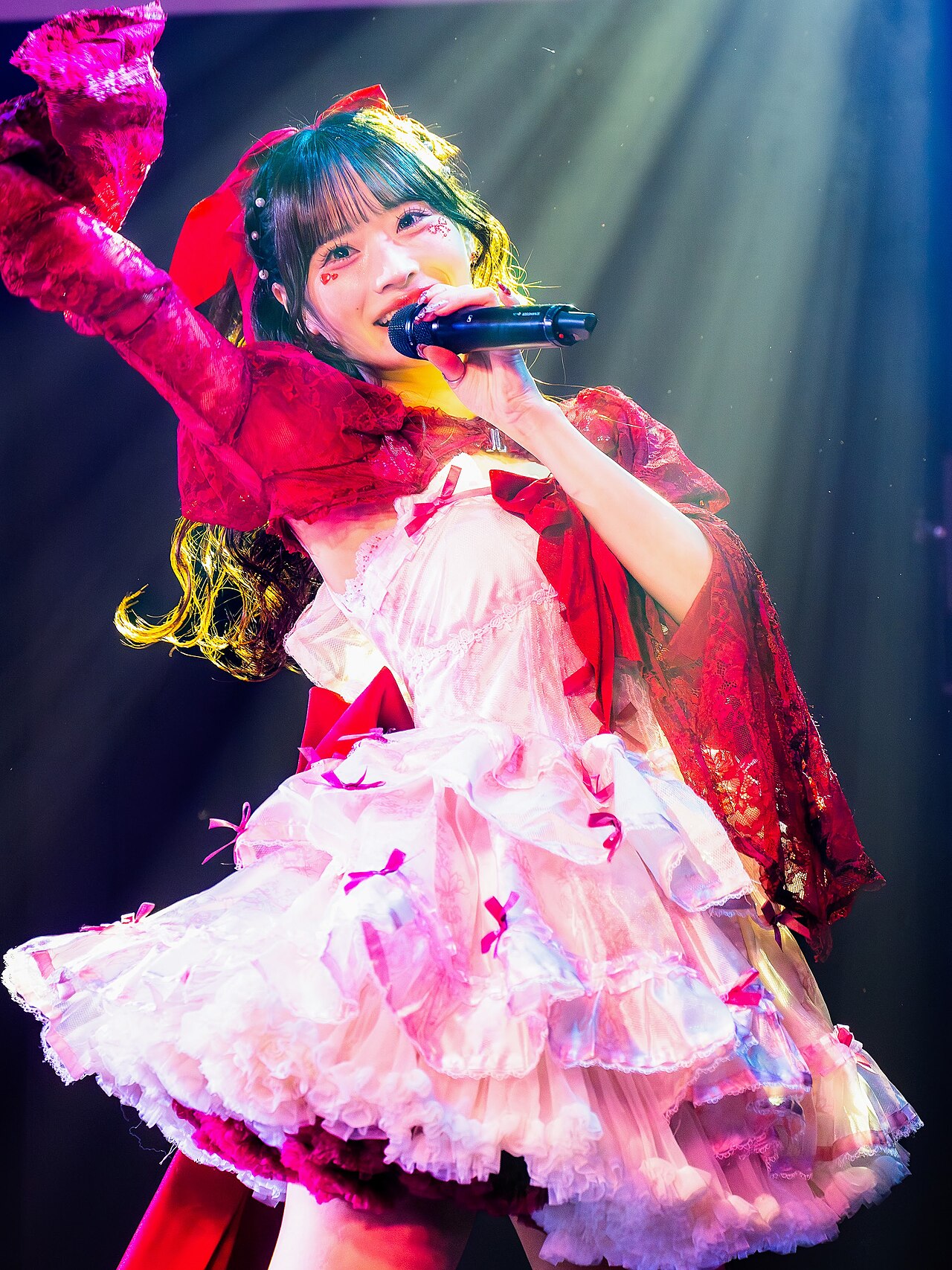
A Japanese idol performing at a birthday live event (2026). Photo: YUTO yahiko, CC BY-SA 4.0, via Wikimedia Commons.
Oshi Culture
Central to idol fandom is the concept of 推し (oshi, "the one you push/support"). Every fan typically designates one member as their oshi — the person they prioritize financially and emotionally. 応援 (cheering, support) is not passive; fans buy multiple copies of singles to cast votes, purchase tickets to handshake events, and follow an idol's every activity on social media.
The relationship is explicitly asymmetric: an idol performs devotion to fans collectively, while a fan devotes themselves to one idol personally. This asymmetry is part of the appeal — fans experience the warmth of connection without the reciprocal demands of a real relationship. See also the dedicated article on 推し.
Wota Culture
The word wota (ヲタ) is a corruption of otaku (オタク), used specifically for hardcore idol fans. Wota culture has its own rich subculture of fan practices:
Wotagei (ヲタ芸)
Wotagei (ヲタ芸) is the elaborate system of call-and-response choreography performed by fans during live shows. Far from passive watching, wota perform synchronized arm movements, wave cyalume light sticks, and deliver scripted chants called kooru (コール) at precise moments:
「オイ!オイ!〇〇最高!オイ!」 "Oi! Oi! [Name] is the best! Oi!"
The MIX (ミックス) is a famous chant sequence performed during instrumental breaks — a rhythmic crescendo building anticipation for the next vocal section. Specific call patterns are associated with individual songs, and learning them is a marker of dedicated fandom.
Fans also use colored light sticks whose colors are assigned to specific members — waving your oshi's color during a performance is a form of visible devotion.
Underground Idols (地下アイドル)
地下アイドル (chika aidoru, "underground idols") are performers operating entirely outside major agencies and mainstream media. They perform in small live houses — venues holding 50 to 500 people — where proximity to fans is even more intense than in the mainstream idol world.
The underground scene emphasizes:
- Physical closeness: fans and performers often mingle freely after shows
- Diversity of genre: many chika idols incorporate rock, metal, or electronic music
- Grassroots support: fans feel genuinely responsible for the idol's survival and 成長 (growth)
- Economic directness: merchandise and event tickets are the primary revenue, with no TV contracts
Groups like BiSH, PassCode, and Dempagumi.inc began in the underground scene before crossing into mainstream visibility. Akiba-kei (アキバ系) idols, based in Akihabara and rooted in otaku culture, are a distinct subtype of chika aidoru.
Virtual Idols and the VTuber Overlap
Japan has a long history of virtual idols dating back to the fictional singer Lynn Minmay from the 1982 anime Macross. The Vocaloid software character Hatsune Miku (初音ミク), launched in 2007, represents the most famous modern example: a synthesized 歌手 with no physical body who performs holographic concerts to thousands of fans waving light sticks.
Virtual YouTubers (VTuber) extend this tradition into live streaming. 声優 performers operate as anime-styled digital avatars, building fanbases through daily interaction — a model structurally identical to the idol system, but conducted entirely online. The same 推し dynamics, the same gifting culture (superchats replacing merchandise), and the same parasocial intensity apply.
The Dark Side of Idol Culture
Idol culture is widely criticized for the structural pressures it places on — predominantly young, female — performers.
The no-romance rule
Most idol contracts impose explicit or implicit bans on dating. The logic is commercial: an idol's appeal partly depends on fans' ability to project romantic fantasies onto her. A revealed relationship breaks that fantasy. In 2013, AKB48 member Minegishi Minami was demoted to trainee status and filmed a public apology video — shaving her own head — after tabloids reported she had spent the night at a male friend's apartment. The incident sparked international coverage and domestic criticism.
Graduation (卒業)
卒業 (sotsugyō, "graduation") is the euphemism used when an idol leaves a group. The graduation system frames departure as a natural, celebratory transition rather than a termination, softening the emotional impact on fans. Most idols "graduate" in their early-to-mid twenties, their careers having peaked during their teenage years.
Parasocial risk and financial exploitation
The handshake event economy creates conditions for intense parasocial attachment. Some fans spend extraordinary sums — documented cases involve hundreds of thousands of dollars over years — to accumulate meeting tickets and votes. The system is designed to monetize emotional intimacy, and the line between devoted ファン and vulnerable individual can be blurry.
Safety incidents have also occurred: in 2019, NGT48 member Yamaguchi Maho disclosed that fans had found her home address and attacked her — a case that exposed serious failures in idol management structures.
Idol Anime
Idol culture has generated a rich parallel world in fiction:
| Title | Tone | Focus |
|---|---|---|
| The Idolm@ster (アイドルマスター) | Earnest, aspirational | Producer-idol relationship; fan service |
| Love Live! (ラブライブ!) | Uplifting, friendship-focused | School idol group saving their school |
| Oshi no Ko (推しの子) | Dark social commentary | Industry exploitation, parasocial harm |
Oshi no Ko (2023–) is notable for directly critiquing the idol industry — addressing the no-romance rule, the financial exploitation of fans, and the psychological cost of performing artificial sincerity. It became one of the most-discussed anime of the 2020s internationally, introducing many non-Japanese viewers to the structural realities of idol culture.
Legacy and Global Influence
Japanese idol culture has proved enormously influential beyond Japan's borders. The K-pop industry — which dominates global pop conversation today — drew directly from the Japanese idol model: manufactured groups, heavy choreography, tiered fan clubs, merchandise ecosystems, and the parasocial architecture of fan devotion. Groups like BTS and BLACKPINK operate systems recognizable to anyone familiar with AKB48.
Within Japan, the idol industry remains one of the most resilient sectors of the 音楽 business, sustaining thousands of active performers across mainstream and underground scenes, and generating billions of yen annually in concerts, merchandise, and media.
Related Dictionary Words
performer (usu. in a boy band or girl group) with an image cultivated to foster a dedicated fan following; Japanese idol
being a fan of; being a supporter of; pushing for
handshake
graduation; completion (of a course)
aid; assistance; help; support; reinforcement
election
underground; below the ground
(telephone) call; ring (of a telephone)
growth; development; growing up; becoming an adult
music