カプセルホテル
kapuseru hoteruA uniquely Japanese form of budget accommodation where guests sleep in compact individual pods stacked in rows, originally designed for salarymen who missed the last train home.
Meaning
The カプセルホテル (capsule hotel) is a form of accommodation in which guests sleep inside individual rectangular pods — each roughly 2 metres long, 1 metre wide, and 1 metre tall — stacked two high in long rows. The word directly combines the English "capsule" with ホテル (hotel). Each pod contains a mattress, pillow, and small built-in amenities such as a reading light, power socket, mirror, and sometimes a small television or screen. Luggage and valuables are stored in a separate ロッカー room, and guests share communal bathrooms and shower facilities.
The experience is intentionally minimal: the capsule is a private sleeping space, not a room. Curtains or sliding shutters provide a degree of プライバシー, and the compact 空間 is designed to feel cosy rather than claustrophobic.
The Pods
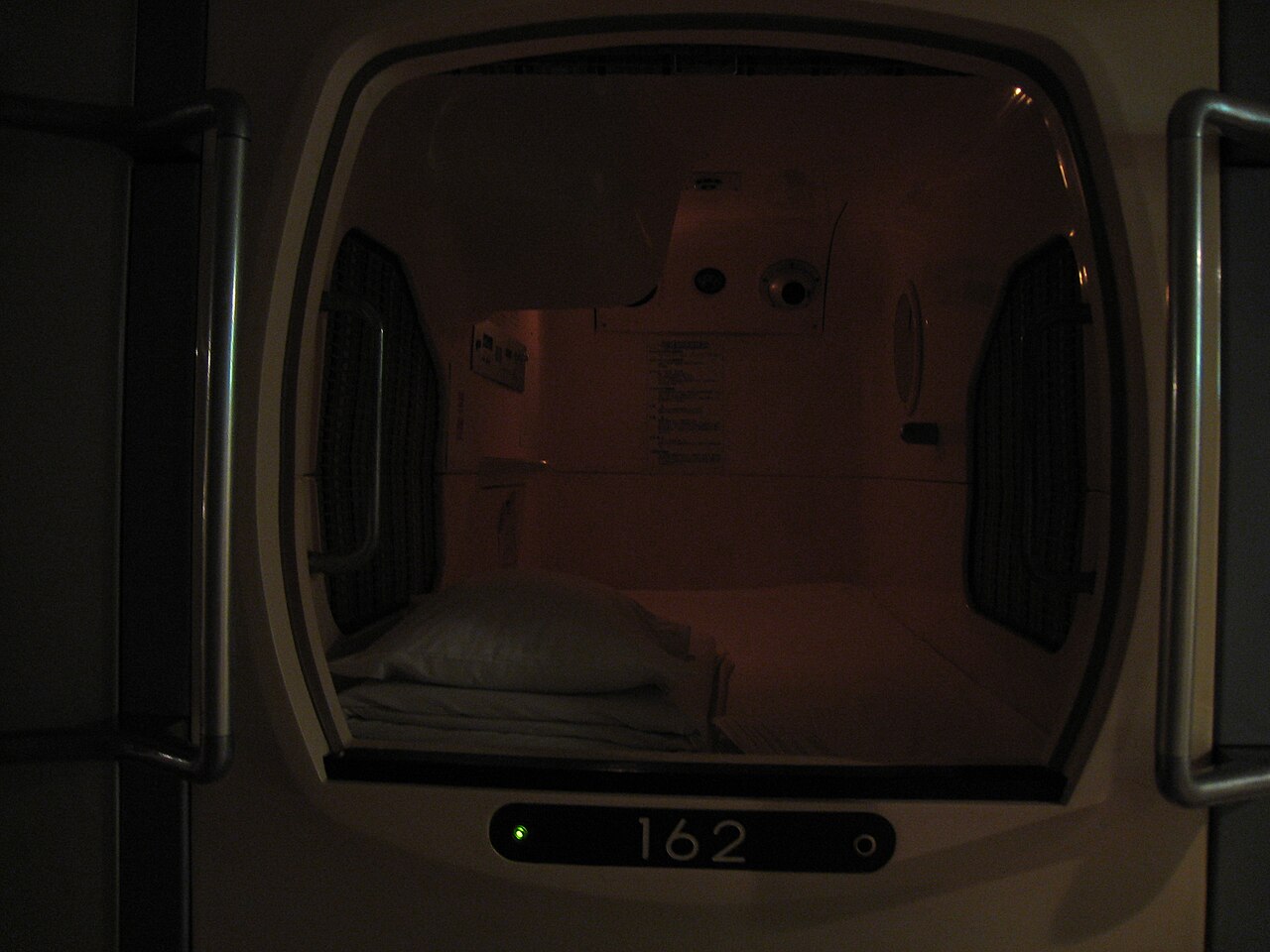
Interior rows of capsule pods in an Osaka hotel, 2007. Public domain (CC0), via Wikimedia Commons.
A standard capsule measures approximately 200 cm × 100 cm × 105 cm — large enough to sit up slightly, read, or watch a screen, but not to stand. The fiberglass or acrylic shell keeps sound reasonably contained, and blackout curtains help block corridor light during 睡眠. Modern capsules in upmarket properties may include USB ports, Bluetooth speakers, air-conditioning controls, and padded walls.
Origin and Cultural Context
The capsule hotel is both a product of Japanese urban ingenuity and a window into the country's working culture. The concept traces its roots to architect Kisho Kurokawa, a leading figure of the Metabolist architecture movement, who exhibited a "Residential Capsule" at the 1970 大阪 World Expo (Expo '70). Kurokawa envisioned modular, replaceable living units as the future of 都市 design.
The idea moved from architecture theory to hospitality in 1979, when Yukio Nakano — an Osaka sauna operator — commissioned Kurokawa to design a practical lodging facility near Umeda station. Nakano wanted somewhere for customers who had missed the 終電 (last train) to sleep properly rather than collapsing on a sauna bench. The resulting Capsule Inn Osaka opened on 1 February 1979 and is widely recognised as the world's first capsule hotel.
The timing was not accidental. Japan's high-growth economic era of the 1970s and 1980s produced the archetypal サラリーマン (salaryman) culture: office workers who routinely stayed late, entertained clients, and often missed the last commuter train home. Capsule hotels, clustered near major stations in 東京, Osaka, and other large cities, offered a clean, affordable solution — far more dignified than sleeping in a park or spending the night in a 24-hour fast-food restaurant.
Prices typically ranged from ¥2,000 to ¥4,500 per night, making them one of the most economical forms of 宿泊 in Japan. Many properties were (and some still are) attached to large communal bathhouses or sento-style 風呂 facilities, which became a social as well as practical amenity.
Evolution
Early capsule hotels catered almost exclusively to men, and many initially operated as men-only establishments. Through the 1990s and 2000s, properties began adding women-only floors, accessible by separate lifts and keycards. Today, fully mixed-gender and women-only capsule hotels are common, particularly in tourist-heavy districts.
The industry has diversified considerably:
| Type | Description |
|---|---|
| Business capsule | Traditional model near stations; minimal amenities, low cost |
| Luxury pod hotel | High-end capsules with designer interiors, lounge areas, quality bedding |
| Sauna & spa capsule | Attached to large communal bathing and sauna facilities |
| Theme capsule | Manga libraries, arcade lounges, co-working spaces on-site |
| Airport capsule | Located inside or adjacent to airports for layover passengers |
The concept has spread internationally, with capsule-style properties opening in Europe, Southeast Asia, and North America — though the Japanese originals remain distinctive for their integration with public bathing culture and the density and efficiency of their 設備.
Usage
Capsule hotels are most commonly used in the following situations:
- Missing the last train after work or a night out
- Budget 旅行 (travel), especially for solo travellers
- Stopovers between long-distance journeys
- A base during short city trips where most time is spent outside
Common phrases and expressions:
カプセルホテルに泊まるのは初めてです。 This is my first time staying in a capsule hotel.
終電を逃したので、近くのカプセルホテルを予約しました。 I missed the last train, so I booked a nearby capsule hotel.
カプセルは狭く見えるが、意外と快適だ。 The capsule looks cramped, but it's surprisingly comfortable.
In everyday speech, guests sometimes refer to the pods simply as カプセル (kapuseru) or the whole facility as カプホ (kapuho), a casual abbreviation.
Architectural Legacy
The capsule hotel is inseparable from the broader legacy of Metabolist 建築. Kisho Kurokawa's earlier Nakagin Capsule Tower (1972) in Tokyo — a landmark of the movement — applied the same modular-capsule philosophy to permanent residential architecture. Though the tower was demolished in 2022 after decades of controversy over its preservation, it remains an iconic reference point for the aesthetic and ideology behind capsule hotels.
The parallel between the two projects reveals something important: the capsule was never simply a budget travel hack. It was a serious architectural idea about how 日本's cities could accommodate large numbers of people efficiently, with each individual retaining a defined private envelope within a shared structure.
See Also
Related forms of budget or communal accommodation in Japan include the 漫画喫茶 (manga cafe), which offers private booths with internet access and is also frequently used as emergency overnight lodging. Hostels (ゲストハウス) and traditional 旅館 (ryokan) represent different points on the accommodation spectrum.