厨二病
chuunibyouA colloquial term for 'eighth-grader syndrome' — the adolescent phase of believing oneself to have special powers, a dark past, or a secret destiny, popularized online and by the KyoAni anime series.
Meaning
The word 厨二病 (ちゅうにびょう, chūnibyō) literally breaks down as 厨二 (chūni, short for 中学二年生 — second-year middle school student, roughly 13–14 years old) and 病 (byō, illness or syndrome). It is often translated into English as "eighth-grader syndrome" or "middle school second-year syndrome".
At its core, chūnibyō describes the developmental phase — or the embarrassing memory of it — in which a young person becomes convinced they are somehow special: that they possess hidden supernatural powers, carry a tragic secret past, or are destined for a fate beyond ordinary human understanding. Think elaborate origin stories, dramatic cloaks, bandaged arms containing dangerous energy, and cryptic diary entries in invented scripts.
The term is used both nostalgically ("I totally had chūnibyō in middle school") and as gentle mockery toward adults still exhibiting the behavior.
Types of Chūnibyō
Over time, Japanese internet culture codified three main flavors:
| Type | Japanese | Description |
|---|---|---|
| Dark chuuni | 邪気眼系 (じゃきがんけい) | The "evil eye" type — claims supernatural powers, wraps arms in bandages, adopts a brooding alter-ego |
| Subcultural chuuni | サブカル系 | Obsesses over underground music, art-house films, or obscure philosophy as markers of superior taste |
| Authority-rejecting chuuni | 社会否定系 | Lectures others about how society is corrupt and conventional people are "sheep" |
The dark chuuni (邪気眼系) is the archetype most recognized in anime and internet culture — the teenager who wraps their right arm in black bandages to suppress a fearsome power known only by a dramatic name like 「漆黒の翼」(the jet-black wings) or 「闇の炎を操る死神の力」(the shinigami power that controls dark flames).
Origin
The word was coined on January 11, 1999, by Hikaru Ijūin (伊集院光), a popular Japanese radio host, during his late-night TBS Radio program. While reflecting on his own adolescence on air, Ijūin joked that he was still suffering from chūnibyō, defining it loosely as "the things people normally do when they're a second-year middle schooler." The segment became a running listener call-in feature where people submitted their own embarrassing symptoms — pretending to like black コーヒー to seem mature, suddenly questioning why 学校 even teaches algebra, or searching intensely for a single "true" best friend.
The segment ended in March 1999, and the term remained obscure outside Ijūin's listener community for years.
Around 2005–2006, chūnibyō was rediscovered on 2channel (now 5channel), Japan's largest anonymous bulletin board. The tone shifted: rather than affectionate self-deprecation, it became a way to mock others' cringeworthy teenage grandiosity. The decisive moment came with a now-legendary post in which a user confessed to an elaborate middle school fantasy involving a secret third eye called the 邪気眼 (jakigan, "evil eye"), bandaged to contain its destructive power — inspired by the character Hiei from the manga Yu Yu Hakusho. The post went massively viral and became one of the most famous copypastas in Japanese internet history, permanently fusing chūnibyō with delusions of supernatural power.
Ijūin himself later remarked on Twitter that he had lost all interest in the word, since it had drifted so far from his original, warmer meaning.
In Popular Culture
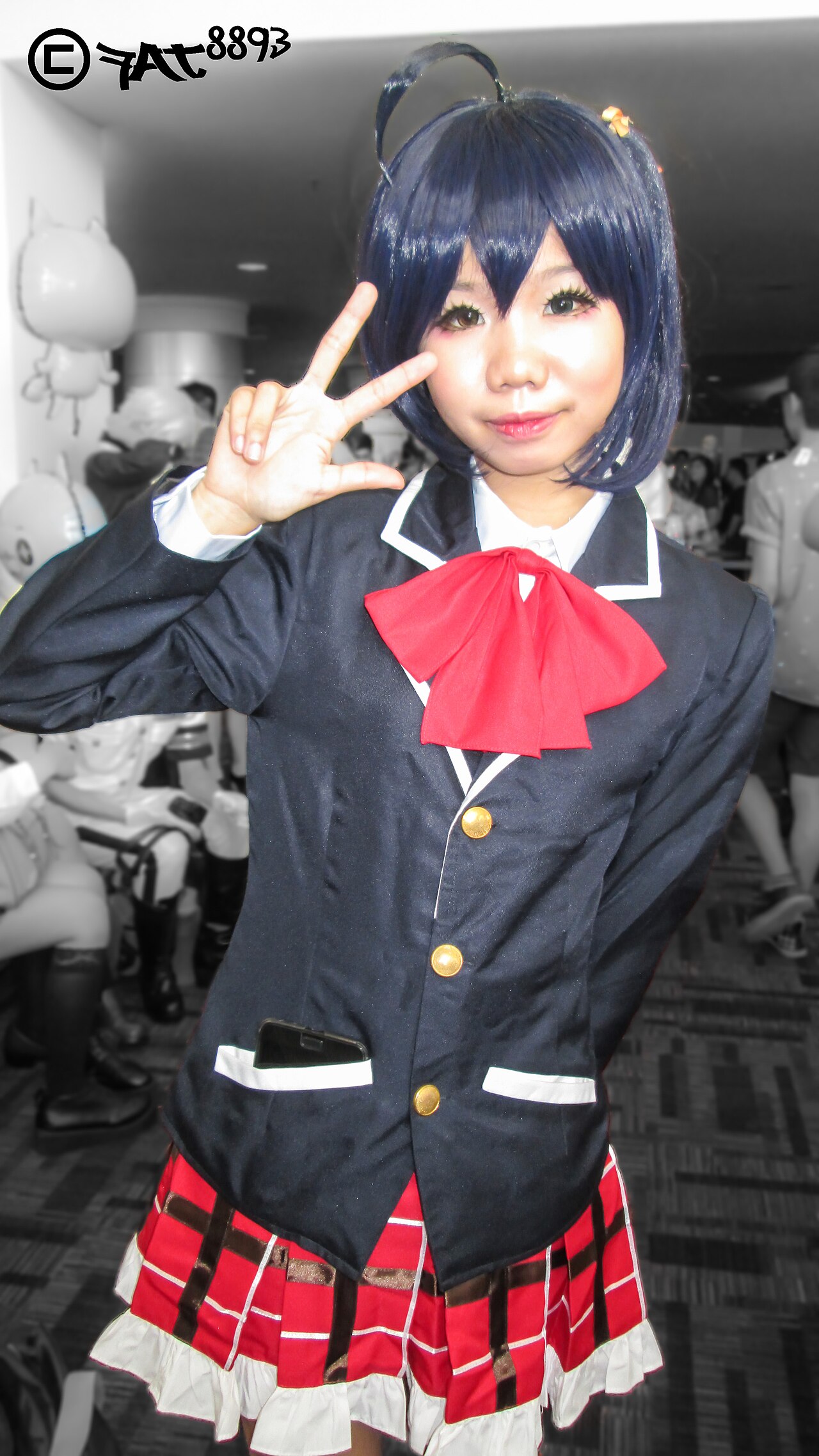
Cosplay of Rikka Takanashi, the iconic chūnibyō character from KyoAni's anime series. Photo: Farhan Ahmad Tajuddin, CC BY 2.0, via Wikimedia Commons.
The concept became globally known through Kyoto Animation's 2012 anime series 中二病でも恋がしたい! (Chūnibyō Demo Koi ga Shitai!, localized as Love, Chunibyo & Other Delusions!). The show follows Yuuta Togashi, a high school student desperate to leave his embarrassing chūnibyō past behind, who falls for Rikka Takanashi — a girl who has fully committed to living as a wielder of the "Wicked Eye" (邪王真眼). Rikka's signature eyepatch, dramatic proclamations, and elaborate battle poses made her one of the most recognizable anime characters of the decade.
The anime spawned a second season, a film, and merchandise, bringing the term to international audiences. For many non-Japanese fans, the KyoAni show is the introduction to the concept.
Beyond anime, chūnibyō surfaces across Japanese culture:
- Social media — Twitter and TikTok users post nostalgic "I had chūnibyō" confessions, often with childhood diary excerpts or drawings of invented runes.
- Games — Characters in JRPGs and visual novels frequently embody chūnibyō archetypes; the trope is common enough to be parodied within the genre itself.
- Light novels — The isekai and fantasy light novel genre is sometimes called "professional chūnibyō," as protagonists routinely possess unique powers and hidden destinies.
Cultural Significance
Chūnibyō occupies a warm-and-cringe space in Japanese cultural memory. Unlike purely negative social labels, it carries genuine affection — almost everyone recognizes their own past self in its symptoms. The word acknowledges that the gap between a child's inflated sense of destiny and adult reality is universal, not shameful.
At the same time, 厨二 is used critically. Describing a politician's speech or a corporation's branding as chūnibyō implies hollow grandiosity — big dramatic words hiding nothing of substance.
The term also reflects Japan's nuanced relationship with adolescence. The 思春期 (shishunki, adolescence) is widely understood as a turbulent identity-formation period, and chūnibyō provides a shared language for its most theatrical excesses — one that laughs with, not at, the teenagers who lived it.
Related Terms
- 厨一病 (chūichibyō) — First-year middle school syndrome; even younger, more innocent grandiosity
- 高二病 (kōnibyō) — Second-year high school syndrome; an older, more cynical variant involving philosophical nihilism and rejecting "normies"
- 邪気眼 (jakigan) — The "evil eye," the archetypal supernatural power claimed by dark-type chūnibyō sufferers
- 黒歴史 (kurorekishi, "black history") — Closely related; refers to embarrassing past deeds one wishes to erase, often chūnibyō-era diary entries or drawings