ガシャポン
gashaponIconic Japanese capsule toy vending machines named after the cranking sound (ガシャ) and the capsule dropping (ポン), dispensing small surprise collectibles for 100–500 yen.
Meaning
ガシャポン (gashapon) refers to the beloved Japanese capsule toy vending machines and the small toys they dispense. The name is pure onomatopoeia: ガシャ (gasha) captures the metallic cranking sound the machine makes as you turn the handle, and ポン (pon) mimics the satisfying thud of the plastic capsule dropping into the retrieval tray. Insert コイン, turn the handle, and a translucent plastic egg — containing a miniature figure, keychain, or trinket — pops out at random. That simple sensory sequence is the essence of the gashapon experience.
The term is a registered trademark of Bandai, though in common speech it is used interchangeably with ガチャポン (gachapon) and the shortened ガチャ (gacha).
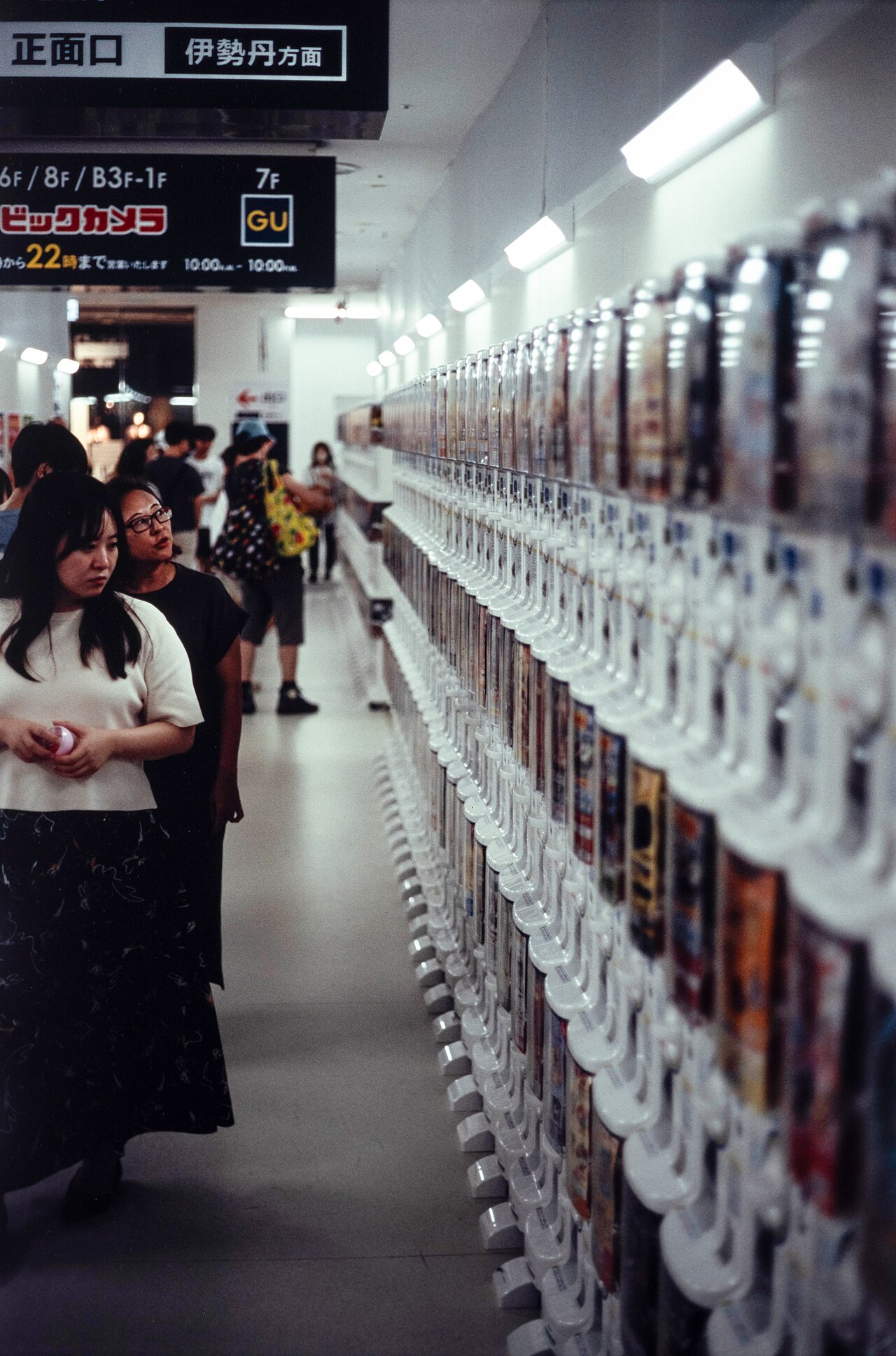
Rows of gashapon machines at BIC Camera, Shinjuku — a common sight in electronics and toy retailers across Japan. Photo: Itsmejames, CC BY 4.0, via Wikimedia Commons.
History
Capsule vending machines first appeared in the United States in the early 20th century, dispensing gum balls. Japan imported the concept in the 1960s, but it was Bandai that transformed it into a cultural institution. In 1977, Bandai launched its first gashapon machines under the ガシャポン brand, initially selling small rubber figures and tiny toys aimed at 子供.
The machines were an immediate hit. Their low price point — starting at just ¥100 — meant children could participate in the 楽しみ of collecting without significant pocket money. Through the 1980s and 1990s, capsule toy lines multiplied, licensing popular anime and tokusatsu characters. Quality steadily improved: what began as simple rubber figures evolved into detailed die-cast miniatures, articulated figures, and miniature food replicas of astonishing accuracy.
By the 2000s, コレクター culture had transformed gashapon from a children's pastime into an adult hobby. Premium lines priced at ¥300–¥500 targeted enthusiasts willing to spend serious money chasing a complete set.
The Experience
The ritual of gashapon is part of its appeal:
- Scan the display — each machine shows the full set of possible 商品 inside.
- Insert 硬貨 (¥100–¥500 depending on the series).
- Turn the large plastic handle clockwise.
- Listen for the ガシャ… ポン.
- Open the capsule and discover which variant you received.
The element of randomness — knowing what you might get but not which one — creates a small thrill even for adults. Getting a duplicate is common; trading spares with friends or strangers is a social ritual in itself. Online communities and swap meets exist specifically for gashapon trading.
ガシャポンをやってみたら、ダブってしまった。 I tried the gashapon and got a duplicate.
欲しいキャラクターが出るまで何回もやってしまった。 I ended up trying it over and over until I got the character I wanted.
Types of Gashapon
Modern gashapon コレクション cover an enormous range of themes:
| Category | Description |
|---|---|
| フィギュア (figures) | Articulated or static character figures, 5–10 cm tall |
| キーホルダー (keychains) | Character charms for bags and phone cases |
| ミニチュア食品 (miniature food) | Hyper-realistic tiny food replicas — sushi, ramen, convenience store snacks |
| 文房具 (stationery) | Tiny erasers, tape dispensers, and staplers that actually work |
| 動物 (animals) | Realistic wildlife figures, often used as teaching toys |
| コラボ (collaboration) | Licensed tie-ins with anime, games, sports teams, and brands |
| 地域限定 (regional limited) | Exclusive to specific cities or tourist spots |
The craftsmanship of high-end lines is remarkable. Some 自動販売機-dispensed figures rival the detail of purpose-built hobby model kits. Food replica sets, in particular, have become internationally celebrated for their uncanny accuracy.
Where to Find Them
Gashapon machines are woven into the fabric of Japanese daily life:
- Train stations and shopping malls: Banks of machines cluster near exits and escalators, catching commuters with spare コイン.
- Electronics retailers: Shops like Yodobashi Camera and BIC Camera line entire corridors with machines, especially in Shinjuku.
- Akihabara: The anime and electronics district has thousands of machines, many stocking anime and game character exclusives.
- Dedicated gashapon shops: Bandai operates the Gashapon Bandai Official Shop in Akihabara, which houses over 3,000 individual machines — widely regarded as the largest gashapon shop in the world. Similar dedicated shops have opened in Ikebukuro and other major districts.
- Amusement arcades: Game centers stock gashapon machines alongside UFO catchers.
- Tourist spots: Temples, theme parks, and scenic spots often carry 限定 regional editions.
Collector Culture
Gashapon collecting is a serious hobby for many Japanese adults. Complete sets in original capsules command premiums on platforms like Mercari and Yahoo! Auctions Japan. Limited collaboration series — for example, a tie-in with a newly released film — sell out within days and reappear at marked-up prices on the secondary market.
The 交換 culture is particularly active. It is common to see adults outside gashapon shops quietly holding up duplicate capsules, hoping to find someone with the complementary piece they need. Online swap threads on X use tags like #ガシャポン交換 to facilitate trades.
Certain designers and sculptors have developed cult followings. Fans seek out machines stocked with work by favourite sculptors the same way art collectors seek galleries.
Regional and Limited Editions
One driver of collector enthusiasm is regional 限定 exclusivity. Many series are tied to specific locations:
- Hokkaido editions feature local dairy mascots and bear imagery.
- Kyoto editions depict geisha, temples, and seasonal motifs.
- Okinawa editions carry tropical fish and shisa lion-dog figures.
- Collaboration editions tied to events appear for a few weeks only.
For tourists, a regional-exclusive gashapon is a portable, lightweight souvenir with a story attached — far more charming than a generic keychain from a gift shop.
From Physical Capsules to Digital Gacha
The gashapon machine directly inspired the digital gacha mechanic that now permeates mobile gaming worldwide. The psychological loop — pay a small amount, receive a ランダム reward, chase the rare item — maps almost exactly from the physical machine to the smartphone screen.
Japanese mobile game developers who grew up feeding ¥100 coins into gashapon machines understood intuitively how compulsive that loop could become. The digital version removes the physical constraint but retains the core dopamine structure. This lineage is why digital gacha is so often discussed in relation to its physical ancestor.
For a deep dive into the digital mechanic, see the ガチャ article.
Global Spread
Gashapon machines have spread well beyond Japan. Dedicated capsule toy machines — often branded as Gashapon or simply gacha machines — now appear in:
- North American and European toy stores and specialist anime shops
- Asian markets, particularly South Korea, Taiwan, Hong Kong, and Southeast Asia
- Dedicated capsule toy boutiques in major cities worldwide
Bandai opened international gashapon retail operations in several countries, and competitor brands export heavily. The machines have become shorthand globally for "Japanese toy culture" and appear regularly in travel content and social media as part of the Japanese tourism experience.
Cultural Significance
Beyond collecting, gashapon machines represent something deeper about Japanese consumer culture: the elevation of everyday 玩具 into objects worthy of craft, care, and community. The 驚き of not knowing what you will receive — and the slight disappointment or delight that follows — is a small but genuine emotional experience. In a culture that prizes kawaii aesthetics and quality miniaturisation, gashapon sits at a perfect intersection.
For many Japanese adults, gashapon carries nostalgia for childhood afternoons outside convenience stores, coins clutched in a fist. For international visitors, it is often the first hands-on encounter with a distinctly Japanese way of turning an ordinary vending transaction into a moment of anticipation and joy.
Related Dictionary Words
capsule
toy
collector
coin
limit; restriction
collection (of art, stamps, etc.); collecting
commodity; article of commerce; goods; stock; merchandise
vending machine
character; personality; disposition
exchange; interchange; switching; reciprocity; barter; substitution; replacement; clearing (of checks, cheques)
random