引きこもり
hikikomoriA Japanese term for severe and prolonged social withdrawal, in which individuals isolate themselves at home for six months or more, avoiding work, school, and outside contact.
Meaning
引きこもり literally combines two verbs: 引く (to pull back, to retreat) and 籠もる (to seclude oneself, to shut oneself in). Together the compound describes the act of withdrawing entirely into one's own space — and, by extension, the person who does so.
The Japanese Ministry of Health, Labour and Welfare defines hikikomori as a condition in which a person confines themselves to their 家 (home) or 部屋 (room), withdrawing from 社会 (society) — including school, work, and any meaningful outside contact — for a continuous period of six months or more. It is classified not as a single psychiatric disorder but as a psychosocial phenomenon, one that frequently co-occurs with depression, anxiety, autism spectrum traits, or other conditions without being reducible to any one of them.
Cultural Context
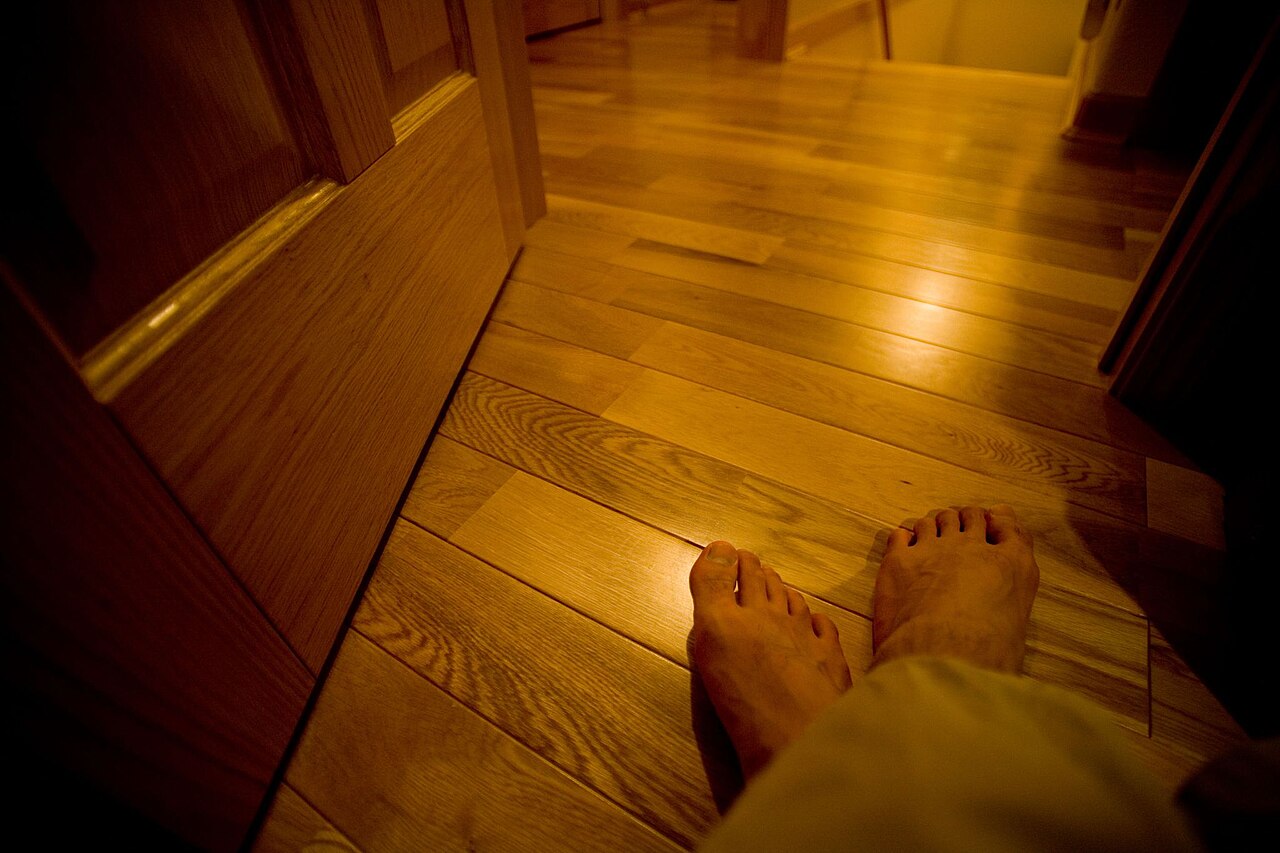
A room lit only by a screen at night — a recurring image of the hikikomori lifestyle. Photo: Hiroh Satoh, CC BY 2.0, via Wikimedia Commons.
The roots of hikikomori stretch back to the late 1970s and 1980s, when Japanese educators and psychologists began noticing a rising pattern of 不登校 (school refusal) among adolescents. By the mid-1990s the phenomenon had grown beyond the school-age population and attracted wider public attention. In 1998, psychiatrist Tamaki Saito (斎藤環) gave it its now-familiar name in his influential book 社会的ひきこもり (Shakai-teki Hikikomori — roughly, "Socially Withdrawn"). He framed it as a culturally shaped condition distinct from Western models of agoraphobia or mere introversion, and his work shaped how Japan — and eventually the world — talked about extreme withdrawal.
Japanese 社会 of that era placed enormous pressure on young people to follow a prescribed life course: excel academically, enter a good university, obtain stable corporate employment, and conform to group norms at every stage. Those who stumbled — through exam failure, workplace bullying (パワハラ), or simply feeling unable to meet expectations — sometimes found it easier to stop participating altogether than to face the shame of visible failure. Once withdrawn, the longer the absence the harder re-entry becomes, creating a self-reinforcing cycle.
The 青年 (young person) who becomes hikikomori is not lazy or merely antisocial in the casual sense. Many experience intense internal suffering, describe feeling like a burden, and desperately want connection while being unable to initiate it. The 孤立 (isolation) is often painful, not chosen as a lifestyle preference.
Prevalence and Demographics
A 2022 Cabinet Office survey estimated 1.46 million people in Japan live as hikikomori — roughly 2% of the working-age population across both the 15–39 and 40–64 age bands. Earlier surveys had put the number closer to 700,000–1 million; the rise partly reflects a broadened official definition that now includes older adults.
While the stereotype is a young man in his twenties playing video games, the reality is considerably more varied:
| Group | Notes |
|---|---|
| Young men (teens–30s) | Historically the most visible group; school or workplace failure is a common trigger |
| Middle-aged adults (40s–60s) | A growing cohort, sometimes called the 8050 problem — 80-year-old parents supporting 50-year-old children |
| Women | Underrepresented in official counts, possibly because female withdrawal is less visible or labelled differently |
The 8050 problem (八〇五〇問題) has become a social-policy concern in its own right: elderly parents who have quietly supported a withdrawn adult child for decades now face their own health decline, raising questions about what happens when the caregiver is gone.
Causes and Contributing Factors
No single cause explains hikikomori. Research points to a combination of individual, family, and societal factors:
- Academic pressure and entrance-exam culture — failure at a critical gateway can feel permanent and shameful
- Workplace bullying and karoshi culture — the same pressure continues into employment
- Family dynamics — overprotective parenting, high parental expectations, or domestic conflict
- 精神 health comorbidities — depression, social anxiety, autism spectrum traits, and OCD are common, though they do not fully account for withdrawal
- Internet and digital media — not a cause in itself, but online spaces can meet basic social and entertainment needs enough to sustain withdrawal indefinitely
- Cultural shame (恥, haji) — re-entering society after absence means explaining where one has been, a prospect many find unbearable
Support and Recovery
支援 (support) structures have grown considerably since the early 2000s. The Japanese government established a formal network of Regional Support Centers for Hikikomori (ひきこもり地域支援センター) in 2009, and by 2018 this had expanded to 85 prefectural-level centres.
Recovery approaches vary, but common elements include:
- Outreach visits (訪問支援) — counsellors or trained peers visit the individual at home rather than requiring them to leave
- Intermediate spaces — drop-in day centres and cafe-style spaces (居場所, ibasho) offer low-pressure social contact
- Peer support — former hikikomori who have re-engaged with society serve as relatable mentors
- Family therapy — since parents often inadvertently sustain the withdrawal pattern, family guidance is central
- Gradual reintegration — simulated work environments and part-time volunteering ease the transition
Importantly, 回復 (recovery) is not defined as returning to the exact life path abandoned — for many, that path was the source of the problem. A sustainable outcome may look quite different from conventional employment and social participation.
Global Recognition
Hikikomori was long considered a uniquely Japanese phenomenon, attributed to Japan's specific cultural pressures. That view has softened. Comparable patterns have been documented in South Korea, China, Taiwan, Italy, France, Spain, and the United States. In 2023 the World Health Organization's ICD-11 introduced a related category of "problems associated with social withdrawal," legitimising international study.
The COVID-19 pandemic prompted renewed attention: lockdown measures blurred the line between enforced and voluntary isolation, and researchers noted both the normalisation of home confinement and, for some existing hikikomori, a paradoxical sense of relief that the outside world had finally caught up with them.
In Popular Culture
Hikikomori has become a recognisable character type in manga, anime, and light novels — sometimes played for comedy, more often as a window into real distress:
- Welcome to the N.H.K. (NHK にようこそ!, 2002 novel; 2006 anime) — the most celebrated portrayal, following a young man convinced a conspiracy is keeping him shut in
- The Tatami Galaxy (四畳半神話大系, 2008 novel; 2010 anime) — explores social avoidance through a magical-realist lens
- Watamote (私がモテないのはどう考えてもお前らが悪い!, 2011 manga) — a socially paralysed high school girl whose internal monologue is painfully recognisable
These works have helped destigmatise conversation about withdrawal both inside Japan and internationally, and are frequently cited by people who identify with the experience.
Related Terms
| Term | Reading | Meaning |
|---|---|---|
| 社会的引きこもり | しゃかいてきひきこもり | shakai-teki hikikomori — the full formal term emphasising social dimension |
| 不登校 | ふとうこう | school non-attendance; often a precursor |
| ニート | にーと | NEET (Not in Education, Employment, or Training); overlapping but distinct |
| 孤独死 | こどくし | dying alone, unnoticed — a feared endpoint for ageing hikikomori |
| 居場所 | いばしょ | a place where one belongs; used for support spaces |
| 8050問題 | はちまるごまるもんだい | the 8050 problem — elderly parents supporting middle-aged withdrawn children |