葛飾北斎
Katsushika HokusaiThe Edo-period ukiyo-e master behind "The Great Wave off Kanagawa," whose woodblock prints reshaped both Japanese art and 19th-century European painting.
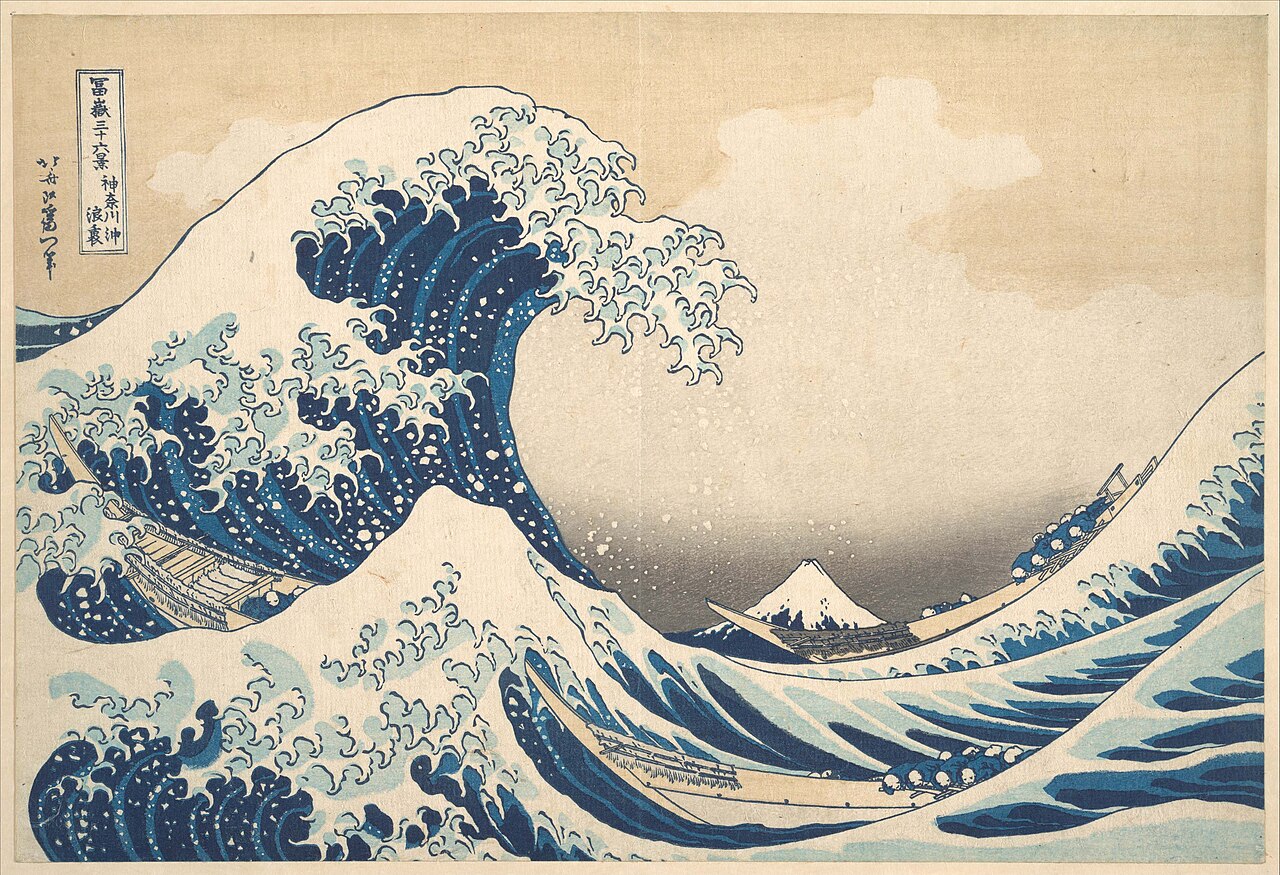
"Under the Wave off Kanagawa" (神奈川沖浪裏), better known as The Great Wave, from Hokusai's series Thirty-six Views of Mount Fuji, c. 1831. Public domain, via Wikimedia Commons / Metropolitan Museum of Art.
Katsushika Hokusai (葛飾北斎, 1760–1849) was a 浮世絵 (ukiyo-e, "pictures of the floating world") 画家 and 絵師 of the late Edo period whose woodblock prints are today among the most recognized images on Earth. His 1831 print The Great Wave off Kanagawa — one panel in the series Thirty-six Views of Mount Fuji (冨嶽三十六景, 富嶽三十六景) — turned a commercial 錦絵 (multi-color print) into a global icon of Japanese art, reproduced on everything from museum walls to emoji keyboards.
Meaning
Hokusai was born in 1760 in the Katsushika district of 江戸 (modern Tokyo) and worked for roughly seven decades, producing an estimated 30,000 works across painting, 木版画 (woodblock prints), sketches, and illustrated books. He is inseparable from two things: the wave, and the mountain.
The Great Wave depicts a towering, claw-like swell threatening three fishing boats, with the small, snow-capped peak of 富士山 (Mount Fuji) visible in the background — a composition that makes the sacred mountain look almost fragile against the raw power of the sea. It was one print among 46 in the Thirty-six Views of Mount Fuji series (Hokusai added ten more views after the original 36 proved popular), all obsessively built around a single subject viewed from different places, seasons, and weather conditions. Fuji, for Hokusai, was not just scenery — in the Edo period it carried religious significance as an object of pilgrimage and a belief that climbing or even viewing it could grant longevity, a fitting fixation for an artist increasingly preoccupied with his own mortality and mastery.
Hokusai is equally famous for constantly renaming himself. Japanese artists of the era often took a professional 雅号 (art-name), but Hokusai treated his like a wardrobe, adopting more than 30 different pseudonyms over his career — including Shunrō, Sōri, Kakō, Taito, Iitsu, and finally Gakyō Rōjin Manji (画狂老人卍, "Old Man Mad About Painting"), each name change often marking a shift in style or a new phase of study.
Usage
In Japanese art history and museum contexts, Hokusai's name and works come up constantly as reference points:
北斎の「神奈川沖浪裏」は世界で最も有名な日本の絵画の一つです。 Hokusai no "Kanagawa oki nami ura" wa sekai de mottomo yūmei na Nihon no kaiga no hitotsu desu. "Hokusai's 'The Great Wave off Kanagawa' is one of the most famous Japanese paintings in the world."
北斎は生涯に三万点以上の作品を残したと言われている。 Hokusai wa shōgai ni sanman-ten ijō no sakuhin o nokoshita to iwarete iru. "Hokusai is said to have left behind more than 30,000 works in his lifetime."
The phrase 冨嶽三十六景 (Fugaku Sanjūrokkei, "Thirty-six Views of Mount Fuji") is used as shorthand for the whole series, while ザ・グレート・ウェーブ ("The Great Wave") or 神奈川沖浪裏 refers specifically to the single most famous print within it — a distinction worth knowing since casual references sometimes conflate the two.
Cultural Context
Ukiyo-e prints were mass-produced, affordable art for ordinary Edo-period city dwellers — closer to posters or postcards than fine-art paintings, sold for roughly the price of a bowl of noodles. Producing one required a team: an artist (like Hokusai) supplied the design, a carver cut the 版画 woodblocks (one per color), and a printer applied ink and pressed paper by hand, layer by layer. This division of labor let a single popular design be printed in the thousands, which is part of why so many original impressions of the Great Wave survive today in museums worldwide, including the Metropolitan Museum of Art, the British Museum, and the Tokyo National Museum.
The Great Wave's international reach began almost by accident. In the 1850s and 60s, Japanese prints started arriving in Europe partly as packing material protecting ceramics for export — and European artists were electrified by what they found. This sparked Japonisme, a wave of enthusiasm for Japanese aesthetics that swept French Impressionist and Post-Impressionist circles. Vincent van Gogh collected ukiyo-e prints and copied several directly; Claude Monet owned a copy of the Great Wave and hung it in his home at Giverny; Claude Debussy is said to have kept the print near his desk while composing the orchestral work La Mer, and later used it on the cover of the score. Hokusai's flattened perspective, bold outlines, and asymmetric compositions influenced how an entire generation of Western painters thought about color, space, and everyday subject matter.
Hokusai himself was famously restless about his own progress. Late in life he wrote a passage — often quoted as his artistic testament — explaining that nothing he had drawn before the age of 70 was worth taking seriously, and that:
百歳になれば、良い意味で神業に達するだろう。 Hyaku-sai ni nareba, yoi imi de kamiwaza ni tassuru darō. "If I reach the age of 100, I will surely have attained a divine level [of mastery], in the good sense of the word."
He asked, essentially, for more time — reportedly saying that if Heaven granted him five more years, he could become a "true painter." He died in 1849 at age 88, working almost until the end.
Legacy Today
Hokusai's influence is everywhere in contemporary visual culture, often without viewers realizing the source. The swirling, cresting wave shape recurs in logos, phone cases, murals, and tattoos worldwide; in 2017 Unicode even modeled the 🌊 water-wave emoji's silhouette on it. Museums regularly mount blockbuster Hokusai retrospectives, and Thirty-six Views of Mount Fuji prints remain among the best-selling art reproductions globally. His late-career obsession with pushing technical mastery further — chasing an ideal he believed was still just out of reach at 88 — has also made him a recurring symbol, in Japan and abroad, for lifelong dedication to craft over quick success.
Related Terms
| Term | Reading | Meaning |
|---|---|---|
| 浮世絵 | ukiyo-e | The woodblock print art style Hokusai worked in |
| 錦絵 | nishiki-e | Multi-color "brocade picture" print technique |
| 富嶽三十六景 | Fugaku Sanjūrokkei | "Thirty-six Views of Mount Fuji," his best-known series |
| 画狂老人 | Gakyō Rōjin | "Old man mad about painting," one of Hokusai's late pseudonyms |
| ジャポニスム | Japonisme | The 19th-century European craze for Japanese art that Hokusai helped ignite |
Related Dictionary Words
ukiyo-e; ukiyoe; Edo-period woodblock print
woodblock print; woodcut; woodprint
Mount Fuji; Mt. Fuji; Fujiyama; Fuji-san
wave; billow; ripple; breaker; swell
painter; artist
Edo (shogunate capital; former name of Tokyo); Yedo
Edo period (1603-1868)
woodcut; woodblock print; art print
painter; artist
alias; pseudonym; pen name; nom de plume
Thirty-six Views of Mount Fuji (woodblock prints by Katsushika Hokusai)
nishiki-e; multi-colour woodblock print