浮世絵
ukiyo-eA genre of traditional Japanese woodblock prints and paintings produced during the Edo period, depicting everyday life, landscapes, beautiful women, kabuki actors, and nature.
Meaning
浮世絵 literally means "pictures of the floating world." The term combines 浮世 (ukiyo, floating world) — a Buddhist concept referencing the transience and pleasures of earthly life — with 絵 (e, picture or painting). During the 江戸 period (1603–1868), the word ukiyo shed its melancholic Buddhist undertones and came to celebrate the vibrant, pleasure-seeking urban culture of cities like Edo (modern-day Tokyo), Osaka, and Kyoto.
浮世絵 were primarily 版画 (woodblock prints), though paintings also existed. Their affordable price made them accessible to the merchant class, spreading 文化 and 芸術 beyond the aristocracy for the first time in Japanese history.
The Woodblock Printing Process
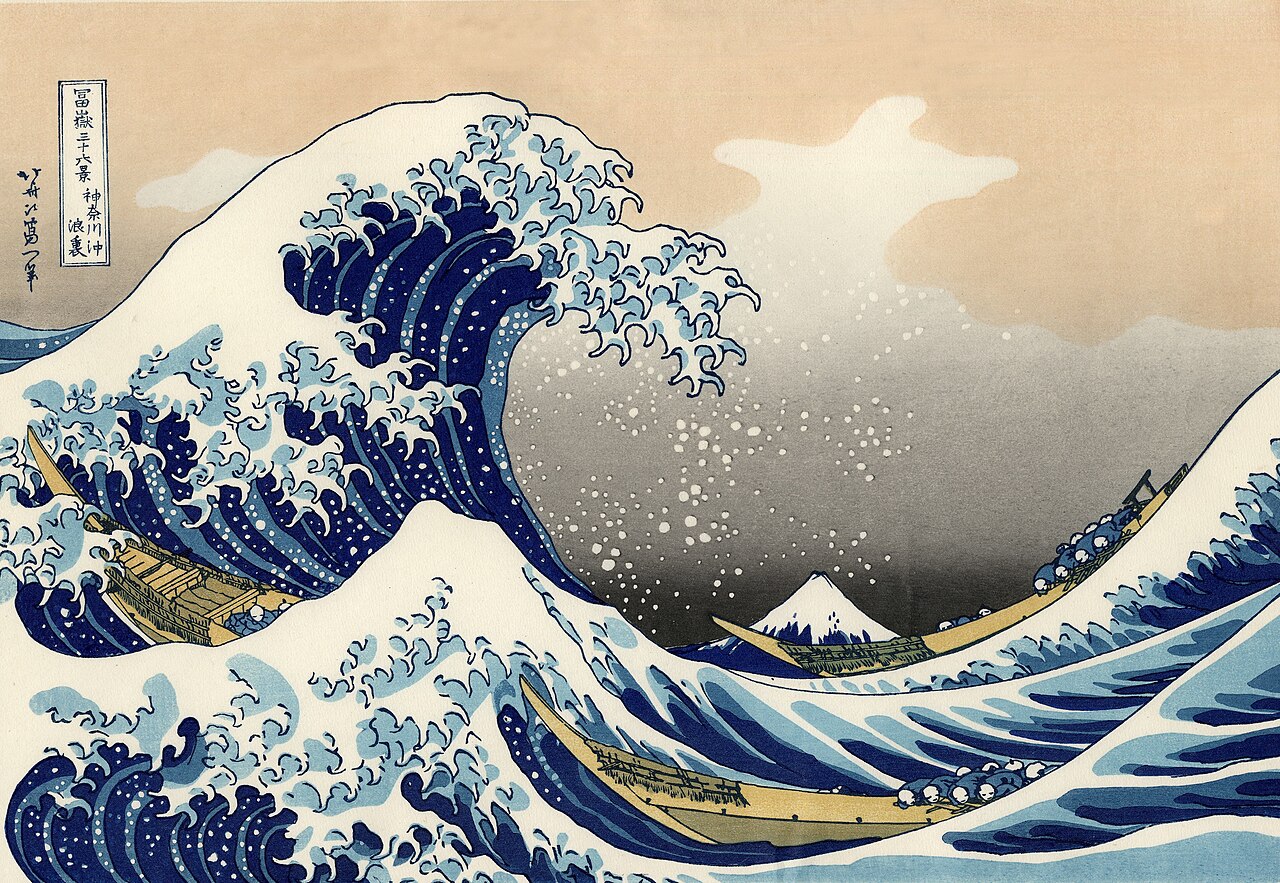
The Great Wave off Kanagawa (神奈川沖浪裏, Kanagawa-oki Nami Ura) by Katsushika Hokusai, c. 1831. Public domain, via Wikimedia Commons.
Creating a single 木版画 (woodblock print) required a collaborative chain of skilled 職人 (craftsmen):
- 絵師 (えし, eshi) — The 絵師, or artist/painter, produced the original design on thin paper called hanshita (版下).
- 彫師 (ほりし, horishi) — The carver transferred the design onto cherry-wood blocks, carving a separate block for each color.
- 摺師 (すりし, surishi) — The printer applied pigments to the blocks and pressed paper against them with perfect registration (合わせ, awase) to build up the layered image.
- 版元 (はんもと, hanmoto) — The 出版 house (publisher) commissioned, distributed, and sold the finished prints.
Early ukiyo-e were monochrome (sumizuri-e, 墨摺り絵). By the 1760s, full multicolor 印刷 (nishiki-e, 錦絵, "brocade pictures") had been perfected, enabling the rich palettes that define the art form.
Major Themes
Ukiyo-e artists depicted the pleasures and spectacles of Edo-period urban life across several distinct genres:
| Genre | Japanese | Subject |
|---|---|---|
| 美人画 | びじんが | 美人 (beautiful women), courtesans, and geisha |
| 役者絵 | やくしゃえ | 歌舞伎 actors in dramatic poses |
| 風景画 | ふうけいが | 風景 (landscapes) and travel scenes |
| 相撲絵 | すもうえ | Sumo wrestlers |
| 春画 | しゅんが | Erotic art (a significant and commercially important category) |
| 花鳥画 | かちょうが | Flowers, birds, and 自然 |
The Great Masters
The Edo period produced several artists whose work remains among the most recognized in the world:
葛飾北斎 (Katsushika Hokusai, 1760–1849) is best known for his series Thirty-Six Views of Mount Fuji (富嶽三十六景, Fugaku Sanjurokkei), which includes The Great Wave off Kanagawa (神奈川沖浪裏). Hokusai worked prolifically into his eighties and reportedly said he wished to live to 110 so that "every dot and every line" he drew would be alive.
歌川広重 (Utagawa Hiroshige, 1797–1858) mastered atmospheric landscapes, particularly The Fifty-Three Stations of the Tokaido (東海道五十三次). His use of rain, mist, and 色 gradations influenced the French Impressionists deeply.
喜多川歌麿 (Kitagawa Utamaro, c. 1753–1806) elevated bijin-ga (美人画) to psychological depth, rendering women's faces and emotions with unprecedented intimacy.
東洲斎写楽 (Toshusai Sharaku, active 1794–1795) produced around 140 bold actor portraits (yakusha-e) in just ten months before vanishing entirely — his identity remains one of art history's great mysteries.
Cultural Context
Ukiyo-e flourished during the 時代 when Japan was under the Tokugawa shogunate's strict social hierarchy. The merchant class (chonin, 町人), officially ranked below farmers despite their wealth, channeled their money and energy into urban entertainment — the theater, teahouses, and the pleasure districts. Ukiyo-e were both the souvenir and the advertisement of this world.
Prints typically sold for the price of a bowl of noodles, making them the mass media of their era. Publishers competed fiercely, and censorship from the shogunate periodically targeted politically sensitive or overly erotic content.
The isolation of the Edo period meant ukiyo-e developed in a distinctly 日本 aesthetic direction: flat planes of color, bold outlines, unusual cropping, and a concern for ma (間, negative space) that would later astonish European eyes.
Influence on Western Art — Japonisme
When Japan reopened to trade in the 1850s, ukiyo-e prints flooded into Europe, often as packing material for porcelain. European artists were transfixed. The movement they sparked, Japonisme (ジャポニスム), reshaped modern Western art:
- Claude Monet collected over 200 Japanese prints and built his famous garden at Giverny in part as a living ukiyo-e landscape to paint.
- Vincent van Gogh copied Hiroshige prints in oil paint and wrote that Japanese art showed "a calm and quiet simplicity" he longed to achieve.
- Edgar Degas adopted ukiyo-e's bold cropping and off-center compositions for his ballet scenes.
- Henri de Toulouse-Lautrec drew direct inspiration for his poster art from Utamaro's flowing outlines.
The influence ran the other direction too: later Meiji-era Japanese artists absorbed Western oil painting and perspective, blending the two traditions.
Legacy and Modern Revival
Ukiyo-e is recognized today as one of 日本's greatest contributions to world 芸術. Hokusai's Great Wave is arguably the most reproduced artwork in human history.
The 伝統 craft of woodblock printing (moku hanga, 木版画) is still practiced by living artists worldwide. Contemporary Japanese artists regularly revisit ukiyo-e themes, rendering manga characters, pop icons, and cityscapes in the classical style — a genre sometimes called neo-ukiyo-e (ネオ浮世絵).
Museums worldwide — the Metropolitan Museum of Art, the British Museum, the Art Institute of Chicago — hold extensive ukiyo-e collections, and high-resolution digital archives have made these prints more accessible than ever.
浮世絵は、江戸時代の庶民文化を今に伝える貴重な芸術である。 (Ukiyo-e wa, Edo jidai no shomin bunka wo ima ni tsutaeru kicho na bijutsu de aru.) Ukiyo-e is a precious art that conveys the popular culture of the Edo period to the present day.
Related Dictionary Words
ukiyo-e; ukiyoe; Edo-period woodblock print
woodblock print; woodcut; woodprint
woodcut; woodblock print; art print
painter; artist
Edo (shogunate capital; former name of Tokyo); Yedo
kabuki; traditional form of drama and music performed by male actors wearing makeup mainly in white and red
beautiful woman; (a) beauty; belle; good-looker
scenery; scene; landscape; view; sight
art; the arts
tradition; convention