自動販売機
jidou hanbaikiJapan's ubiquitous vending machines, or jihanki, sell everything from hot and cold drinks side by side to ice cream and hot food, and are famous worldwide for their density, reliability, and occasional strangeness.
Meaning
自動販売機(じどうはんばいき, jidou hanbaiki)literally means "automatic selling machine" — a vending machine. In everyday speech it's almost always shortened to 自販機 (jihanki), and drink machines specifically are sometimes called 自動販売機 or, more casually, just 販売機. Whatever the label, the word points to one of the most recognizable pieces of Japanese street furniture: a brightly lit box, usually red or blue, standing on a sidewalk, outside a house, at a train platform, or halfway up a mountain trail, ready to dispense a 缶コーヒー or a bottle of お茶 at any hour of the day or night.
What makes the jihanki a genuine cultural phenomenon rather than just street equipment is the sheer scale and normalcy of it. Japan has roughly one vending machine for every 23 people — around 5 million machines nationwide, one of the highest densities per capita anywhere in the world. They cluster especially thickly in cities but turn up in the most unexpected rural, coastal, and mountain locations too, wired to the grid wherever there's a road.
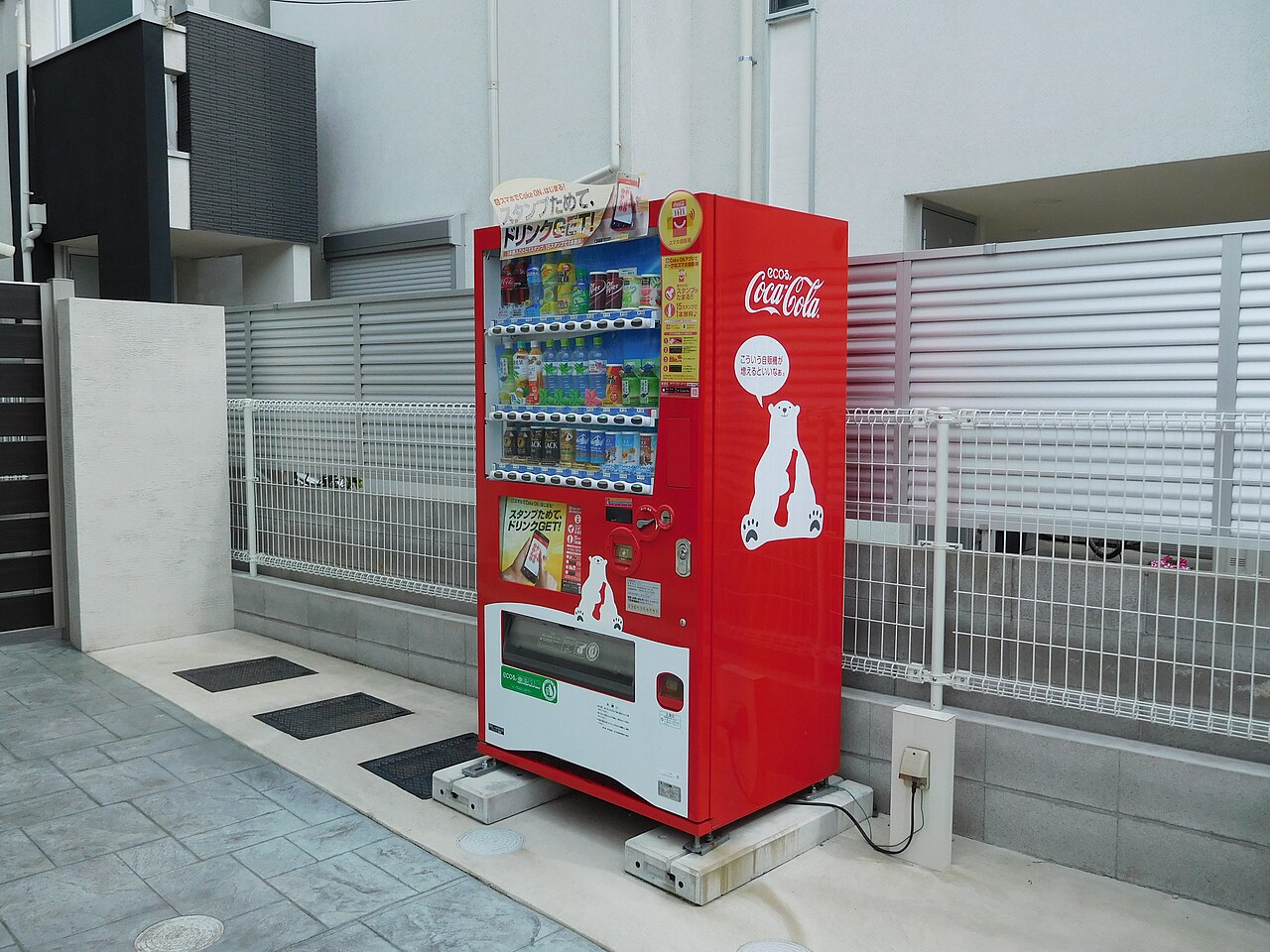
A typical roadside drink vending machine in Kita-ku, Tokyo. Photo: Vasconium, CC BY-SA 3.0, via Wikimedia Commons.
Hot and Cold, Side by Side
The single most distinctive feature of a Japanese drink machine is that it sells both hot (ホット) and cold (冷たい / コールド) drinks from the same unit — usually marked with a red label for hot items and a blue label for cold ones on the same row of buttons. Internally the machine is divided into heated and refrigerated compartments, so a can of hot black coffee and an ice-cold sports drink can sit in adjacent slots. This is largely unheard of outside Japan, where vending machines are almost always cold-only.
The hot compartment is switched on seasonally (roughly October to April, brand and region depending), which is why a can of coffee that felt scalding-hot in January comes out merely cool by June. 缶コーヒー — canned coffee, an industry pioneered in Japan and popularized nationwide by companies like サントリー (BOSS), UCC, and Coca-Cola's Georgia brand — is the quintessential jihanki purchase: cheap, always available, and, in winter, comfortingly 暖かい in the hand on a cold commute.
「寒いから、あったかい缶コーヒー買おう。」 "It's cold, so let's buy a hot canned coffee."
What's Sold
While drinks dominate — soda, tea, お茶, bottled water, energy drinks, and canned coffee make up the bulk of Japan's roughly 2.2 million beverage machines — vending machines here sell a startling range of other things too:
| Category | Examples |
|---|---|
| Hot food | Instant ramen, hot canned soup, French fries, hot dogs, even whole hamburgers dispensed and heated on the spot |
| Frozen treats | Ice cream, popsicles, frozen fruit |
| Snacks & light meals | Bread, rice balls, bananas, boiled eggs |
| Alcohol & tobacco | Beer and sake (increasingly rare, age-verification required), cigarettes (ID-card locked) |
| Novelty items | Batteries, umbrellas, neckties, fortunes (おみくじ), gachapon capsule toys, and — in a handful of famous tourist-photo cases — things like canned bread or novelty souvenirs |
Most of these oddities are outliers rather than the everyday norm — the vast majority of machines simply sell drinks — but their existence is documented widely enough that "weird Japanese vending machines" has become its own small genre of travel writing and YouTube content, reinforcing the country's reputation for vending-machine ubiquity and ingenuity.
Cashless Payment
Modern jihanki accept far more than coins and small bills. Most machines in cities now read 電子マネー (electronic money) IC cards like Suica, Pasmo, and ICOCA — the same rechargeable transit cards used on trains and buses — letting a commuter tap a card instead of fumbling for 小銭 (loose change). Many newer machines also accept QR-code mobile payment apps and contactless credit cards. Even so, a huge number of older or rural machines remain 現金-only, taking 硬貨 and small notes, which is one reason Japan's shift to a fully cashless society has been slower than in some other developed countries — the vending machine fleet is simply too large to replace overnight.
Reliability, Trust, and Disaster Preparedness
Outdoor machines loaded with cash and merchandise, sitting unattended on public streets 24 hours a day, work in Japan because of a broader cultural expectation of low street crime and low vandalism. Vending machine theft and damage do happen, but at rates dramatically lower than in many countries with comparable machine density — low enough that operators can profitably run machines in isolated spots (rural roadsides, mountain trailheads, quiet residential streets) that would be considered too high-risk elsewhere.
Vending machines also quietly function as small pieces of disaster infrastructure. Many beverage-company machines are fitted with battery backup and a manual release mechanism: during a 停電 (power outage) or 災害 such as an earthquake, these machines can be switched by the operator, or in some cases automatically, into free-vend mode, dispensing drinks without payment to people who need water in an emergency. Companies including Coca-Cola Japan, Suntory, and Ito En operate networks of these "disaster-response vending machines" (災害対応自動販売機), especially near evacuation shelters and along major roads, as part of local-government disaster-preparedness agreements.
Role in Daily Life
Because they're everywhere, jihanki function as an ambient utility rather than a special errand — closer to a public tap than a shop. A hot canned coffee before catching the first train, a cold barley tea pulled from a machine between summer errands, a quick drink bought from the machine outside a コンビニ rather than going inside: for most Japanese people this barely registers as a purchase decision. Convenience stores (コンビニ) offer similar around-the-clock convenience with a much larger selection, but they require walking in, browsing, and standing in line; a vending machine is faster — insert payment, press a button, and the drink drops in seconds, with no interaction required at all. That combination of density, reliability, and near-total anonymity of transaction is what makes the jihanki feel like such distinctly Japanese everyday infrastructure, even though automated selling technology exists worldwide.
Variations and Related Terms
- 自販機 (jihanki) — the everyday abbreviation used in casual speech; 自動販売機 is the full, more formal term seen on signage and in news reports.
- 券売機 (kenbaiki) — ticket-vending machines, a related but distinct category used for train tickets and for ordering at counter-service restaurants (ramen shops in particular often use a 券売機 at the entrance instead of a waiter taking the order).
- ガチャガチャ / ガチャポン (gachagacha / gachapon) — capsule-toy vending machines, a beloved sub-category in their own right, common outside toy shops, arcades, and stations.
- 災害対応自動販売機 — "disaster-response vending machines," the free-vend-capable emergency machines described above.
Related Dictionary Words
vending machine
vending machine
canned coffee
electronic money
coin
power outage; power failure; power cut; blackout
convenience store
tea (esp. green or barley)
cash; ready money; money on hand; currency
small change; coins
warm; mild; (pleasantly) hot