喫茶店
kissatenThe old-style Japanese coffee shop — a smoky, wood-paneled Shōwa-era institution serving siphon coffee and retro dishes like naporitan, now enjoying a nostalgia-driven revival.
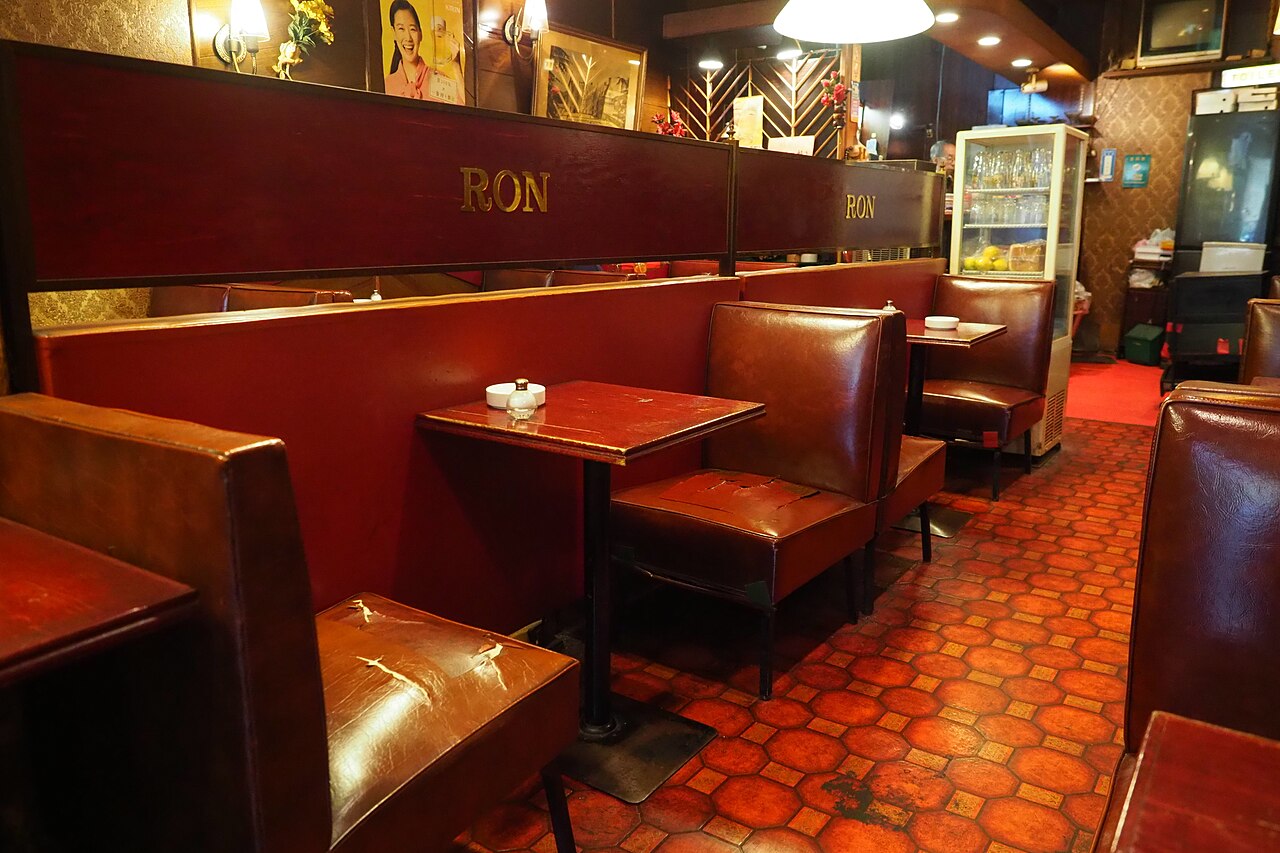
Interior of RON, a long-running kissaten in Nihonbashi, Tokyo, with its worn leather booths and warm, wood-paneled dining room — the classic kissaten look. Photo: othree, CC BY 2.0, via Wikimedia Commons.
Meaning
喫茶店 (kissaten) literally means "tea-drinking shop" — 喫 ("to consume/drink") + 茶 ("tea") + 店 ("shop") — but in practice it refers to a very specific kind of establishment: an old-fashioned, independently run Japanese coffee shop, usually decorated in a moody, wood-paneled 昭和-era (Shōwa, 1926–1989) style, serving hand-dripped or siphon-brewed coffee alongside a small menu of retro Western-style dishes.
The key distinction locals make is between a kissaten and a modern カフェ (kafe). A カフェ typically means a chain-run coffee shop in the Starbucks/Doutor mold — self-service counters, laptop-friendly seating, standardized menus. A kissaten is the opposite in almost every respect: table service from a lone proprietor, antique furniture, dim lighting, and a menu that hasn't changed in decades. The more specific term 純喫茶 (jun-kissa, "pure kissaten") is often used for an old-school kissaten that never served alcohol and has kept its classic character fully intact, as opposed to kissaten that later drifted toward a bar or café format.
Legally, kissaten occupy their own category too. Under Japan's Food Sanitation Act, a kissaten license historically only permitted serving non-alcoholic drinks and simple food — full liquor service required a separate restaurant or bar license. This is one reason classic kissaten menus center on coffee, tea, juice, and light food rather than izakaya-style drinking fare, and why kissaten culture grew up as something distinct from Japan's bar and snack-bar traditions.
Defining Features
A handful of features recur across almost every classic kissaten:
| Feature | Typical form |
|---|---|
| Coffee | Hand-drip or vacuum サイフォン (siphon) brewing, made to order by the proprietor |
| Interior | Dark 木造 paneling, low lighting, worn leather booths, antique clocks and bric-a-brac |
| Proprietor | A マスター (master, if male) or ママ (mama, if female) who runs the counter personally, often for decades |
| Menu | ナポリタン (naporitan) ketchup spaghetti, thick "coffee-shop" プリン pudding, egg sandwiches, cream soda, and thick "American" toast |
| Smoking | Historically full 喫煙 permitted throughout, an atmosphere that lingers in the yellowed walls of surviving shops even where smoking is now restricted |
| Seating | Individual booths or 個室-like partitioned tables meant for lingering alone with a book or newspaper, not turnover |
Specialty kissa: jazz kissa and manga kissa
Over the 20th century the basic kissaten format branched into specialized subtypes:
- Jazz kissa (ジャズ喫茶) and its classical-music cousin meikyoku kissa (名曲喫茶) built their whole identity around a serious sound system and a large record collection. Customers came not to chat but to sit in near-silence and listen — talking too loudly, or requesting the "wrong" record, could get a customer scolded by the master. Legendary ジャズ kissa in Tokyo and Kyoto still operate this way today, curating listening sessions around vinyl.
- Manga kissa (漫画喫茶), the ancestor of today's manga-kissa internet/manga cafés, began as kissaten with shelves of 漫画 for customers to read over coffee. The modern manga kissa has evolved into something quite different — private reclining booths, internet access, showers, and overnight stays — but the name still points back to its kissaten roots.
Usage
The word is used straightforwardly to refer to the shop or the category of shop:
昔ながらの喫茶店でナポリタンを食べた。 Mukashi nagara no kissaten de naporitan o tabeta. "I ate naporitan at an old-fashioned kissaten."
この喫茶店、マスターが淹れるサイフォンコーヒーが絶品なんです。 Kono kissaten, masutā ga ireru saifon kōhī ga zeppin nan desu. "At this kissaten, the siphon coffee the master brews is exceptional."
It also appears as a search term for tourists and younger Japanese hunting for a genuine old shop, often paired with adjectives like レトロ (レトロ, retro) or ノスタルジック (nostalgic), or narrowed with 純喫茶 to mean specifically the untouched, pre-café-boom kind of shop.
Cultural Context
Origins: from Meiji curiosity to postwar boom
Coffee shops calling themselves kissaten existed as early as the Meiji era, but the format that defines "classic kissaten" today crystallized in the decades after WWII. In the ration-scarce, rebuilding cities of the late 1940s and 1950s, a kissaten was one of the few places offering a warm room, real coffee (often a luxury import), and a radio or record player — a small, affordable escape. Ownership was typically a single family or an individual proprietor rather than a chain, and licensing under the Food Sanitation Act kept kissaten legally separate from bars: a kissaten sold coffee and light food, not alcohol, which shaped its role as a daytime, unhurried "third place" rather than a nightlife venue.
Through the 高度経済成長期 (the postwar high-growth years) and into the 1970s–80s, kissaten proliferated by the tens of thousands across Japan, becoming the default meeting spot for business talks, dates, study sessions, and idle afternoons. Menus filled out with the now-iconic retro dishes — naporitan (spaghetti tossed in ketchup, said to derive from an Occupation-era American army cook's improvisation), thick pudding à la mode, pizza toast, and cream soda served in a tall glass with a cherry and a scoop of ice cream. Interiors leaned into a heavy, almost European coffeehouse look: dark wood, stained glass, velvet booths, and chandeliers, deliberately different from the plain tea houses that preceded them.
Decline: the café-chain era
From the 1990s onward, the number of kissaten fell sharply as chains like Doutor, Starbucks (which entered Japan in 1996), and later convenience-store coffee offered cheaper, faster, self-service coffee that fit a more time-pressed, smoking-restricted urban lifestyle. Aging owners without successors closed up rather than modernize, and many buildings were redeveloped. Government statistics tracking kissaten numbers show a decline from a peak of roughly 150,000+ shops nationwide in the early 1980s to a small fraction of that today.
Revival: nostalgia as the new trend
In the 2010s and 2020s, however, surviving kissaten have found new life. Younger Japanese who never experienced the Shōwa era firsthand have discovered kissaten through social media as a genre of retro aesthetic — a reaction against the sameness of modern chain cafés. Terms like 純喫茶 and レトロ喫茶 circulate on Instagram and X alongside photos of jukeboxes, cream soda, and velvet booths; guidebooks and blogs devoted entirely to "junkissa hunting" (純喫茶巡り) have multiplied; and some historic kissaten that once struggled to find customers are now drawing lines of young people and international tourists eager to photograph an interior that looks untouched since 1975.
This revival mirrors a broader pattern in Japan of formerly unfashionable Shōwa-era design — 喫茶店 interiors, retro fonts, showa-style diners — being recast as charming and authentic precisely because it resists the homogeneity of contemporary chain design. For the dwindling number of aging masters and mamas still pouring siphon coffee by hand, it has meant an unexpected second wind: shops that seemed destined to quietly close are, in some cases, thriving again as destinations in their own right.
Related Terms
- 純喫茶 (jun-kissa) — a kissaten that has never served alcohol and preserves the classic, unmodernized format
- ジャズ喫茶 (jazz kissa) / 名曲喫茶 (meikyoku kissa) — kissaten built around serious music listening
- 漫画喫茶 (manga kissa) — the manga-and-internet café descendant of the kissaten name
- カフェ (kafe) — the modern, often chain-run café format kissaten is contrasted against
Related Dictionary Words
coffee shop; tearoom; coffee lounge; coffeehouse; cafe
coffee shop that does not serve alcohol
siphon
Naporitan; Napolitan; Japanese spaghetti dish made with ketchup
to master (a skill)
mom; mommy; mum; mummy; mother; mama; mamma
Shōwa era (1926.12.25-1989.1.7)
retro; nostalgic; old-fashioned
smoking (tobacco)
wooden; made of wood; wooden construction
single (room); room for one; one's own room; private room; private compartment
jazz
cartoon; comic; comic strip; manga