抹茶
matchaFinely ground powdered green tea at the heart of Japanese tea ceremony and modern food culture, prized for its vivid colour, umami depth, and meditative preparation.
Meaning
抹茶 (まっちゃ, matcha) is a type of 緑茶 made by stone-grinding shade-grown 茶葉 into an ultra-fine powder. Unlike steeped tea, where the leaves are discarded, matcha suspends the entire leaf in water — meaning drinkers consume the whole plant. The kanji 抹 means "to rub" or "to grind," and 茶 means "tea," so the compound literally translates as "ground tea."
The powder ranges in colour from pale yellow-green (lower grade, later harvest) to an intense, almost electric jade (high-grade ceremonial, early harvest). Flavour depends heavily on quality: premium matcha is rich with umami, naturally sweet, and subtly vegetal, with only a pleasant bitterness; culinary grade is more astringent and better suited to cooking than drinking plain.
Preparation
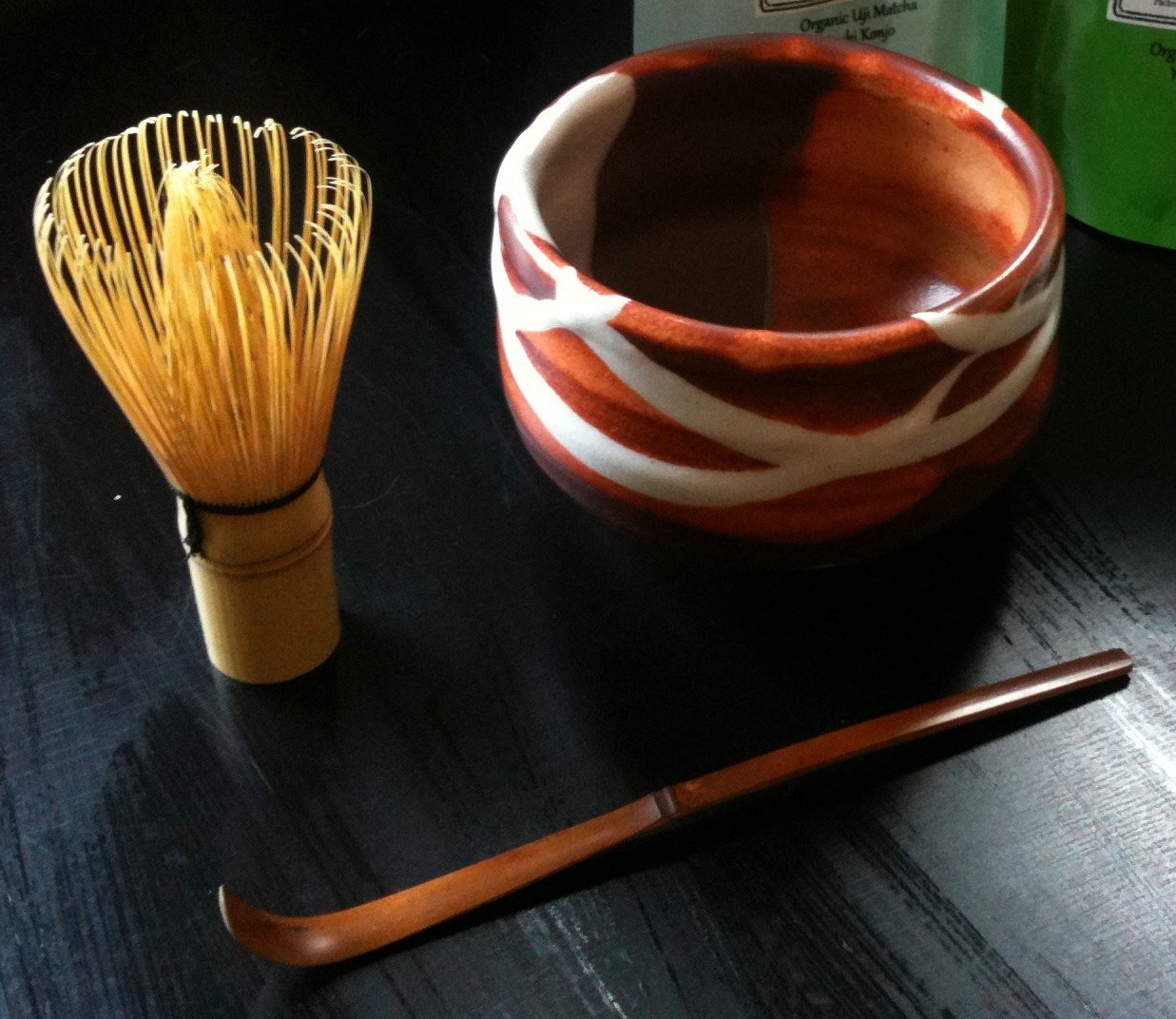
A classic matcha set — 茶碗 (chawan bowl), 茶筅 (chasen bamboo whisk), and matcha powder. Photo: Kaminix, CC BY 3.0, via Wikimedia Commons.
Traditional matcha preparation follows the steps of 点前 (temae), the choreographed technique taught in 茶道:
- Sift a small amount of powder into a 茶碗 (chawan, ceramic tea bowl)
- Add a small quantity of hot water (around 70–80 °C — never boiling)
- Whisk briskly in a W-shaped motion with a 茶筅 (chasen, split-bamboo whisk) until a fine froth forms
- 飲む from the bowl in a few measured sips
There are two styles of matcha drink:
| Style | Japanese | Water Ratio | Texture |
|---|---|---|---|
| Thin tea | 薄茶 (usucha) | ~60 ml | Light, frothy |
| Thick tea | 濃茶 (koicha) | ~20 ml | Syrup-like, smooth |
Usucha is the style most commonly encountered in tea ceremonies for guests. Koicha is reserved for more formal occasions and requires higher-quality matcha because its concentrated flavour leaves nowhere to hide imperfections.
Cultural Context
Matcha's journey to Japan began in the late 12th century when the Zen 僧侶 Eisai returned from China carrying tea seeds and the practice of whisking powdered tea. He planted seeds in 京都 and wrote the Kissa Yōjōki ("Drinking Tea for Health"), extolling お茶 as a medicine for the body and mind. Buddhist monasteries adopted matcha quickly — its caffeine kept 寺 monks alert during long meditation sessions, and its preparation became a ritual act of mindfulness.
By the 16th century, the tea master Sen no Rikyū codified what became the definitive form of the Japanese tea ceremony, known as chanoyu ("hot water for tea"). He established the four principles still central to tea practice today:
- 和 (wa) — harmony
- 敬 (kei) — respect
- 清 (sei) — purity
- 寂 (jaku) — tranquility
These values were to be embodied in every movement, in the design of the 茶室 (tea room), in the choice of 和菓子 served alongside, and in the humble 茶碗 cradled in both hands. The 茶道 that descended from Rikyū's teachings remains one of Japan's most studied traditional arts, with millions of practitioners today.
Production Regions
Japan's finest matcha comes from three main regions:
| Region | Prefecture | Character |
|---|---|---|
| Uji | Kyoto | Sweetest, most balanced; considered the gold standard |
| Nishio | Aichi | Mild, slightly grassy; largest volume producer |
| Yame | Fukuoka | Deep umami; prized by connoisseurs |
The distinctive bright green colour and sweet flavour result from a crucial cultivation step: tana shading, where tea bushes are covered with reed screens or black cloth for 20–30 days before harvest. Blocking sunlight triggers an increase in chlorophyll and L-theanine (an amino acid responsible for umami and calm alertness) while reducing catechin bitterness. After harvest, the leaves are steamed, dried, and deveined to produce tencha — the raw material that is then stone-ground into matcha.
Matcha in Food and Drink
Matcha's 苦い edge and grassy depth make it a natural foil for 甘い flavours, which is why it pairs so perfectly with 和菓子. Traditional pairings include:
- 練り切り (nerikiri) — sculpted white bean-paste sweets shaped into seasonal motifs
- 羊羹 (yōkan) — firm red-bean jelly
- 大福 (daifuku) — soft mochi filled with sweet bean paste
Beyond the 茶室, matcha has expanded into a broad range of foods and beverages:
- 抹茶ラテ — matcha blended with 牛乳 (steamed milk) and, typically, 砂糖
- 抹茶アイスクリーム — matcha ice cream, ubiquitous at Japanese dessert shops
- 抹茶ケーキ / 抹茶ロールケーキ — cakes and Swiss rolls with matcha cream
- 抹茶チョコレート — white or milk chocolate infused with matcha
- 抹茶そば — soba noodles coloured and flavoured with matcha
Global Boom and the Matcha Crisis
Matcha remained largely unknown outside East Asia until the early 2000s. International exposure accelerated when major café chains began offering matcha lattes, and the drink's photogenic green hue made it enormously popular on Instagram and TikTok. By the mid-2020s, matcha had become a global wellness symbol, associated with カフェイン and L-theanine providing a calmer, more sustained alertness than coffee.
The surge in global demand has placed real pressure on Japanese producers. Uji farmers, who pass terraced fields down through generations, have struggled to scale output without sacrificing quality. The term matcha crisis (抹茶危機) began appearing in Japanese media around 2023–2024, reflecting shortages, rising prices, and concern that high-volume export demand could dilute the 文化 of careful, slow production that defines authentic Japanese matcha.
Within Japan, a parallel boom in matcha-themed cafés has spread well beyond 京都, with dedicated matcha-only shops appearing in Tokyo, Osaka, and beyond, offering elaborate matcha parfaits, thick matcha lattes, and seasonal matcha menus.
Grades and Quality
There is no official regulatory framework for matcha grades, but sellers commonly use two categories:
| Grade | Use | Colour | Taste |
|---|---|---|---|
| Ceremonial (式用) | Drinking plain | Vibrant green | Sweet, smooth, umami-rich |
| Culinary (料理用) | Cooking, baking | Yellow-green | More bitter, robust |
Within ceremonial grade, specialist producers further distinguish harvest rounds: first flush (一番茶, ichibancha, May) is the finest; second flush (二番茶) is milder. Colour, aroma, and fineness of grind are the key quality markers when buying.
Health and Wellness
Matcha's 健康 credentials have fuelled much of its modern popularity. Because the whole leaf is consumed, matcha delivers significantly higher concentrations of antioxidants — particularly catechins such as EGCG — than steeped green tea. The combination of カフェイン and L-theanine is credited with producing focused, calm energy without the jitteriness associated with coffee. Japanese studies have also explored links between regular green tea consumption and reduced risk of cardiovascular disease and cognitive decline, though direct matcha-specific evidence continues to be researched.
Related Dictionary Words
matcha; powdered green tea
green tea; Japanese tea
tea ceremony; Way of Tea; sadō
rice bowl; tea cup; teacup
tea whisk; bamboo whisk for making Japanese tea
wagashi; traditional Japanese confectionery
tea leaf; tea leaves
tea (esp. green or barley)
tearoom; tea house; tea-ceremony room; tea arbour; tea arbor
tea ceremony procedure; tea ceremony etiquette