茶道
sadoThe Japanese way of tea — a ritualized practice of preparing and drinking matcha rooted in Zen aesthetics, mindfulness, and the philosophy of finding beauty in simplicity.
Meaning
茶道 (さどう / ちゃどう) literally means "the way of 茶" — the path of tea. The word combines 茶 (tea) with 道 (way, path, or discipline), the same dō suffix found in martial arts like judō and kendō, and in ikebana. That suffix signals something deeper than a skill: a lifelong practice through which one cultivates character.
The 道 in 茶道 is not merely a method for making a beverage. It is a codified aesthetic and spiritual discipline centred on the preparation and presentation of 抹茶 (powdered green tea) to guests, with every movement, object, and seasonal detail carrying deliberate meaning.
The Ceremony
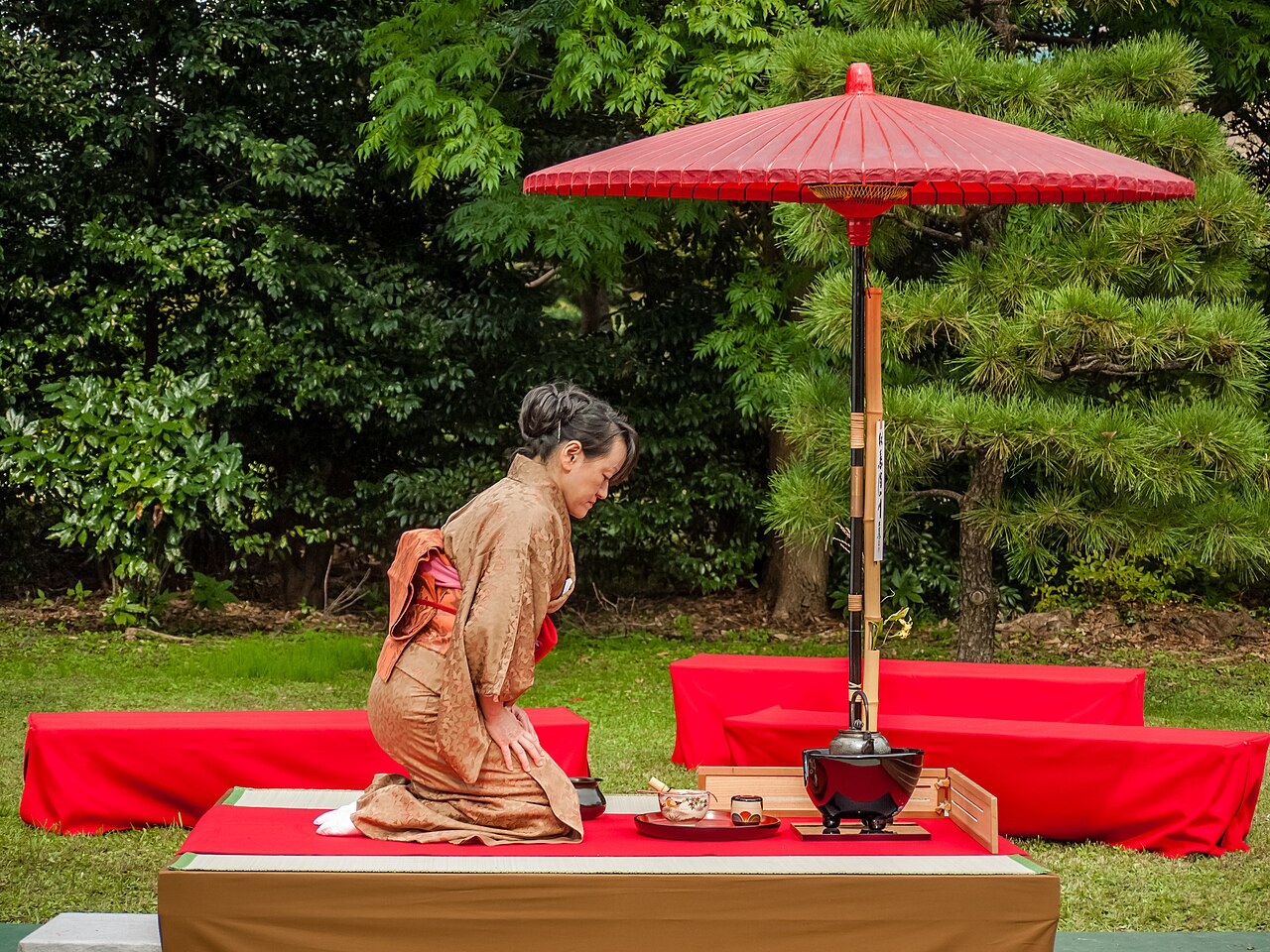
A host performs the ritual preparation of matcha during a tea ceremony. Photo: Ermell, CC BY-SA 4.0, via Wikimedia Commons.
A tea gathering (chakai or chaji) takes place in a 茶室 (tea room) or a garden teahouse, typically approached through a roji — a dewy garden path designed to ease the transition away from ordinary life. Guests enter the small, low-doored room as equals, regardless of social rank.
The host performs 点前 (temae) — the precise choreography of preparing and serving tea. Every motion is intentional:
- Wiping the 茶碗 (tea bowl) with a silk cloth
- Scooping 抹茶 with a bamboo ladle
- Whisking the tea to a smooth, frothy consistency
- Presenting the bowl with a bow
Guests rotate the bowl before drinking (to avoid placing one's lips on the front), admire the 茶碗, and exchange quiet appreciation with the host. 和菓子 (traditional sweets) are served beforehand to balance the tea's bitterness.
The room is decorated with a hanging scroll (kakemono) and a single seasonal flower arrangement — never more than is needed.
Cultural Context
Tea was brought to Japan from China by Buddhist monks in the 9th century, but the ritualized practice as it exists today took shape in the 15th and 16th centuries. The monk Murata Jukō (村田珠光, 1423–1502) is credited with infusing the practice with 禅 (Zen) sensibility, insisting that the spirit of the tea room and the spirit of 禅 were inseparable.
The tea master Sen no Rikyū (千利休, 1522–1591) is considered the supreme authority who gave 茶道 its definitive form. He distilled its philosophy into four principles:
| Japanese | Reading | Meaning |
|---|---|---|
| 和 | wa | Harmony |
| 敬 | kei | Respect |
| 清 | sei | Purity |
| 寂 | jaku | Tranquility |
Rikyū championed the aesthetic of 侘び (wabi) — a beauty found in imperfection, rusticity, and incompleteness. A cracked bowl repaired with gold, a weathered bamboo scoop, a simple clay cup: these were prized above ornate lacquerware. This sensibility connects 茶道 directly to the broader Japanese aesthetic philosophy of wabi-sabi.
After Rikyū's death (forced suicide by his patron Toyotomi Hideyoshi), his legacy was carried on by his descendants. Today three main schools — Urasenke, Omotesenke, and Mushakojisenke — trace their lineage directly to Rikyū and continue teaching his tradition.
Practice and Discipline
Learning 茶道 is understood as 修行 — a form of training that goes beyond technique. Students study 作法 (proper etiquette and form) for years before performing even a simple 点前. The physical repetition is a meditative act: quieting the mind, sharpening awareness of the present moment.
The concept of ichi-go ichi-e (一期一会, "one time, one meeting") is central: every gathering is unrepeatable. The host prepares as if this meeting will never come again — and guests attend with the same awareness. This transforms the making of tea into something closer to a living poem.
茶道 also has a strong seasonal dimension. The 茶室 decor, the choice of sweets, the water temperature, and even the style of 点前 shift with the 季節 (season). The tea year has its own calendar: the opening of the hearth (ro biraki) in November marks the beginning of the cooler-season practice.
Etiquette for Guests
Attending a tea ceremony as a guest carries its own 礼儀 (etiquette):
- Wear clean, subdued clothing (no strong perfume that would interfere with the tea's fragrance)
- Enter the tea room quietly and take the designated seat
- Eat the 和菓子 fully before the tea is served
- Receive the 茶碗 with both hands; rotate it two turns clockwise before drinking
- After drinking, wipe the rim gently and rotate back before returning the bowl
- Compliment the host on the tea and the utensils
Modern Practice
茶道 remains very much alive in contemporary Japan. It is taught in schools, universities, and community centres, and practiced by an estimated three to five million people. Many Japanese women study it as part of a broader cultural education, though the practice is by no means limited by gender.
Outside Japan, 茶道 schools have spread across Europe, the Americas, and Asia. Urasenke, the largest school, maintains international branches in many countries and has played a significant role in cultural diplomacy.
The 精神 (spirit) of 茶道 — mindfulness, hospitality, respect for seasonality, and the beauty of the impermanent — continues to resonate far beyond the tea room.
茶の湯とはただ湯をわかし茶をたてて飲むばかりなることと知るべし
"The tea ceremony is nothing more than boiling water, preparing tea, and drinking it — you should know this." — Sen no Rikyū
Related Dictionary Words
tea ceremony; Way of Tea; sadō
matcha; powdered green tea
rice bowl; tea cup; teacup
tearoom; tea house; tea-ceremony room; tea arbour; tea arbor
tea ceremony procedure; tea ceremony etiquette
manners; etiquette; propriety
dhyana (profound meditation)
training; practice; discipline; study
wagashi; traditional Japanese confectionery
tatami mat; Japanese straw floor coverings