祭り
matsuriJapanese festivals rooted in Shinto tradition, celebrated with portable shrines, taiko drumming, food stalls, fireworks, and communal dancing throughout the year.
Meaning
祭り (matsuri) refers to any festival or celebration in Japan, but the word carries far deeper meaning than a simple party. At its core, matsuri is a sacred act — a time when communities gather to honor the gods (kami), give thanks for good harvests, pray for protection, and reinforce the social bonds that hold neighborhoods together. The word derives from the verb matsuru (祀る), meaning "to enshrine" or "to worship," and that religious essence remains present even in the most secular modern festivals.
Japan has thousands of matsuri each year, from intimate neighborhood celebrations attended by a few dozen residents to massive national events drawing millions of visitors. Whether it is a summer evening of goldfish scooping and yakitori at a local shrine or the grand processions of the Gion Matsuri in Kyoto, the spirit is recognizable: the temporary dissolution of everyday life, the donning of traditional dress, and the shared experience of joy.
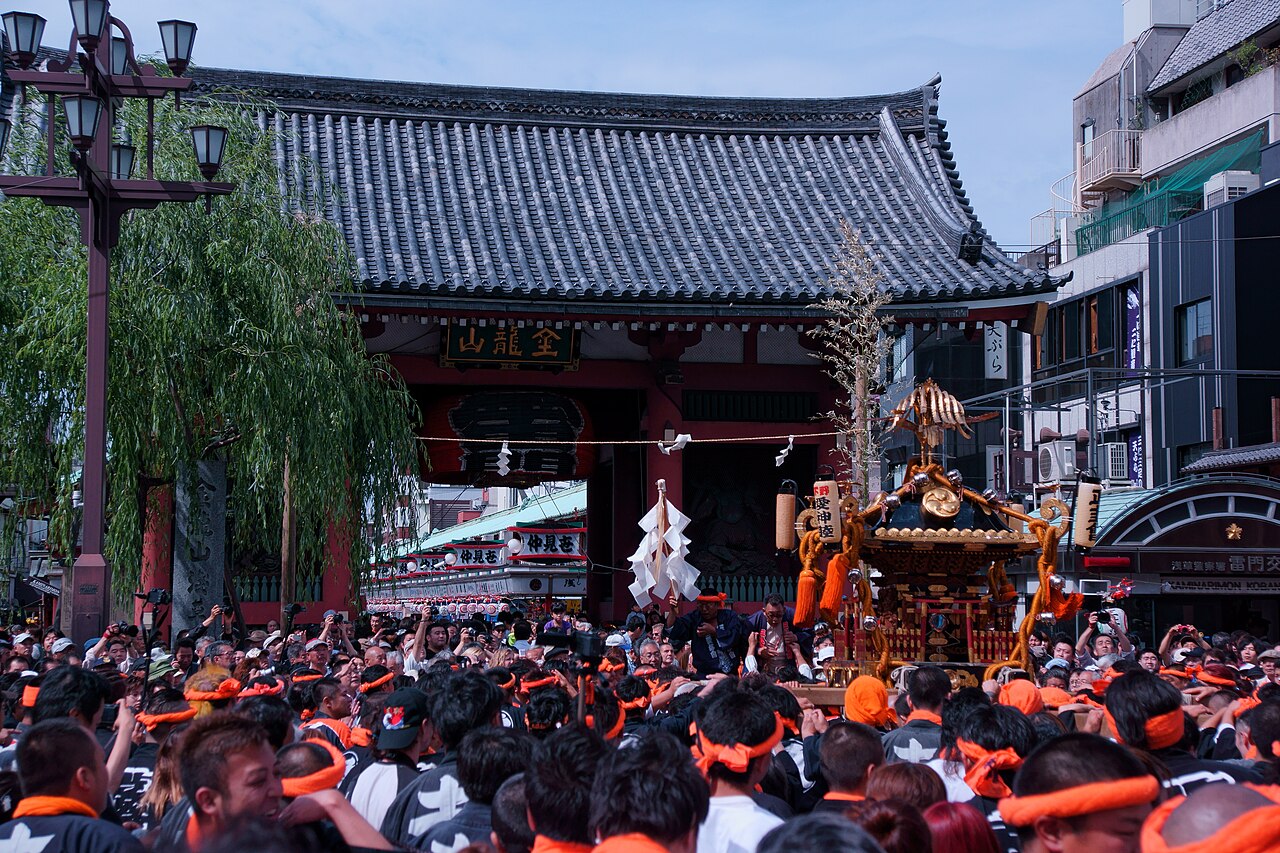
Mikoshi procession near Kaminarimon, Asakusa. Photo: Takao Sato, CC BY-SA 4.0, via Wikimedia Commons.
Shinto Origins
神道 (Shinto), Japan's indigenous spiritual tradition, underlies virtually every traditional matsuri. Shinto teaches that kami — divine spirits — inhabit natural features, ancestor figures, and sacred objects. Matsuri were originally rituals performed at 神社 (shrines) to invite kami into the human world, receive their blessings, and then respectfully send them back.
The agricultural calendar shaped the earliest festivals. Spring matsuri (haru matsuri) prayed for plentiful crops; autumn matsuri (aki matsuri) expressed gratitude for the harvest. Summer festivals (夏祭り) often had a different purpose — appeasing restless or malevolent spirits (goryō) believed to cause epidemics during the hot season. Over centuries these ritual functions blended with community celebration, creating the festive atmosphere associated with matsuri today.
Buddhist influence, introduced to Japan in the sixth century, added another layer. The most prominent example is the Bon season in mid-August, when ancestors' spirits are believed to return to the living world. 盆踊り — communal circle dancing — originally guided these spirits home and is now one of the most widely practiced summer matsuri traditions.
Types of Matsuri
Matsuri can be grouped in several ways:
By season:
| Season | Japanese | Typical character |
|---|---|---|
| Spring | 春祭り (haru matsuri) | Rice planting prayers, shrine processions |
| Summer | 夏祭り (natsumatsuri) | Goryō appeasement, bon odori, fireworks |
| Autumn | 秋祭り (aki matsuri) | Harvest thanksgiving, energetic portable shrines |
| Winter | 冬祭り (fuyu matsuri) | New Year rites, fire festivals |
By religious affiliation:
- Shinto matsuri — centered on a local or major shrine and its enshrined kami
- Buddhist matsuri — associated with temples, notably the Bon observances
- Secular / civic matsuri — modern festivals with little or no religious framing, organized by local governments or tourism boards
By scale:
- Jinja matsuri (shrine festivals) — held annually at virtually every one of Japan's approximately 80,000 shrines
- Sanno matsuri, Tenjin matsuri, Gion matsuri — major inter-neighborhood festivals with centuries of recorded history
- Regional pride festivals — Nebuta Matsuri, Awa Odori, Sapporo Snow Festival, celebrated as cultural treasures
Festival Elements
Mikoshi — the Portable Shrine
The 神輿 (mikoshi) is an ornate portable shrine, lacquered and gilded, in which a kami temporarily resides during the festival. Carried on the shoulders of dozens of participants who chant "Wasshoi! Wasshoi!" or "Seiya! Seiya!", the mikoshi is paraded through the neighborhood streets, allowing the kami to visit and bless the community. The rhythmic swaying and jostling — sometimes quite vigorous — is intentional: it invigorates and delights the kami. Participating in carrying the mikoshi is considered a great honor and a way of accumulating good fortune.
Taiko — Festival Drums
太鼓 (taiko) drumming is the sonic heartbeat of matsuri. The deep, resonant boom of large taiko carries for great distances, announcing the festival's presence and energizing both performers and spectators. Taiko groups perform complex rhythmic patterns, sometimes combined with flute (fue) and hand-held gongs (kane) in the traditional hayashi ensemble. The sound creates the unmistakable emotional atmosphere that Japanese people associate with summer evenings and festive processions.
Yukata — Festival Dress
浴衣 (yukata) — lightweight cotton kimono — are the unofficial uniform of summer matsuri. Originally bathhouse wear, yukata became festival clothing during the Edo period. Seeing crowds in yukata drifting through the lantern-lit grounds of a shrine is one of the quintessential images of Japanese summer. Women's yukata often feature bold floral or geometric patterns; men's tend toward indigo stripes or quieter earth tones. Wearing yukata to a summer matsuri, even among young people, is considered fashionable rather than old-fashioned.
Yatai — Food Stalls
屋台 (yatai) are the food and game stalls that line the approaches to festival grounds. Their warm light, the smell of grilling food, and the calls of vendors are inseparable from the matsuri experience. Common stalls include:
- 焼き鳥 (yakitori) — grilled chicken skewers
- たこ焼き (takoyaki) — octopus-filled batter balls, a specialty of Osaka
- りんご飴 (ringo ame) — candied apples on sticks
- かき氷 (kakigōri) — shaved ice with flavored syrup
- 金魚すくい (kingyo sukui) — goldfish scooping with a paper-framed net
- 射的 (shasheki) — shooting gallery with cork guns
The yatai zone is where children spend their pocket money and where dating couples stroll hand in hand.
Hanabi — Fireworks
花火 (hanabi, literally "flower fire") are intimately associated with summer matsuri. Large fireworks displays (hanabi taikai) are staged over rivers and bays across Japan every July and August, drawing tens of thousands of spectators who spread out on riverbanks in yukata, necks craned skyward. Japan's fireworks culture is highly refined — competing pyrotechnic families have guarded their techniques for generations, and connoisseurs discuss the visual patterns and color combinations with the same seriousness as wine or tea.
Bon Odori
盆踊り is the communal circle dance of the Bon season. Dancers move in a ring around a raised wooden scaffold (yagura) from which musicians and singers perform. The steps are designed to be simple enough for anyone to join regardless of ability — participation is the point, not performance. Regional bon odori styles differ dramatically: Awa Odori from Tokushima features exuberant arm-flinging footwork; the Gujo Odori in Gifu has over a dozen distinct dances performed through the night.
Famous Festivals
祇園祭 (Gion Matsuri) — Kyoto, July Japan's most celebrated festival, held throughout the entire month of July at Yasaka Shrine. The highlight is the Yamaboko Junkō, a procession of towering floats (yamaboko) — some over twenty meters tall, some dating back to the sixteenth century — pulled through central Kyoto by white-gloved volunteers. Listed by UNESCO as an Intangible Cultural Heritage.
阿波踊り (Awa Odori) — Tokushima, August A four-day summer festival centered on the distinctive Awa dance, performed in troupes (ren) of dancers, musicians, and lantern carriers. The call-and-response chant goes: "Odoru aho ni miru aho, onaji aho nara odoranya son son" — loosely, "The dancing fool and the watching fool — if you're going to be a fool, you might as well dance." Around one million spectators attend each year.
ねぶた祭 (Nebuta Matsuri) — Aomori, August Huge illuminated papier-mâché floats (nebuta) depicting legendary warriors and mythological figures are paraded through the streets at night. Dancers called haneto leap and shout in front of the glowing floats. The sight of these brilliantly lit giants moving through the darkness is extraordinary.
さっぽろ雪まつり (Sapporo Snow Festival) — February Held in Odori Park, this winter matsuri features enormous snow and ice sculptures, some the size of buildings, carved over several days by teams of sculptors. It draws approximately two million visitors and has given rise to similar snow festivals worldwide.
天神祭 (Tenjin Matsuri) — Osaka, July One of Japan's three great festivals, centered on Osaka Tenmangu shrine. The celebration includes a river procession (funa togyo) of over one hundred decorated boats carrying the kami along the Okawa River, accompanied by fireworks — a combination of water, fire, and community spectacle.
Usage
The word 祭り is used in both everyday speech and formal contexts.
今週末、地元の神社でお祭りがあります。 Konshūmatsu, jimoto no jinja de o-matsuri ga arimasu. "There's a festival at the local shrine this weekend."
夏祭りで浴衣を着て、花火を見ました。 Natsumatsuri de yukata wo kite, hanabi wo mimashita. "I wore a yukata to the summer festival and watched the fireworks."
神輿を担いだことがありますか? Mikoshi wo katsuidakoto ga arimasu ka? "Have you ever carried a mikoshi?"
The honorific prefix o- is frequently added: お祭り (o-matsuri) sounds warmer and more familiar in speech.
Modern Matsuri
Contemporary Japan has seen matsuri evolve in several directions. Traditional shrine festivals face demographic challenges: rural communities with aging populations struggle to find enough young men to carry mikoshi, and some festivals have been scaled back or discontinued. At the same time, urban neighborhoods have revived dormant festivals as a tool for community-building, and tourism has breathed new commercial life into large regional events.
A new genre of "matsuri" has also emerged: music festivals, food festivals, and pop-culture conventions that borrow the word's connotations of communal celebration without the religious content. Anime and gaming events sometimes call themselves matsuri; stadium concerts are framed as shared festive experiences. The word has become a flexible cultural shorthand for any joyful mass gathering.
For the Japanese diaspora abroad, matsuri have become important expressions of cultural identity. Japanese cultural festivals in cities around the world — from the Nisei Week in Los Angeles to the Japan Festival in London — bring taiko, yukata, and yatai food to communities far from Japan, transmitting the feeling of o-matsuri to new generations.
At their heart, matsuri remain what they have always been: a suspension of ordinary time, a moment when community and the sacred briefly touch, and an occasion to be fully alive in the present.
Related Dictionary Words
festival; feast; matsuri
Shinto shrine
Shinto; Shintoism
mikoshi; portable Shinto shrine carried through the streets during festivals
drum
yukata; light cotton kimono worn in the summer or used as a bathrobe
fireworks
cart (esp. a food cart); stall; stand
Bon Festival dance; Lantern Festival dance
summer festival; summer matsuri