旅館
ryokanTraditional Japanese inns offering tatami rooms, futon bedding, yukata robes, kaiseki cuisine, and communal hot spring baths — a full immersion in Japanese hospitality culture.
Meaning
旅館 (ryokan) literally combines 旅 (ryo, "travel") and 館 (kan, "building" or "hall") — a building for travelers. But the word carries far more weight than its etymology suggests. A ryokan is not simply a place to sleep; it is an entire mode of experiencing Japan, bundling lodging, meals, bathing, and a deeply personal form of service into a single, immersive stay.
Where a Western hotel keeps guests at arm's length through check-in counters, room service menus, and anonymous corridors, a ryokan folds you into the rhythms of a Japanese household. You are welcomed with tea, fitted with a 浴衣 (yukata) robe, shown to a room floored entirely with 畳 (tatami) rush mats, and from that moment onward, a personal attendant called a 仲居 (nakai) becomes your host, guide, and quiet guardian for the length of your stay.
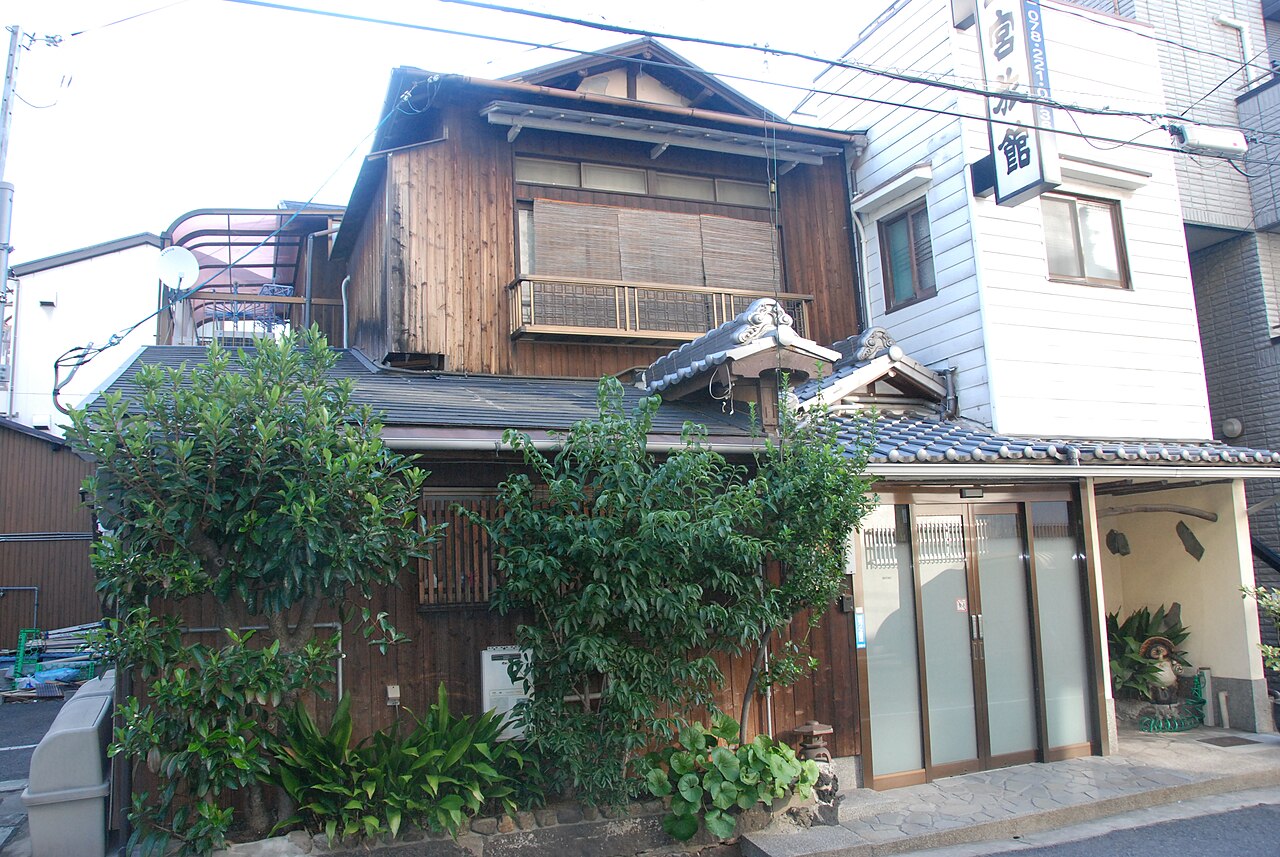
A traditional ryokan exterior — timber construction, paper lanterns, and a noren curtain mark the entrance. Photo: Maarten Heerlien, CC BY 2.0, via Wikimedia Commons.
History and Origins
The ryokan tradition stretches back to at least the Nara period (710–794 CE), when the Buddhist monk Gyoki established free roadside lodging facilities called fuseya to shelter pilgrims and officials traveling along the imperial highways. Over the following centuries these evolved into hatago — commercial inns along the great highways of feudal Japan — where 旅人 (tabibito, travelers) could rest, eat, and stable their horses.
By the Edo period (1603–1868), travel culture had flourished into a minor industry. The five great roads (gokaidō) connecting Edo (now Tokyo) to the provinces were lined with hatago and honjin (high-status inns reserved for feudal lords and officials). Ordinary commoners made pilgrimages to Ise Shrine or Konpira-san in Shikoku, and entire cottage industries of lodging and hospitality grew up around these routes.
The modern ryokan as we know it crystallized during the Meiji era (1868–1912) and the early twentieth century. As railways spread across Japan, hot-spring towns previously accessible only by foot or palanquin suddenly became weekend destinations. 宿泊 (shukuhaku, overnight lodging) at an 温泉 (onsen) ryokan became the aspirational leisure activity of the emerging urban middle class — a tradition it has maintained ever since.
The Signature Features
Tatami Rooms and Futon Bedding
Every proper ryokan room is floored in 畳 (tatami) — thick mats woven from rush grass over a rice-straw core. Tatami has a distinctive, faintly grassy scent and a pleasant springiness underfoot. Shoes and slippers are removed at the room's threshold; guests walk barefoot or in socks on the mats.
During the day the room functions as a sitting room, centered on a low table (chabudai) and cushions (zabuton). In the evening the nakai returns to transform the space: the table is pushed aside, 布団 (futon) mattresses are unrolled from the closet (oshiire), and the room becomes a bedroom. In the morning the process reverses. This twice-daily ritual of the transforming room is one of the quietly magical aspects of ryokan life.
The Yukata
On arrival, guests are given a 浴衣 (yukata) — a lightweight, unlined cotton robe — along with a thicker outer robe (tanzen or haori) for cooler seasons. The yukata is meant to be worn throughout the stay: in your room, to the baths, along the 廊下 (rōka, corridors) of the inn, and often even into the surrounding town, especially in onsen resort areas where it is perfectly ordinary to see guests strolling the streets in their ryokan yukata and wooden 下駄 (geta) sandals.
Wrap the left side over the right — never the right over left, which is reserved for funeral dress.
Kaiseki Cuisine
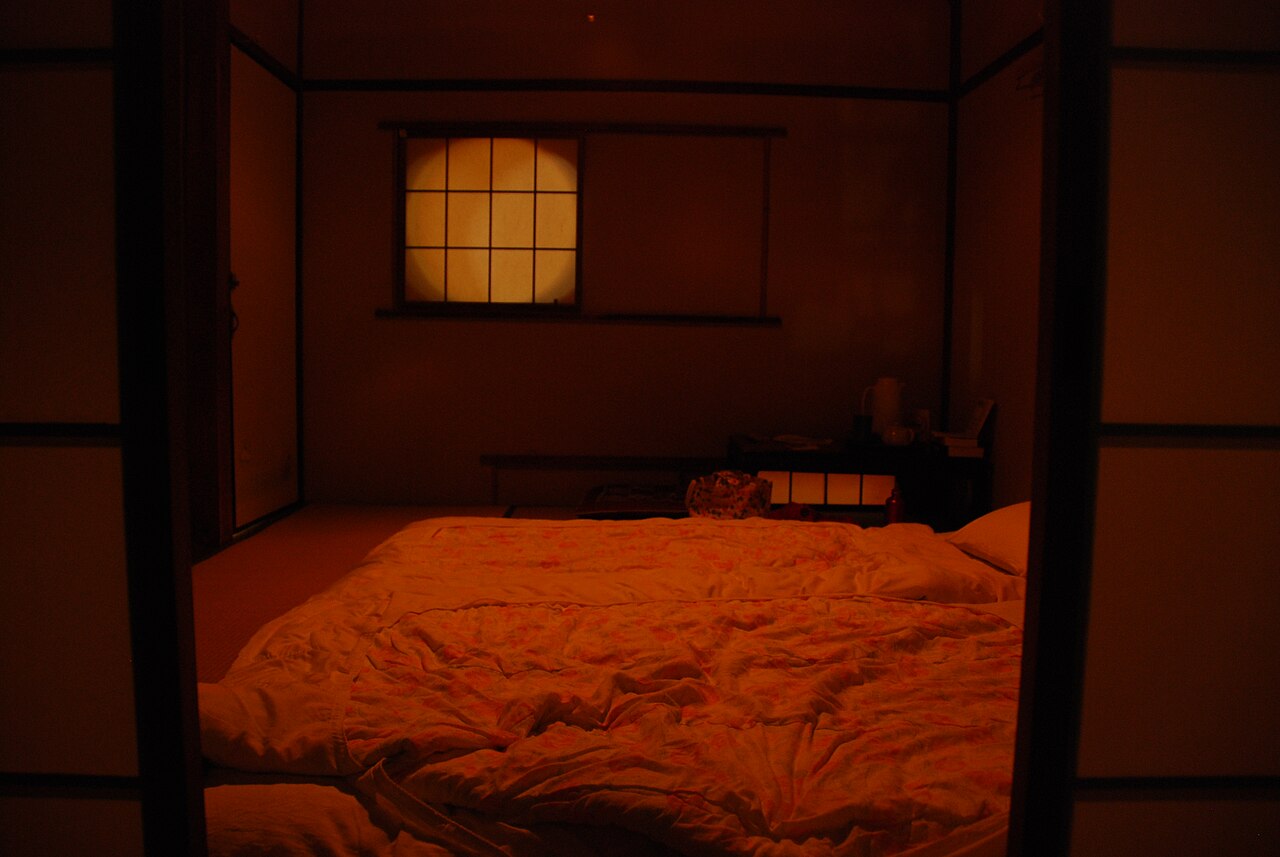
A typical ryokan guest room: tatami mats, futon bedding, shoji screens filtering the garden light. Photo: Maarten Heerlien, CC BY 2.0, via Wikimedia Commons.
The 懐石 (kaiseki) dinner served at a ryokan is the centrepiece of the stay — often the most elaborate meal a visitor to Japan will eat. Served course by course in the guest room or a private dining room, a kaiseki meal typically comprises eight to twelve courses: a seasonal appetizer (sakizuke), soup, sashimi, simmered dishes, grilled fish, a hot pot, a rice course, and pickles, culminating in a small dessert. Each dish reflects the season, the local terroir, and the chef's artistry.
Breakfast the following morning is equally considered: miso soup, steamed rice, grilled fish, pickled vegetables, rolled egg (tamagoyaki), tofu, and seaweed — restrained, nourishing, and deeply Japanese.
The meal is typically included in the room rate (ippaku nishoku, one-night two-meal plan), and timing is often fixed. Guests are asked to specify their preferred dinner hour at check-in; missing it is considered poor form.
The Baths
At ryokan with their own hot springs — onsen ryokan — the bath is as important as the bed. Most offer at least two communal baths: an indoor bath (uchiyoku) and an outdoor bath (露天風呂, rotenburo), separated by gender. Luxury ryokan add private baths (kashikiri-buro) that guests can reserve, and the finest establishments provide a dedicated private 温泉 bath attached to the guest room itself (heya-buro).
Bathing rules are firm: rinse thoroughly at the washing station before entering the shared water, no swimwear, hair tied up or on the head, no towels in the tub. The ethos is communal cleansing rather than private bathing — entering a rotenburo under an open sky, surrounded by bamboo or rock garden, in all weathers, is an experience most visitors describe as transformative.
Omotenashi: The Art of Selfless Hospitality
The concept of omotenashi (おもてなし) — Japanese hospitality — is nowhere more fully expressed than in a ryokan. The word is often translated as "hospitality" but carries a specific nuance: service rendered wholeheartedly, without expectation of reward, anticipating needs before they are voiced. Unlike Western hotel service, it is not transactional.
The nakai (仲居) embodies this ideal. She (traditionally female, though this is changing) greets guests at the entrance, shows them to their room, prepares and serves the meals, draws the bath, lays the futon, and appears whenever needed — often seeming to materialize before the guest has fully formulated the thought of needing something. Tipping is not customary and can even cause embarrassment; the nakai's care is understood as her professional honour, not a transaction.
Types of Ryokan
Ryokan exist across a wide spectrum:
| Type | Description | Price Range |
|---|---|---|
| Luxury ryokan (hōteru class) | Private onsen baths, multi-chef kaiseki, celebrated ryokan such as Tawaraya (Kyoto) or Beniya Mukayu (Kaga Onsen) | ¥50,000–¥200,000+/person |
| Mid-range ryokan | Communal onsen, full kaiseki meals, 和室 rooms | ¥15,000–¥40,000/person |
| Minshuku (民宿) | Family-run guest houses, home-style meals, simpler rooms | ¥6,000–¥15,000/person |
| Business ryokan | Urban locations, minimal service, sometimes no meals | ¥5,000–¥10,000/person |
Prices are per person including dinner and breakfast (ippaku nishoku) unless noted.
The minshuku (民宿) sits at the affordable end: a family-run inn where the owner cooks, the rooms are simple, and the atmosphere is more like a private home than a curated experience. For budget travelers willing to embrace the ryokan format without the luxury, minshuku offer excellent value.
Famous Ryokan Destinations
Hakone (箱根), southwest of Tokyo, is perhaps Japan's most accessible ryokan destination — an easy day-trip that many travelers extend to an overnight stay. Ryokan here overlook Mount Fuji and the Hakone mountains, with volcanic hot springs flowing beneath.
Kinosaki Onsen (城崎温泉) in Hyogo Prefecture is the quintessential ryokan town: seven public bathhouses line a willow-draped canal, and guests wander between them in their yukata and geta all evening. The town has barely changed in a century.
Kyoto (京都) is home to some of Japan's most celebrated historic ryokan, including Tawaraya — founded in the early 18th century and regularly cited among the finest hotels in the world. Staying in Kyoto's ryokan quarters connects directly to the aesthetic world of wabi-sabi and the tea ceremony.
Gero Onsen (下呂温泉) in Gifu Prefecture and Kusatsu Onsen (草津温泉) in Gunma are inland hot-spring towns with long traditions of therapeutic bathing and an abundance of mid-range ryokan.
Nikko (日光), famous for its shrine complexes, also hosts ryokan in the surrounding Kinugawa and Yumoto Onsen areas.
Etiquette at a Glance
- Shoes off at the entrance (genkan): exchange for the slippers provided. Remove slippers again before stepping onto tatami.
- Meal timing: confirm your dinner hour at check-in. Meals are often served at fixed times; late arrivals may find the kitchen closed.
- Yukata wrapping: left side over right, always.
- Bath rules: wash first, no towel in the tub, no swimwear, tattoos may be restricted in communal baths (a traditional policy still enforced at some establishments).
- Noise in corridors: ryokan are quiet environments. Corridors and communal spaces are walked softly, voices kept low, especially after 9 pm.
- Tipping: not expected and potentially awkward. The service charge is built into the room rate.
- Checkout: typically 10–11 am. Guests often ask the nakai to store luggage while they soak in the morning bath one last time.
Modern Context
The number of registered ryokan in Japan peaked in the mid-twentieth century and has declined steadily since — from roughly 80,000 establishments in the 1970s to around 37,000 today. Many rural and mountain ryokan have struggled with aging owners, depopulation, and competition from hotel chains and short-term rental platforms.
Yet the ryokan has also experienced a notable cultural renaissance. International tourism to Japan surged in the 2010s and resumed powerfully after 2023, and many foreign visitors specifically seek out the ryokan experience. Younger Japanese travelers, often more accustomed to urban hotels, have rediscovered ryokan as a form of domestic cultural tourism. High-end ryokan are booked months or even years in advance.
Some ryokan have modernised thoughtfully: Western-style beds in otherwise traditional rooms (wa-yo shitsu), English-speaking nakai, vegetarian or allergen-sensitive kaiseki menus, and accessible baths for guests with mobility needs. The best of these manage innovation without sacrificing the essential quality that makes a ryokan distinct: the feeling that, for one night, you are a guest not merely of a building, but of Japan itself.
Related Dictionary Words
ryokan; traditional Japanese inn
hot spring
tatami mat; Japanese straw floor coverings
yukata; light cotton kimono worn in the summer or used as a bathrobe
kaiseki; sophisticated traditional Japanese cuisine brought in courses
futon; Japanese bedding consisting of a mattress and a duvet
waitress (in a ryokan or traditional restaurant); hostess
open-air bath; rotenburo; rotemburo
accommodation; lodging
Japanese-style room