サンリオ
sanrioThe Japanese character-goods company behind Hello Kitty, My Melody, and Kuromi, whose kawaii mascots turned licensed "kyaraguzzu" (character goods) into one of Japan's most successful cultural exports.
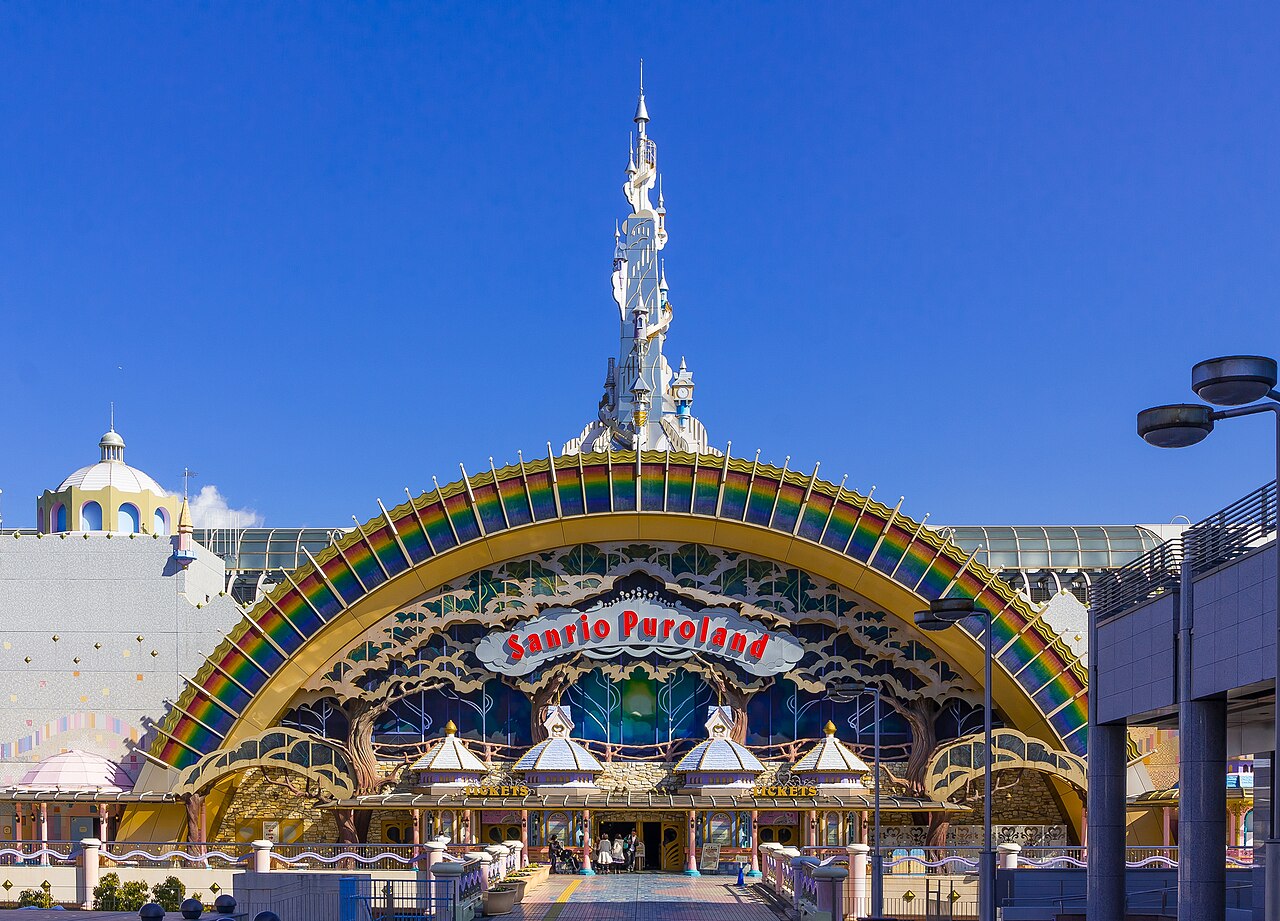
Sanrio Puroland, the company's indoor theme park in Tama, western Tokyo, opened in 1990. Photo: Kakidai, CC BY-SA 4.0, via Wikimedia Commons.
Meaning
Sanrio (サンリオ) is a Japanese 会社 founded in 1960 that designs, licenses, and sells キャラクター — original cartoon characters — printed on everything from stationery and stuffed animals to handbags, kitchenware, and credit cards. Its best-known character, Hello Kitty (ハローキティ, launched in 1974), is arguably the most recognizable 可愛い character on Earth, but Sanrio's roster also includes My Melody, Kuromi, Cinnamoroll, Pompompurin, Gudetama, Keroppi, and dozens more, each with its own backstory, friend group, and product line.
The business model behind this is sometimes called kyaraguzzu bijinesu (キャラグッズビジネス, "character goods business"): a character is created first, a personality and mini-mythology are built around it second, and merchandise follows. Unlike a mascot invented to promote an existing product, a Sanrio character is the product — its image is licensed onto thousands of unrelated goods, and the company profits from ライセンス fees and its own retail stores as much as from manufacturing anything itself.
Origin and History
Sanrio was founded by Shintaro Tsuji in 1960 as the Yamanashi Silk Center, a company that originally sold rubber sandals printed with cute illustrations. Tsuji noticed that adding a simple picture to an everyday object made it sell far better, and he pivoted the company toward designing and licensing original characters — renaming it Sanrio (from the Spanish san río, "holy river") in 1973.
Hello Kitty debuted in 1974 on a small vinyl coin purse, drawn by designer Yuko Shimizu. She was deliberately given almost no backstory or mouth, on the idea that a blank expression lets the viewer project their own mood onto her — a design choice Sanrio has cited for decades as key to the character's universal appeal. Hello Kitty is officially a British schoolgirl named Kitty White who lives outside London with her family, a detail most fans outside Japan don't even know.
Hello Kitty as a Global Phenomenon
By the 2000s, Hello Kitty had grown from stationery mascot into a full 象徴 of Japanese 可愛い (kawaii) culture recognized worldwide. She has appeared on private jets, Air Asia livery, McDonald's Happy Meal toys, Fender guitars, and countless luxury collaborations, and Sanrio has run branded cafes and the indoor theme park Sanrio Puroland (サンリオピューロランド) in Tama, western Tokyo, since 1990.
Her popularity outlasted the peak of the character-goods boom that produced her: while Sanrio's Japanese sales dipped in the 2000s as its core audience of schoolgirls diversified into anime and idol fandoms, Hello Kitty merchandise abroad — especially in North America, Latin America, and Southeast Asia — kept growing, making her one of the most successful licensing properties any Japanese company has ever produced, on par with major anime and video game franchises in revenue.
Other Notable Sanrio Characters
| Character | Debut | Profile |
|---|---|---|
| ハローキティ Hello Kitty | 1974 | White 猫 with a red bow; the flagship character |
| マイメロディ My Melody | 1975 | Pink hooded rabbit, gentle and kind |
| ポムポムプリン Pompompurin | 1996 | Lazy golden retriever puppy who loves pudding |
| けろけろけろっぴ Keroppi | 1988 | Cheerful frog from Donut Pond |
| クロミ Kuromi | 2005 | My Melody's mischievous rival; punk-styled skull-and-crossbones motif |
| シナモロール Cinnamoroll | 2001 | White puppy with long ears he can fly with; cafe mascot origin |
| ぐでたま Gudetama | 2013 | A perpetually exhausted, boneless egg yolk — a deliberately anti-cute, deadpan character reflecting a later shift in Sanrio's tone |
Kuromi in particular illustrates how Sanrio has diversified beyond pastel cuteness: her gothic, rebellious design attracted a teen and young-adult fanbase quite different from Hello Kitty's original audience, and she has become one of the company's most popular characters among older fans and internationally on social media in the 2020s.
Character Goods Culture (キャラグッズ)
Japan's broader kyaraguzzu (グッズ) culture long predates and extends well past Sanrio — it includes anime and game merchandise, 玩具 capsule toys (gacha), and stationery lines from many companies — but Sanrio helped establish its commercial template: characters with no fixed narrative medium (no ongoing manga or TV series required) that exist purely to be liked and collected. This is part of why Sanrio characters differ from yuru-chara (ゆるキャラ), Japan's local and corporate mascot characters — see the yuru-chara article — which are typically created to promote a specific region, event, or organization rather than to be sold as standalone goods.
かわいいものを持っているだけで、少し幸せな気持ちになる。 Just having something cute makes you feel a little happier.
This sentiment, often expressed by Sanrio fans, captures the emotional logic of the business: goods are bought less for utility than for the small daily comfort of 可愛い design. Fans might carry a Hello Kitty 財布 and バッグ, decorate their 文房具 with My Melody stickers, and give Pompompurin plushies as プレゼント for a friend's 誕生日.
Cultural Context
Sanrio's success is often cited as one of the clearest examples of Japan's postwar soft-power 輸出, alongside anime, manga, and video games. Its characters helped popularize "kawaii" as an aesthetic category recognized outside Japan, well before the term entered English dictionaries. Government and tourism campaigns have at times drawn on this recognition (Hello Kitty served as a tourism ambassador for Japan in the 2000s), even though Sanrio itself is a private 企業 with no formal government role.
Domestically, Sanrio characters occupy a specific niche distinct from anime/manga IP and from yuru-chara: they belong to no fixed story, age bracket, or region, which is precisely what let Hello Kitty travel so easily across cultures and generations — from 1970s schoolgirls to the character's own late-2020s fanbase of adult collectors, many of whom grew up with her and now buy nostalgia-driven 商品 as adults.
Related Terms
- キャラグッズ (kyaraguzzu) — character goods/merchandise generally
- かわいい文化 (kawaii bunka) — kawaii culture, the broader aesthetic movement
- ゆるキャラ (yuru-chara) — regional/corporate mascot characters; see the dedicated yuru-chara article for how this related but distinct category works
- 推し活 (oshikatsu) — the broader fan-support culture that also drives character-goods buying
Related Dictionary Words
character; personality; disposition
cute; adorable; charming; lovely; pretty
company; corporation; firm
commodity; article of commerce; goods; stock; merchandise
export; exportation
enterprise; business; company; corporation
goods; merchandise; commercial items
cat (esp. the domestic cat, Felis catus); feline
girl; daughter; baby girl
popularity; public favor
culture; civilization; civilisation
toy
bag
wallet; purse; coin purse; billfold; pocketbook
birthday
present; gift
stationery
license; licence
mascot
amusement park