ゆるキャラ
yuru kyaraYuru-chara are Japan's beloved official mascot characters representing local governments, regions, events, and companies, known for their deliberately awkward charm and kawaii design.
Meaning
ゆるキャラ (yuru-chara) is a portmanteau of ゆるい (yurui, meaning loose, relaxed, or easygoing) and キャラクター (character). It refers to the category of official マスコット characters created to represent Japanese local governments, prefectures, cities, towns, events, and corporations.
The term was coined around 2004 by manga artist and cultural commentator Miura Jun (みうらじゅん), who used it to describe the wave of endearingly awkward mascot characters appearing across Japan. Unlike polished commercial mascots, yuru-chara are deliberately loose — slightly off, unpretentious, and all the more lovable for it.
The Three Criteria
Miura Jun outlined three unofficial but widely cited criteria that define a true yuru-chara:
| Criterion | Japanese | Description |
|---|---|---|
| Strong message | メッセージ性 | The character embodies a clear concept or the identity of its region |
| Awkward movement | ゆるい動き | Clumsy, waddling, or fumbling behavior that evokes warmth and protectiveness |
| Lovable personality | 愛らしい性格 | An unpretentious, friendly character with no pretension of being cool |
The deliberate imperfection is essential. A too-polished mascot loses the yuru quality. It is precisely the wobbling gait, oversized costume head, and stumbling at public appearances that make audiences feel 愛らしい affection.
Famous Examples
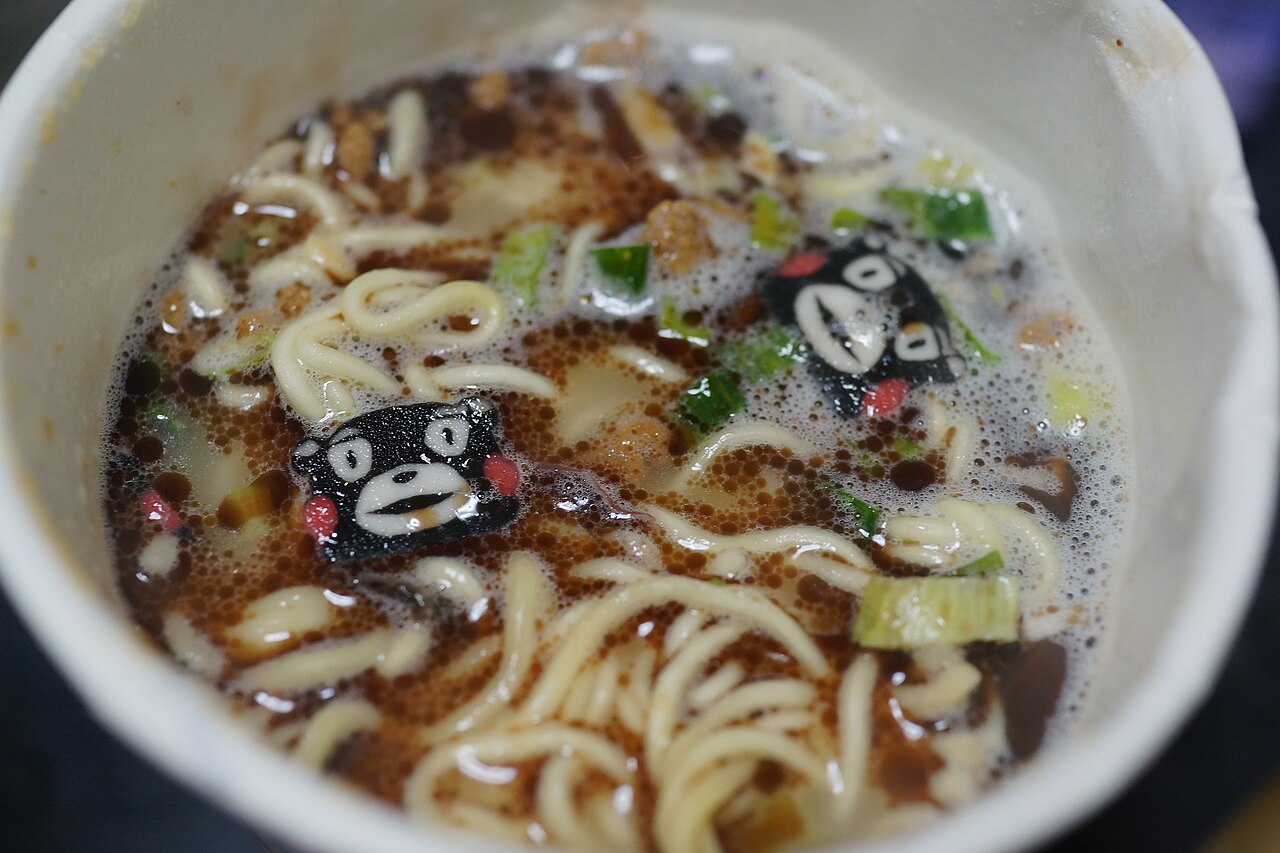
Kumamon (くまモン), the official mascot of Kumamoto Prefecture. Photo: ayu oshimi, CC BY-SA 2.0, via Wikimedia Commons.
くまモン (Kumamon) — Kumamoto Prefecture
Kumamon is arguably the most 経済ally successful yuru-chara ever created. Designed in 2010 to promote Kumamoto Prefecture after the Kyushu Shinkansen opening, the round black bear with rosy cheeks became a national sensation. Kumamoto Prefecture licenses the Kumamon image for free to qualifying businesses, and by the mid-2010s Kumamon-branded products were generating over 1,000 億円 (100 billion yen) in annual sales. He has appeared in everything from packaging and clothing to international campaigns, and has been used as a tool of soft power diplomacy abroad.
ふなっしー (Funassyi) — Funabashi City
Funassyi is a pear spirit mascot representing Funabashi City in Chiba Prefecture — with a twist: it is an unofficial character that was never 公式ly sanctioned by the city government. Operated by a single individual and known for high-energy, screaming stage performances and a catchphrase of "nashiiiー!" (なしー!), Funassyi became a genuine celebrity, appearing on national television and at major events. Its success as an unofficial character challenged the assumption that only government-backed mascots could achieve prominence.
ひこにゃん (Hikonyan) — Hikone City
Hikonyan, a samurai-helmeted white cat representing Hikone City in Shiga Prefecture, was one of the earliest breakout yuru-chara stars. Created in 2007 for the 400th anniversary of Hikone Castle, Hikonyan helped establish the template for the phenomenon and inspired countless imitators across Japan.
Cultural Context
Yuru-chara sit at the intersection of several deep currents in Japanese culture. They are a product of 地域 identity politics — Japan's local governments compete intensely for tourism revenue, investment, and national attention, and an effective mascot can put an otherwise-overlooked 地方 town on the map. They are also an expression of Japan's kawaii aesthetic applied to civic branding, using the logic of 萌え — emotional attachment triggered by cute or vulnerable character design — to build affection for a place rather than a fictional persona.
The phenomenon accelerated in the 2000s alongside social media, which allowed mascot characters to develop fan bases and go viral beyond their home regions. By the early 2010s, hundreds of new yuru-chara were being created each year by local governments hoping to replicate Kumamon's economic success.
ゆるキャラグランプリ (Yuru-Chara Grand Prix)
From 2010 to 2020, the annual Yuru-Chara Grand Prix (ゆるキャラグランプリ) held online voting competitions to crown Japan's most popular mascot. At its peak the contest attracted tens of millions of votes and intense local rivalry, with regional governments mobilizing citizens and businesses to vote for their mascot. The competition generated enormous media coverage and became a cultural event in itself, though it was eventually discontinued in 2020 amid concerns that the voting had become dominated by organized campaigns rather than genuine grassroots popularity.
Economic and Social Impact
The yuru-chara boom had measurable economic effects. Beyond Kumamon's extraordinary figures, mascots became a standard tool of regional revitalization (地域おこし, chiiki okoshi). Tourism boards, product manufacturers, and event organizers all found that a well-loved キャラ could drive consumer spending and media attention.
Yuru-chara also became an export of Japanese soft power. Kumamon made appearances in Taiwan, China, and Southeast Asia, and the concept of government-sponsored cute mascots influenced neighboring countries. The ブランドing logic of yuru-chara — using designed lovability to create regional identity — has been studied internationally as a model for place marketing.
Criticism and Saturation
By the 2010s, critics noted that Japan had produced so many yuru-chara that most failed to stand out. Estimates suggested there were over 1,500 active mascots competing for attention. Some local governments spent millions of yen creating mascots that were quickly forgotten, leading to debates about wasteful spending. The term "yuru-chara fatigue" (ゆるキャラ疲れ) entered popular discourse, and the Grand Prix's discontinuation reflected a broader sense that the phenomenon had peaked.
Nevertheless, the most successful characters remain beloved cultural institutions, and new mascots continue to be created. Kumamon in particular has transcended the yuru-chara category to become a genuinely iconic Japanese character recognized internationally.
Related Terms
- ご当地キャラ (gotōchi kyara) — Regional characters; overlaps significantly with yuru-chara but emphasizes local identity over looseness/awkwardness
- 着ぐるみ (kigurumi) — The full-body costume suits that performers wear to embody yuru-chara at public events
- 地域おこし (chiiki okoshi) — Regional revitalization; the broader movement that yuru-chara serve
- ゆるい — The source adjective: loose, relaxed, not trying too hard