サザエさん
sazae-sanThe Guinness World Record-holding anime about an ordinary Tokyo family, whose Sunday-evening ending theme is so tied to the end of the weekend that it gave its name to "Sazae-san Syndrome," Japan's term for the Sunday-night blues.
Meaning
サザエさん (Sazae-san) is the title character and the name of Japan's best-known family sitcom — a comic strip turned television anime about the unremarkable daily life of an ordinary middle-class Tokyo household. The anime has aired on Fuji TV every Sunday evening without interruption since October 5, 1969, making it the longest-running animated television series in the world, a title officially recognized by Guinness World Records.
But サザエさん means more than a TV show. Because the series airs at 6:30 p.m. on Sundays — the last stretch of the weekend before Monday classes and workdays resume — its ending theme has become a kind of national alarm clock. Hearing it triggers a specific, widely-recognized feeling of dread that Japanese people call サザエさん症候群 (Sazae-san shōkōgun, "Sazae-san Syndrome"): the creeping gloom of realizing free time is over. It's a concept-with-a-name that doesn't map neatly onto any single English word, and it's arguably more culturally significant today than the show's plots themselves.
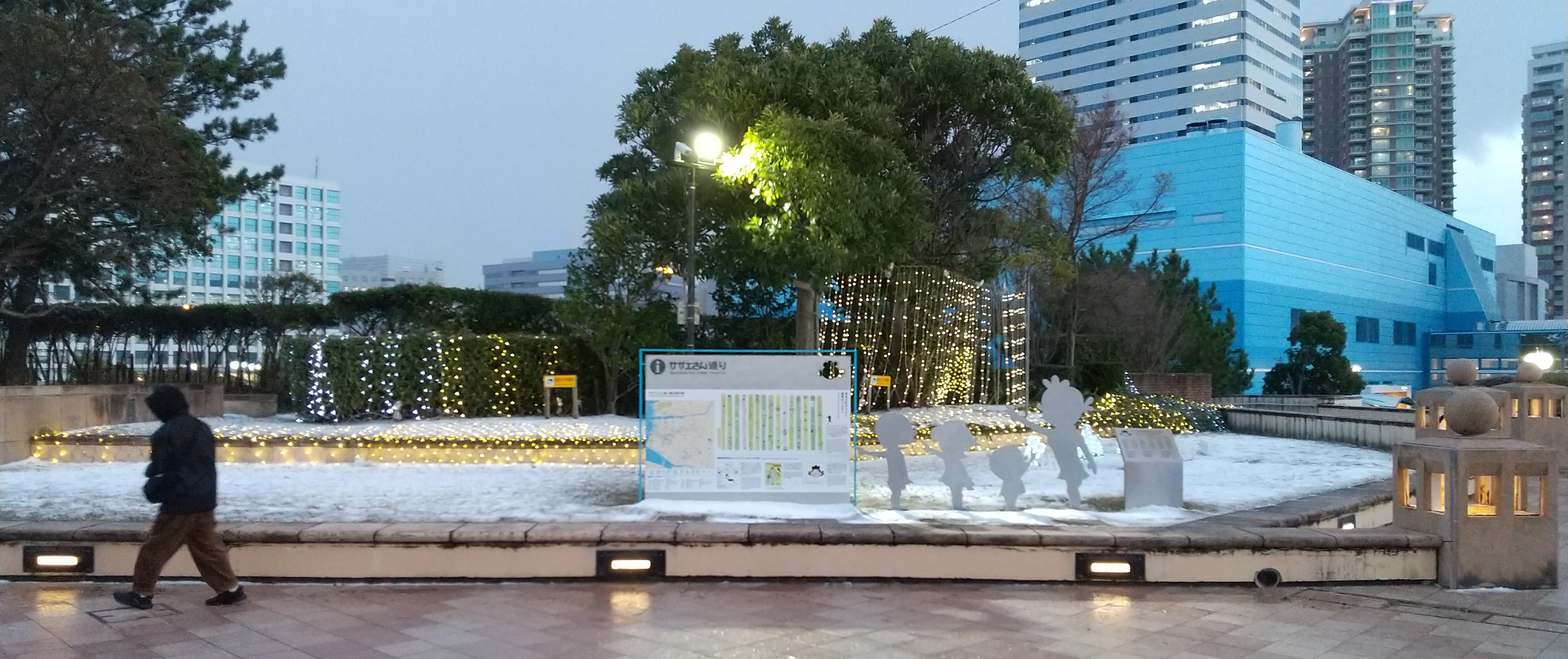
Sazae-san-dōri, a shopping street in Fukuoka's Momochihama district, near where creator Machiko Hasegawa once lived and reportedly conceived the story. Photo: Hirho, CC BY-SA 4.0, via Wikimedia Commons.
The Isono-Fuguta Family
The series follows three generations living under one roof — the Isono family, joined by Sazae's husband Masuo, who takes the unusual step (for 1940s fiction) of marrying into his wife's household rather than the reverse. True to a running joke among fans, nearly every character's name is fished (sometimes literally) from the sea, reflecting creator Machiko Hasegawa's fondness for the Fukuoka coastline where she first sketched the family.
| Character | Relationship | Name meaning |
|---|---|---|
| 磯野サザエ (Isono Sazae) | Protagonist, eldest daughter | sazae — a turban shell (a spiral sea snail) |
| 磯野波平 (Isono Namihei) | Sazae's father | nami (wave) + hei, a common name suffix |
| 磯野フネ (Isono Fune) | Sazae's mother | fune — boat |
| 磯野カツオ (Isono Katsuo) | Sazae's younger brother | katsuo — bonito (a fish) |
| 磯野ワカメ (Isono Wakame) | Sazae's younger sister | wakame — a type of edible seaweed |
| フグ田マスオ (Fuguta Masuo) | Sazae's husband | fugu — pufferfish |
| フグ田タラオ (Fuguta Tarao) | Sazae and Masuo's son, "Tara-chan" | tara — cod |
| タマ (Tama) | The family cat | generic cat name, unrelated to the sea theme |
Hasegawa intended the Isono-Fuguta household to represent an idealized, everyday postwar Japanese family — never rich, never poor, occasionally squabbling but fundamentally warm. Each episode is typically three unconnected short stories built around small domestic mishaps: Namihei losing his temper, Katsuo dodging homework, Sazae misunderstanding a neighbor. There is no ongoing plot to follow and, famously, no character ever ages — more on that below.
History & Origins
Machiko Hasegawa (長谷川町子, 1920–1992), one of Japan's first professional female cartoonists, created サザエさん as a four-panel newspaper comic (yonkoma) in 1946, shortly after the end of World War II. She has said the idea came to her while walking along Momochihama beach in Fukuoka with her sister, naming the characters after things they saw by the water. The strip ran first in the local Fukunichi Shimbun and later, from 1949 to 1974, in the national Asahi Shimbun — by the end of its run, roughly 6,477 strips had been published, collected into 68 volumes that have sold well over 100 million copies combined.
The anime adaptation, produced by TCJ (now Eiken), premiered on Fuji TV on October 5, 1969, and has continued in weekly first-run production ever since — not reruns, but newly animated episodes, decade after decade. As of the most recent Guinness World Records renewal in November 2024, サザエさん had been on the air for 55 years, surpassing its own previous record and putting it well ahead of competitors like The Simpsons. Voice actress 加藤みどり (Katō Midori) has played Sazae herself since the very first episode in 1969, which itself earned a second Guinness World Record for longest career voicing a single animated character.
Sazae-san Syndrome (サザエさん症候群)
This is the concept that makes サザエさん more than television trivia. サザエさん症候群 describes the specific wave of anxiety, melancholy, and physical unease — sometimes reported as fatigue, stomachache, or trouble sleeping — that hits as Sunday evening winds down and Monday looms. The name comes directly from the show's timeslot: because サザエさん has aired at 6:30 p.m. every Sunday for over half a century, its cheerful ending theme has become an unmistakable, almost Pavlovian signal that the weekend is officially over.
日曜日の夜、サザエさんのエンディングを聞くと憂鬱になる。 Nichiyōbi no yoru, Sazae-san no endingu o kiku to yūutsu ni naru. "Hearing the Sazae-san ending on Sunday night makes me feel gloomy."
また明日から仕事か…サザエさん症候群だ。 Mata ashita kara shigoto ka… Sazae-san shōkōgun da. "Work again starting tomorrow... it's the Sazae-san blues."
The phrase is not a clinical diagnosis — it's closer to a shared cultural shorthand, the Japanese equivalent of what English speakers call "the Sunday scaries" — but it is used constantly and unironically in everyday conversation, magazine features, workplace small talk, and even by counselors discussing mild work-related anxiety. Public surveys on the topic vary, but several consumer polls have found that roughly half of respondents say the feeling resonates with them, and it shows up as a recurring theme in Japanese pop psychology writing every autumn as the school and fiscal year settle into its weekly rhythm.
A few related terms circle the same idea:
| Term | Literal sense | Nuance |
|---|---|---|
| サザエさん症候群 | "Sazae-san syndrome" | The specific, TV-cued version of Sunday dread |
| ブルーマンデー症候群 | "Blue Monday syndrome" | The broader psychological term for Monday-onset anxiety |
| 月曜病 (getsuyōbyō) | "Monday sickness" | Casual term for feeling unwell or unmotivated on Mondays |
| サザエさんタイム (Sazae-san taimu) | "Sazae-san time" | The dwindling hour before the show airs, when people rush to finish weekend errands |
What makes サザエさん症候群 a great example of Japanese having a precise word for a universal feeling: English speakers clearly feel the same dread, but without a single show that half the country watches at the same hour every week, there's no equally specific cultural hook to hang it on. In Japan, the association is so strong that some parents and productivity writers half-jokingly recommend avoiding the broadcast entirely to dodge the mood it triggers.
A World That Never Ages: Sazae-san Time-Space
Fans have their own term for another quirk of the show: サザエさん時空 ("Sazae-san time-space"), the observation that decades pass in the real world while the Isono-Fuguta family stays frozen in place. Sazae remains 24, Katsuo remains an 11-year-old fifth-grader, and Namihei never loses another hair — even as the show's backgrounds quietly update to include smartphones, convenience stores, and Tokyo Skytree. The phrase has become general internet shorthand in Japan for any long-running series where characters mysteriously never age despite an ever-advancing setting.
Records & Legacy
- Longest-running animated TV series — Guinness World Records, first awarded in 2013 and repeatedly extended; as of the November 2024 renewal, サザエさん had aired continuously for 55 years.
- Longest career voicing a single animated character (female) — held by Katō Midori, who has voiced Sazae since 1969.
- Cultural landmark status — Sazae-san-dōri ("Sazae-san Street") in Fukuoka's Momochihama district and a separate namesake street in Sakura-Shinmachi, Tokyo (where Hasegawa later lived) both honor the series with statues, signage, and the Hasegawa Machiko Art Museum.
- Generational reach — the show is regularly watched across three or four generations of the same family at once, a rarity for any television program anywhere.
For a series with almost no ongoing plot, no character growth, and no season finales, サザエさん's staying power says something distinct about its role in Japanese life: it isn't appointment television so much as a weekly ritual, one so reliable that its own ending theme became a byword for the end of the weekend itself.
Usage
As a proper noun, サザエさん simply refers to the show, the manga, or the title character:
うちの祖母はサザエさんを毎週欠かさず見ています。 Uchi no sobo wa Sazae-san o maishū kakasazu mite imasu. "My grandmother watches Sazae-san every single week without fail."
As shorthand for the feeling, サザエさん症候群 (or just "サザエさんが始まった…", "Sazae-san just started...") signals that the weekend's over:
サザエさんが始まった…週末が終わる。 Sazae-san ga hajimatta… shūmatsu ga owaru. "Sazae-san just started... the weekend's ending."