宝塚歌劇団
Takarazuka KagekidanJapan's all-female musical theater troupe, founded in 1914, famous for its otokoyaku male-role stars and lavish revue-style productions.
Meaning
Takarazuka Revue (宝塚歌劇団, Takarazuka Kagekidan) is an all-female Japanese musical theater company based in the city of Takarazuka, Hyōgo Prefecture, just outside Osaka. Every role in every production — from dashing princes to elegant heroines to comic villains — is played by a woman. The troupe is best known for its 男役 (otokoyaku, "male-role" actresses), who specialize in playing men with a stylized, idealized masculinity, and its 娘役 (musumeyaku, "female-role" actresses), who play women opposite them. Founded in 1914, Takarazuka has grown into one of Japan's most enduring and distinctive performing-arts institutions, with roughly 400 performers organized into five numbered troupes.
History and Founding
Takarazuka was created in 1913–1914 by the railway and business magnate Ichizō Kobayashi, president of the Hankyu Railway. Kobayashi wanted to draw passengers to the end of his new rail line in the hot-spring town of Takarazuka, and he hit on the idea of a wholesome, family-friendly theatrical spectacle that would double as a tourist attraction. He deliberately made the troupe all-female — a mirror image of the all-male 歌舞伎 tradition — partly to distinguish it from the disreputable associations then attached to actresses, and built the company around a guiding motto that remains its official slogan today: Kiyoku, Tadashiku, Utsukushiku (清く正しく美しく, "Modest, Fair, Beautiful"). The first performance was staged in 1914; by the 1920s the company had moved into an increasingly ambitious Western-style 舞台 (stage) format blending operetta, ballet, and revue numbers with Japanese theatrical sensibility, and it has performed continuously (aside from wartime interruptions) ever since. Today the company is owned by the Hankyu Hanshin Holdings conglomerate and performs at the Takarazuka Grand Theater and the Tokyo Takarazuka Theater in Hibiya.
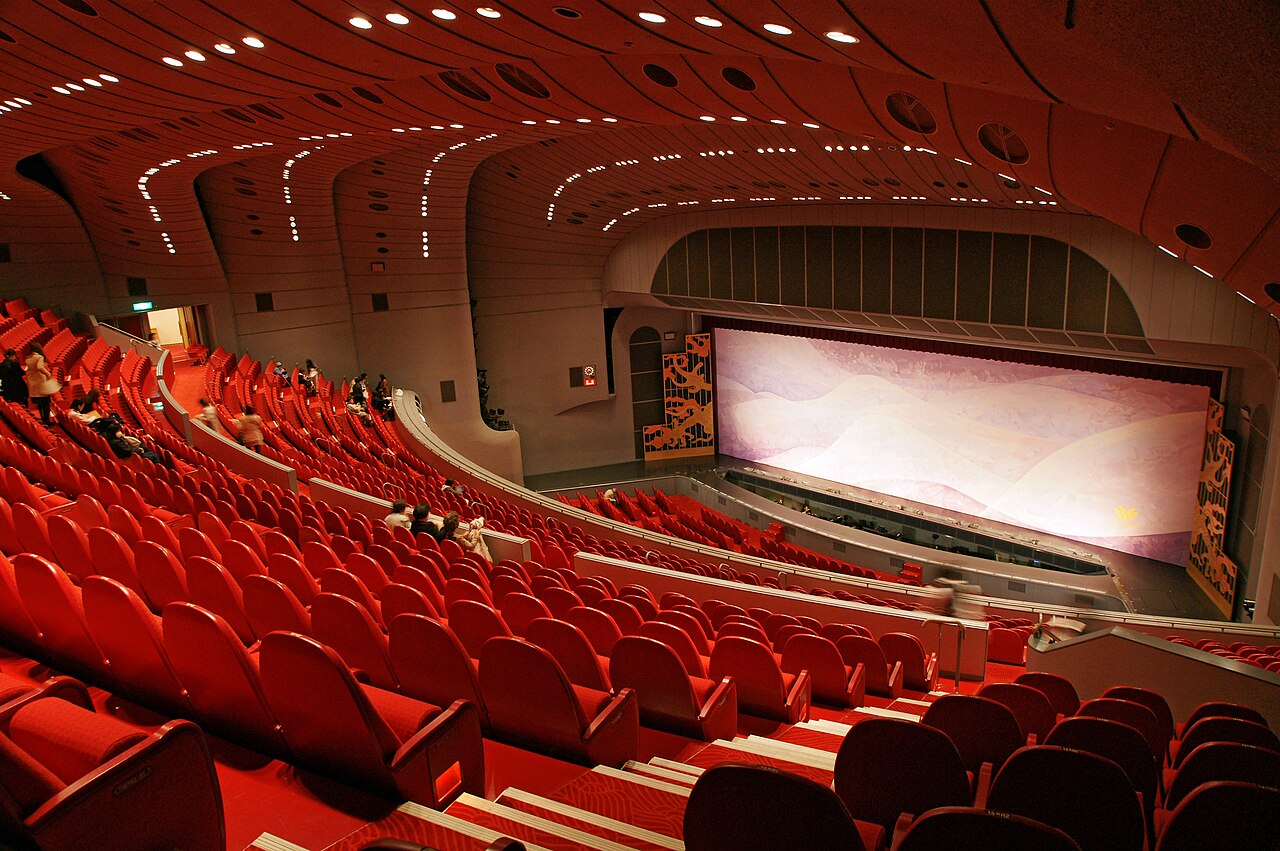
The Takarazuka Grand Theater in Takarazuka, Hyōgo, home stage of the Revue. Photo: 663highland, CC BY 2.5, via Wikimedia Commons.
The Otokoyaku and Musumeyaku System
The heart of Takarazuka's appeal is its strict division between male-role and female-role specialists, decided early in a performer's career and rarely changed afterward. An otokoyaku trains extensively to master a lowered vocal register, broad-shouldered posture, cropped and slicked-back hairstyles, and a confident, chivalrous stage manner intended to embody an idealized, romantic masculinity rather than to imitate real men. A musumeyaku, by contrast, cultivates conventionally feminine grace, higher vocal tone, and elaborate costuming. Each production is built around a lead pair — the Top Star (トップスター), always an otokoyaku, and her Top Musumeyaku partner — whose on-stage chemistry drives ticket sales and fan devotion. Because otokoyaku perform a constructed, larger-than-life ideal of male charm — attentive, elegant, emotionally expressive in ways real men on stage or screen rarely are — they have become iconic figures in Japanese pop culture, admired above all by the Revue's overwhelmingly female audience.
Troupe Structure
Since the early 20th century, Takarazuka's roughly 400 performers have been organized into distinct troupes, each with its own Top Star pair, repertoire, and devoted fan following:
| Troupe | Japanese | Founded |
|---|---|---|
| Flower (Hana-gumi) | 花組 | 1921 |
| Moon (Tsuki-gumi) | 月組 | 1921 |
| Snow (Yuki-gumi) | 雪組 | 1924 |
| Star (Hoshi-gumi) | 星組 | 1933 |
| Cosmos (Sora-gumi) | 宙組 | 1998 |
A sixth group, Senka (専科, "specialty course"), sits outside the troupe rotation. It is made up of senior, highly experienced performers — often former Top Stars — who are loaned out to guest-star in productions across all five troupes, or take on especially demanding character roles that call for seasoned skill.
The Takarazuka Music School
Every performer passes through the same narrow gate: the Takarazuka Music School (宝塚音楽学校), a two-year academy in the city of Takarazuka that accepts roughly 40 生徒 (students) a year — typically teenage girls fresh out of junior high or high school — from an applicant pool that can number well over a thousand. The curriculum covers Western and Japanese dance, vocal training, acting, and piano, but the school is equally famous for its severe internal discipline: first-year students rise before dawn to clean the school grounds, must bow and defer to every upperclassman, and are forbidden from even walking in front of a senior student. Graduation (卒業, sotsugyō) leads directly into assignment to one of the five troupes as a full Takarasienne (タカラジェンヌ), the affectionate term for a Takarazuka performer, and — notably — into the expectation that a performer will eventually retire (graduate from the Revue itself) while still relatively young, often to make way for the next generation of stars.
Style and Productions
A typical Takarazuka program pairs a full-length dramatic musical — adapted from European history, Japanese literature, Shakespeare, or manga — with a second-half revue: a dazzling, plotless sequence of song-and-dance numbers built around elaborate feather headdresses, sequined costumes, and a signature moment in which the cast descends Takarazuka's famous grand staircase (大階段) in a blaze of lights. The blend of Broadway- and Parisian-revue-style spectacle with distinctly Japanese pacing, vocal style, and emotional register is the troupe's signature aesthetic, and it has rarely been imitated successfully outside the company itself.
Fandom
Takarazuka fans (タカラヅカファン) form one of Japan's most tightly organized and loyal fan cultures. Individual performers, and especially Top Stars, have official fan clubs that coordinate ticket-buying, gift-giving, and etiquette around performances — including strict rules about applause timing and standing to greet a star's entrance. Because tickets are notoriously hard to obtain and the fandom skews heavily toward women of all ages, Takarazuka fandom has been studied by sociologists as an early, influential example of intense parasocial celebrity devotion in Japan, predating and paralleling the idol industry.
Cultural Influence
Takarazuka's visual and emotional grammar — androgynous, glamorous men played by women; sweeping, melodramatic romance; elaborate period costuming — has fed directly back into Japanese pop culture, especially shōjo manga. The clearest example is Riyoko Ikeda's manga The Rose of Versailles (ベルサイユのばら, 1972), whose cross-dressing heroine Oscar François de Jarjayes was itself partly modeled on the otokoyaku archetype; Takarazuka's own 1974 stage adaptation became a sensation (the "Berubara Boom") that in turn cemented the Top Star system still used today. That two-way exchange between Takarazuka and shōjo manga helped establish enduring archetypes — the beautiful, chivalrous "prince" figure and the gender-bending heroine — that recur throughout later manga and anime, from The Rose of Versailles itself to Revolutionary Girl Utena and beyond.
Notable Alumnae
Several Takarazuka graduates have gone on to prominent careers in Japanese film, television, and stage beyond the Revue, carrying its distinctive stage presence and vocal training into the wider entertainment industry. The company has also inspired stage adaptations and homages abroad, and its performers occasionally tour internationally, though its core audience and cultural footprint remain concentrated in Japan.
Related Dictionary Words
opera company; opera troupe; musical revue; operetta company; operetta troupe
male part or role
female part or role (drama, kabuki, etc.)
flower; blossom; bloom; petal
Moon
snow; snowfall
star (usu. excluding the Sun); planet (usu. excluding Earth); heavenly body
space; air; midair
music school; music academy; conservatory
drama; theatre; theater; play
stage (of a theatre, concert hall, etc.)
rose
revolution
pupil; student; schoolchild
graduation; completion (of a course)
practice; practising; training; study