侘び寂び
wabi-sabiThe Japanese aesthetic philosophy of finding beauty in imperfection, impermanence, and incompleteness, rooted in Zen Buddhism and the tea ceremony tradition.
Meaning
Wabi-sabi (侘び寂び) is one of the most distinctive and enduring concepts in Japanese aesthetics — a worldview that embraces the beauty found in things that are imperfect, impermanent, and incomplete. Rather than seeking flawlessness, wabi-sabi finds value and even elegance in the rough, the worn, the weathered, and the transient.
The term combines two separate words with overlapping but distinct meanings. 侘び (wabi) originally carried a sense of loneliness or hardship but evolved to describe a quiet, austere simplicity — a humble beauty stripped of excess. 寂 (sabi) refers to the quality of age and wear that accumulates on things over time: the patina of an old bronze bell, the moss on a stone lantern, the faded ink of a brushwork scroll. Together, they describe an 美意識 — an aesthetic sensibility — that perceives loveliness precisely where perfection is absent.
At its philosophical core, wabi-sabi is inseparable from the Buddhist recognition of 無常 (mujō) — impermanence — one of the three marks of existence. Nothing lasts, nothing is finished, nothing is perfect. To wabi-sabi eyes, this is not a cause for sorrow but an invitation to appreciate things as they are, in this moment.
Origins
The intellectual roots of wabi-sabi reach back to thirteenth-century Japan, when Zen Buddhism took hold among the samurai and artistic classes. 禅 teachings emphasized direct experience over elaborate ritual, simplicity over ornamentation, and the present moment over anxious striving. These values permeated the arts, giving rise to forms of expression that prized restraint and naturalness.
The concept crystallized most powerfully in the Japanese 茶道 (chadō) — the way of tea. In the fifteenth century, the Zen priest Murata Jukō (村田珠光) began to reform the tea ceremony away from the then-fashionable Chinese style, which prized magnificent imported utensils and lavish displays. He introduced humble, unglazed domestic wares and small, rustic tea rooms as a deliberate aesthetic statement.
This direction was perfected in the sixteenth century by the legendary tea master Sen no Rikyū (千利休, 1522–1591), who is widely regarded as the single most influential figure in defining what wabi-sabi means in practice. Rikyū famously favored uneven 茶碗 (chawan, tea bowls) made by hand, rough-plastered walls, asymmetrical flower arrangements, and tea rooms so small — sometimes a mere two tatami mats — that all guests had to stoop through a tiny crawl entrance, erasing social distinctions. His vision synthesized aesthetics, ethics, and spirituality into a single, austere ideal.
Key Characteristics
Wabi-sabi can be recognized through several interlocking qualities:
Imperfection (不完全): Objects shaped by hand or by 自然 inevitably carry irregularities — a glaze that pools unevenly, a branch that grows at an odd angle. These flaws are not defects to be corrected but signatures of authenticity. An imperfect surface is alive in a way a machine-made one is not.
Impermanence: Cherry blossoms (sakura) are beloved in Japan not despite their brief season but because of it. The same principle applies to the rust on iron, the peeling paint of a wooden gate, the way afternoon light falls differently each day. Transience makes things precious.
Incompleteness: Wabi-sabi aesthetics often deliberately leave something unresolved — a gap in a garden fence, negative space in a painting, a haiku that trails into silence. The viewer or listener is invited to complete the meaning. This quality appears in the concept of ma (間), the meaningful pause or empty space that gives art room to breathe.
Naturalness: Wabi-sabi objects tend to reflect the materials they are made from rather than conceal them. Unvarnished wood, unpolished stone, clay fired without perfect control — these communicate an honest relationship between maker, material, and process.
Quietude: The overall mood is one of stillness, restraint, and modest scale. Wabi-sabi spaces do not shout.
In Design and Art
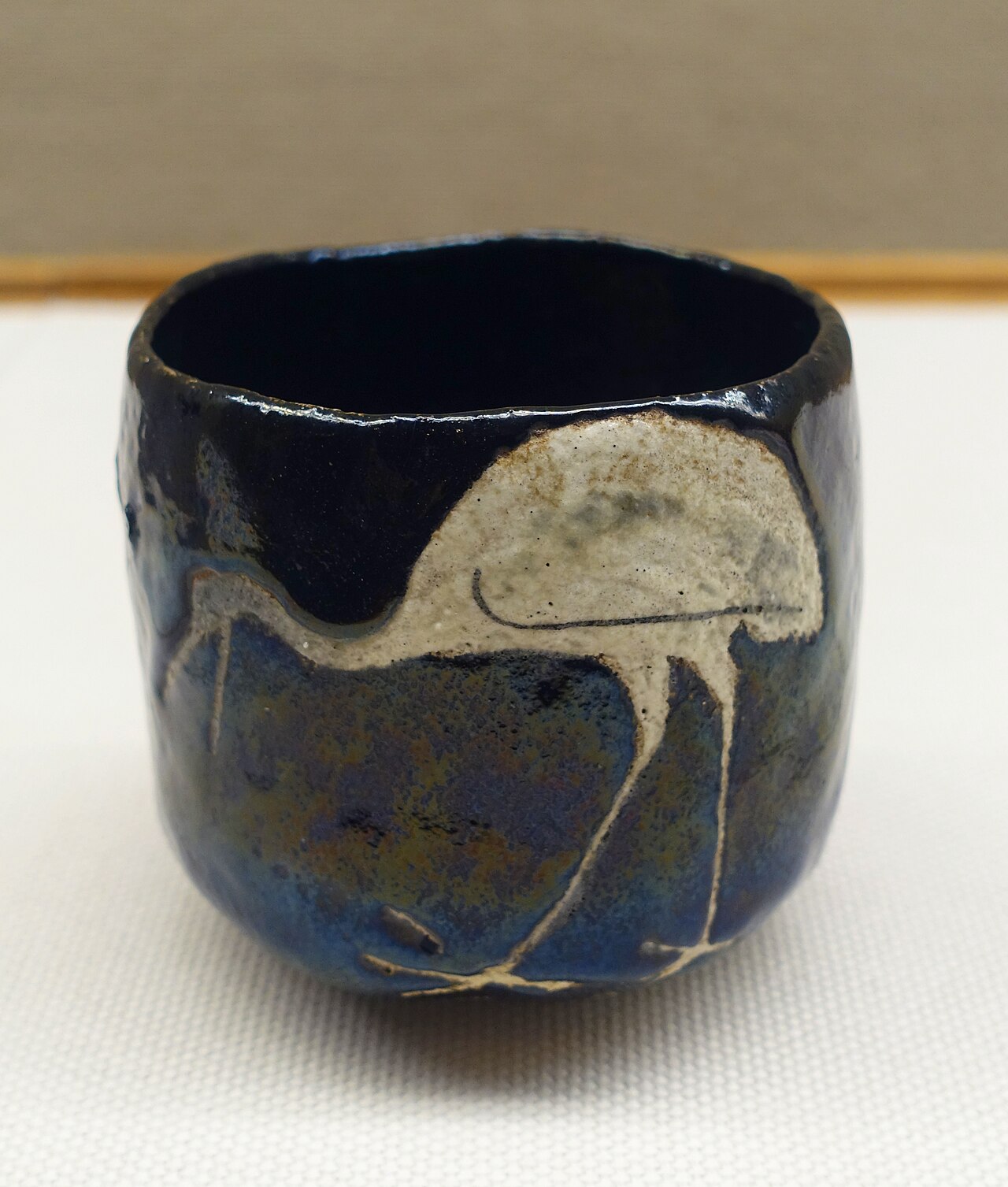
A black Raku-ware tea bowl from the Edo period, Tokyo National Museum. Public domain, via Wikimedia Commons.
The most iconic material expression of wabi-sabi is Raku ware (raku-yaki), the 陶芸 tradition developed in Kyoto during the sixteenth century at the request of Sen no Rikyū. Raku bowls are pinched by hand rather than thrown on a wheel, fired at low temperatures, and cooled rapidly — processes that produce irregular shapes, crackled surfaces, and unpredictable glazes. No two bowls are identical. The deliberate roughness is the point.
Kintsugi (金継ぎ) — the art of repairing broken pottery with gold lacquer — is wabi-sabi made explicit: the crack is not hidden but highlighted, transforming damage into history and beauty. See the kintsugi article for a deeper look at this related practice.
In garden design, wabi-sabi principles guide the famous karesansui (枯山水), or dry rock gardens, found at temples such as Ryōan-ji in Kyoto. Raked gravel represents water; weathered stones suggest mountains or islands. The 庭園 is unfinished in the sense that its meaning resists a single interpretation — each visitor sees something different.
俳句 (haiku) poetry embodies wabi-sabi in language. Matsuo Bashō (松尾芭蕉), the seventeenth-century master, captured fleeting natural moments in seventeen syllables:
古池や 蛙飛び込む 水の音 furu ike ya / kawazu tobikomu / mizu no oto "An old pond — a frog jumps in, sound of water."
The image is mundane, momentary, and irrepeatable. That is precisely its power.
生け花 (ikebana), the art of flower arrangement, applies the same principles: wildflowers over cultivated blooms, bare branches alongside a single blossom, asymmetry over symmetry, empty space as a compositional element rather than a void to be filled.
Modern Influence
Wabi-sabi remained largely a Japanese concern until the late twentieth century, when design writers and architects began to introduce the concept to Western audiences. Leonard Koren's 1994 book Wabi-Sabi for Artists, Designers, Poets and Philosophers is widely credited with bringing the term into global design discourse.
Since then, wabi-sabi has become a touchstone for movements reacting against mass production, digital perfection, and disposable culture. Its influence can be traced in:
- Scandinavian design, which shares an emphasis on natural materials, simplicity, and honesty of construction (hygge and wabi-sabi are frequently compared, though they are culturally distinct)
- The handmade and craft revival, where imperfect ceramics, hand-woven textiles, and artisan goods are valued precisely for their irregularity
- Minimalist interior design, where raw concrete, aged wood, patinated metal, and unbleached linen create spaces that feel worn-in and authentic rather than showroom-perfect
- Photography and visual art, where grain, blur, fading, and decay are embraced rather than corrected
Wabi-sabi offers a pointed contrast to dominant Western aesthetic ideals rooted in classical symmetry, rational proportion, and the pursuit of the ideal form. Where Greek aesthetics prize the perfect statue, wabi-sabi prizes the cracked bowl. Where digital culture prizes the retouched, wabi-sabi prizes the unfiltered.
In Japan, the concept permeates daily life in ways that are rarely articulated explicitly — in the preference for wooden chopsticks over plastic, the love of autumn leaves, the lingering attachment to old neighborhoods, the way a much-used tool is quietly cherished. Wabi-sabi is less a design philosophy than a disposition toward life: patient, attentive, and at ease with the passage of time.