和菓子
wagashiTraditional Japanese confectionery crafted with exceptional artistry, central to the tea ceremony and deeply intertwined with the seasons and gifting culture.
Meaning
和菓子 (wagashi) are traditional Japanese sweets whose name combines wa (和), meaning "Japanese" or "harmonious," and kashi (菓子), meaning confectionery or sweets. The term distinguishes these indigenous creations from yōgashi (洋菓子), the Western-style cakes and pastries that arrived during the Meiji era. Wagashi are not merely food — they are considered edible art, meticulously shaped and colored to evoke the natural world, the passing 季節, and poetic imagery drawn from classical literature.
At their core, most wagashi are built from a small repertoire of humble ingredients: 小豆 (azuki beans), 餅 (glutinous rice), 砂糖 (sugar), and 米粉 (rice flour). The art lies not in elaborate ingredients but in the transformation of these simple elements into objects of breathtaking delicacy.
Types of Wagashi
Wagashi encompass a wide family of sweets, traditionally classified by moisture content into namagashi (fresh sweets), han-namagashi (semi-dry), and higashi (dry sweets).
Namagashi — Fresh Sweets
Fresh wagashi are the most celebrated and perishable category, often lasting only one to three days.
- 練り切り (Nerikiri): The pinnacle of wagashi craft. Made from shiro-an (white bean paste) blended with glutinous rice, nerikiri is hand-shaped and colored to resemble 桜 blossoms, chrysanthemums, maple leaves, or seasonal fruits. Each piece is a miniature sculpture.
- 大福 (Daifuku): Soft, pillowy mochi skin stuffed with sweet bean paste. Ichigo daifuku, with a whole strawberry nestled inside, has become one of Japan's most beloved modern variations.
- Mochi: Pounded 餅 rice shaped into rounds and filled or coated in various ways — dusted in kinako (roasted soybean flour), wrapped around red bean paste, or flavored with 抹茶.
- Sakuramochi: A pink 桜-tinted mochi filled with anko and wrapped in a salt-pickled cherry blossom leaf. It is quintessentially 春.
- Kashiwa Mochi: Mochi filled with bean paste and wrapped in an oak leaf, traditionally eaten on Children's Day (May 5).
Han-namagashi — Semi-dry Sweets
- Monaka: Crisp wafers of baked mochi shell — often shaped like flowers, cranes, or seasonal motifs — filled with sweetened bean paste.
- Yokan (羊羹): A firm, dense jelly made from 小豆, 砂糖, and agar-agar. Neri-yōkan is solid; mizu-yōkan (water yokan) is softer and is a beloved 夏 sweet.
- Dorayaki: Two fluffy pancakes sandwiching a generous filling of tsubu-an (chunky red bean paste). Its round, golden shape is said to resemble a dora (Japanese gong).
Higashi — Dry Sweets
Dry wagashi have low moisture content and a long shelf life. They are typically served at formal tea ceremonies with thick 抹茶.
- Rakugan: Pressed sugar-and-rice-flour sweets molded into intricate seasonal shapes. Their chalky sweetness is designed to dissolve slowly against the bitterness of matcha.
- Konpeitō: Tiny star-shaped sugar crystals in bright colors, introduced by Portuguese traders in the 16th century and now fully assimilated into Japanese culture.
Wagashi and the Tea Ceremony
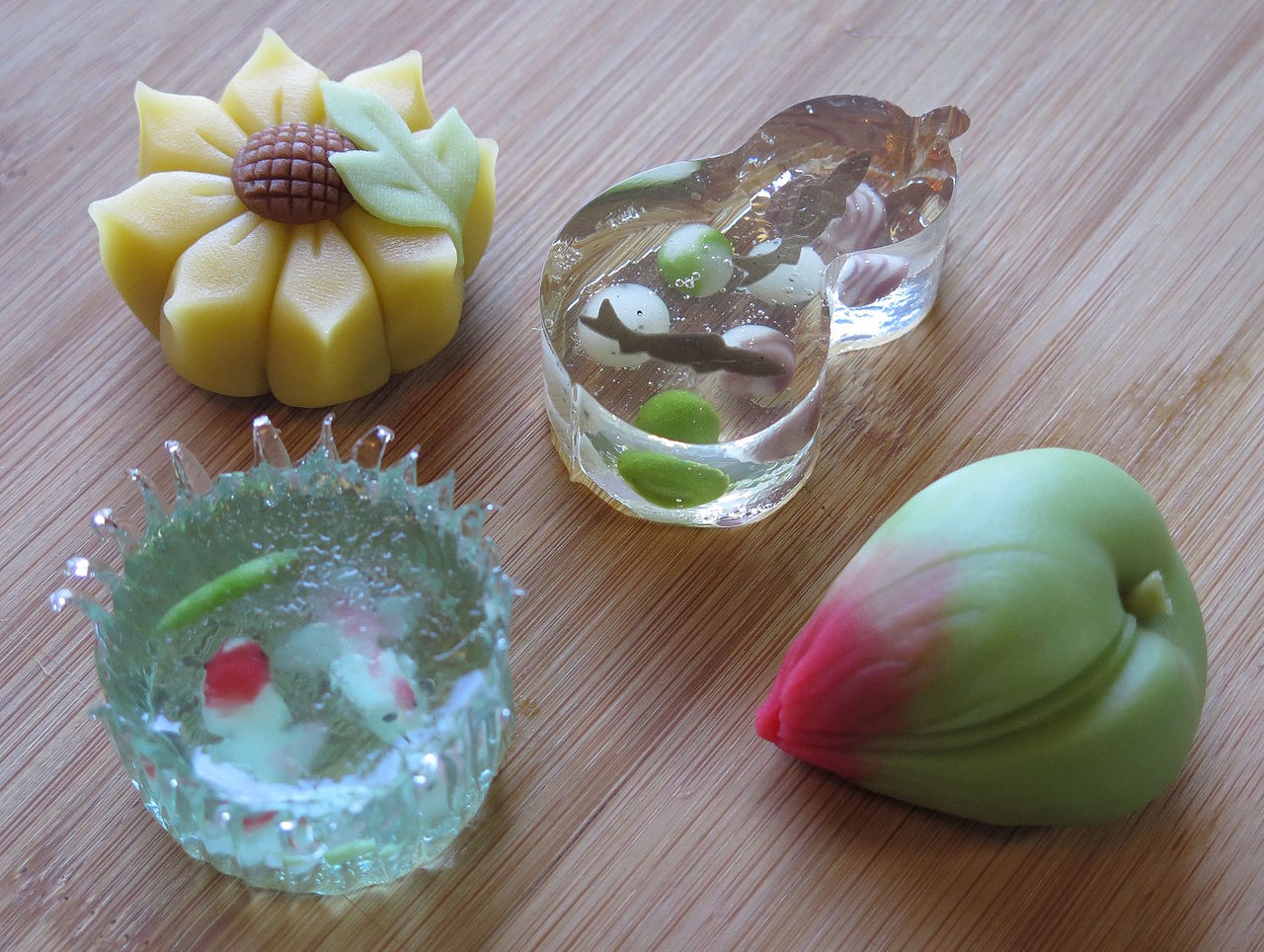
Summer wagashi arranged for serving. Public domain, via Wikimedia Commons (CC0, Douglas Perkins).
The relationship between wagashi and 茶道 (sadō / chadō, the Way of 茶) is inseparable. When the tea master Sen no Rikyū (1522–1591) codified the aesthetics of the tea ceremony in the late Sengoku period, wagashi were enshrined as an essential element of the ritual. The sweetness of the confection prepares the palate for the profound bitterness of 抹茶, creating a balance that is both culinary and philosophical.
In a formal tea ceremony, the host selects a wagashi that speaks to the season, the occasion, or a classical poem. A guest receiving a piece of nerikiri shaped like a snow-dusted pine bough in 冬 understands it as a complete aesthetic statement — a poem written in sugar and bean paste. The guest admires the piece before eating it, often asking the name (omae) of the sweet, which is given in the manner of a haiku title.
Wagashi served at tea ceremonies are categorized by timing:
- Omogashi / Jōnamagashi: Rich, moist sweets served before thick matcha (koicha).
- Higashi: Dry sweets served with thin matcha (usucha).
The concept of 風雅 (fūga — elegance, refinement) is central to how wagashi are judged. A wagashi master is expected to be fluent in classical poetry, the lunar calendar, and the symbolism of the natural world.
Seasonal Wagashi
The 季節 (seasons) are the lifeblood of wagashi culture. The Japanese calendar — with its 72 micro-seasons (shichijūni-kō) — gives wagashi artisans an almost limitless vocabulary of motifs. Department store wagashi counters refresh their displays monthly, and many celebrated confectioneries maintain strict seasonal menus.
| Season | Representative Wagashi | Motif |
|---|---|---|
| 春 | Sakuramochi, Uguisu Mochi | Cherry blossoms, bush warbler |
| 夏 | Mizu-yōkan, Kanten jelly | Water, fish, morning glory |
| 秋 | Momiji Manju, Kuri Kinton | Maple leaves, chestnut, moon |
| 冬 | Hanabira Mochi, Rakugan | Plum blossom, snow, crane |
Hanabira Mochi (花びら餅, "petal mochi") deserves special mention. Served only in January, it consists of a thin, flat mochi folded around miso-sweetened bean paste and a candied burdock root. It is the first wagashi of the New Year and carries deep ceremonial significance in Kyoto's Ura Senke tea school.
Tsukimi Dango (月見団子, moon-viewing dumplings) are stacked in a pyramid and offered during the mid-autumn moon-viewing festival (o-tsukimi) in September or October.
Seasonal wagashi are also central to Japan's gift-giving culture. Beautifully boxed assortments (omiage) from famous regional confectioneries are among the most treasured gifts one can bring back from a trip.
The Art of Wagashi Making
A skilled wagashi 職人 (shokunin, artisan) undergoes years of apprenticeship — traditionally a minimum of three to five years — before being entrusted with making even a single nerikiri independently. The training mirrors that of other Japanese 伝統 (traditional) crafts: repetition, observation, and humility before the master.
The key skills include:
- Color blending: Natural colorants derived from plants — matcha, gardenia, safflower, indigo — are mixed by hand to achieve subtle gradations impossible to achieve with artificial dyes.
- Shaping: Using tools called sansaku-bera (three bamboo spatulas) and bare hands, the artisan sculpts bean paste into petals, leaves, and creatures with extraordinary precision.
- Knife work: Some wagashi require fine incisions to suggest the veins of a leaf or the individual petals of a chrysanthemum.
- Seasonal literacy: A wagashi maker must know which motifs are appropriate for each moment in the calendar — presenting a cherry blossom design in autumn would be a serious aesthetic error.
Major wagashi-producing regions include Kyoto (the spiritual home of wagashi, known for Kyō-gashi), Kanazawa (famous for refined Kaga-gashi), and Tokyo (Edo-style confections known as Edo-gashi). Each region carries distinct aesthetic traditions shaped by local history, climate, and the water quality used in confectionery production.
The craft is promoted by the Zenkoku Wagashi Kyōkai (全国和菓子協会, National Wagashi Association), which administers the nationally recognized Jōnamagashi gino-shi qualification for master confectioners.
Modern Wagashi
Contemporary wagashi artisans are pushing the boundaries of 伝統 while honoring its spirit. Innovations include:
- Craft wagashi cafés: Shops where customers can watch nerikiri being made to order, or attend workshops to shape their own.
- Fusion flavors: Wagashi filled with chocolate ganache, cheese, or fruit curds — bridges between traditional wagashi and Western-style confectionery.
- Transparent wagashi: A hyper-clear water mochi called mizu shingen mochi that resembles a raindrop, served with kinako and kuromitsu, which went viral globally around 2014–2015.
- Modern presentation: Young confectioners create wagashi inspired by anime characters, abstract art, or architectural forms, reaching new audiences while preserving the underlying craft.
Despite modernization, the underlying philosophy remains: wagashi should evoke an emotion, a season, or a moment in nature — the fleeting beauty of mono no aware captured in sweetened bean paste.
Related Dictionary Words
wagashi; traditional Japanese confectionery
tea ceremony; Way of Tea; sadō
nerikiri; confection made from white bean paste and sugar
great fortune; good luck
yōkan; jellied dessert made from red bean paste, agar, and sugar
mochi; small rice cake made from glutinous rice
matcha; powdered green tea
season; time of year