ヤンデレ
yandereAn anime/manga character archetype: outwardly sweet and loving, but obsessive, unstable, or violent underneath, especially when jealous.
Meaning
ヤンデレ (yandere) describes a character — most often a romantic interest — who appears gentle, devoted, and even shy or sweet on the surface, but who harbors an obsessive, possessive love that curdles into instability or violence once that love feels threatened. The affection is real, even overwhelming, but it is filtered through jealousy, insecurity, or delusion, so it can express itself as stalking, isolating the love interest from friends and rivals, emotional manipulation, or in the most extreme fictional portrayals, 監禁 (confinement) or outright violence toward anyone who gets in the way.
The word is a portmanteau of 病む (yamu, "to become sick / mentally unwell") and デレデレ — more precisely the dere half of ツンデレ (tsundere), the slang for lovestruck, openly affectionate behavior. So a yandere is literally someone who is "dere" (smitten, devoted) but also "yande" (sick, unhinged) — devotion pushed past the point of health. A character can be introduced as ordinary, shy, or even cheerful, and the yandere label only becomes clear once a trigger — usually 嫉妬 (jealousy) or fear of abandonment — reveals the darker layer underneath.
Yandere vs. Tsundere
Yandere is frequently discussed alongside tsundere, and the two are often confused by newcomers, but the mechanism of each is different:
| Tsundere | Yandere | |
|---|---|---|
| Surface behavior | Cold, harsh, or dismissive (ツン) | Sweet, gentle, devoted |
| Hidden layer | Warmth and affection (デレ) they're too proud/shy to show | 執着 (obsession) and instability that surfaces under stress |
| Trigger for the "real" side | Kindness, persistence, earning their trust | 嫉妬, fear of losing the loved one, perceived betrayal |
| Emotional arc | Negative-to-positive (hostility softens into love) | Positive-to-negative (love curdles into danger) |
| Typical tone | Comedic, romantic | Suspenseful, horror-tinged, dramatic |
Where a tsundere's arc moves from coldness toward warmth as a relationship develops, a yandere's arc runs the opposite direction: the 愛情 (affection) is present and genuine from the start, and the tension comes from watching how far that love will go once it feels threatened.
Usage
ヤンデレ functions as a noun and an adjectival label, almost always applied to a fictional character or, jokingly, to real people showing possessive behavior.
あのヒロインはヤンデレだから、浮気したら本当に殺されるかもしれない。 Ano hiroin wa yandere dakara, uwaki shitara hontō ni korosareru kamo shirenai. "That ヒロイン (heroine) is a yandere, so if you cheat on her you might actually get killed."
彼女、普段は優しいのに、ヤンデレ入ってるよね。 Kanojo, fudan wa yasashii noni, yandere haitteru yo ne. "She's usually so sweet, but she's got a yandere streak, doesn't she."
Fans also use it as a shorthand tag when describing or searching for character types ("ヤンデレ系" — "yandere-type"), and self-deprecatingly online to admit to being clingy or jealous in a relationship, though real-world use is almost always exaggerated for comic effect rather than a literal claim.
In Anime and Manga
Yandere characters have been a recognizable archetype since at least the 2000s, gaining particular traction through visual novels and horror-romance stories where the reveal of a character's yandere side functions as a genre twist. Well-known examples that shaped the archetype's reputation include Yuno Gasai from Future Diary (未来日記), whose devotion to the protagonist manifests as extreme violence toward anyone perceived as a rival, and Kotonoha Katsura from the visual novel School Days, whose breakdown after betrayal became one of the most-referenced yandere moments in otaku discourse. The archetype also inspired Yandere Simulator, an indie stealth game built entirely around playing as a yandere protagonist eliminating romantic rivals, which helped cement the term with an international audience well beyond Japan.
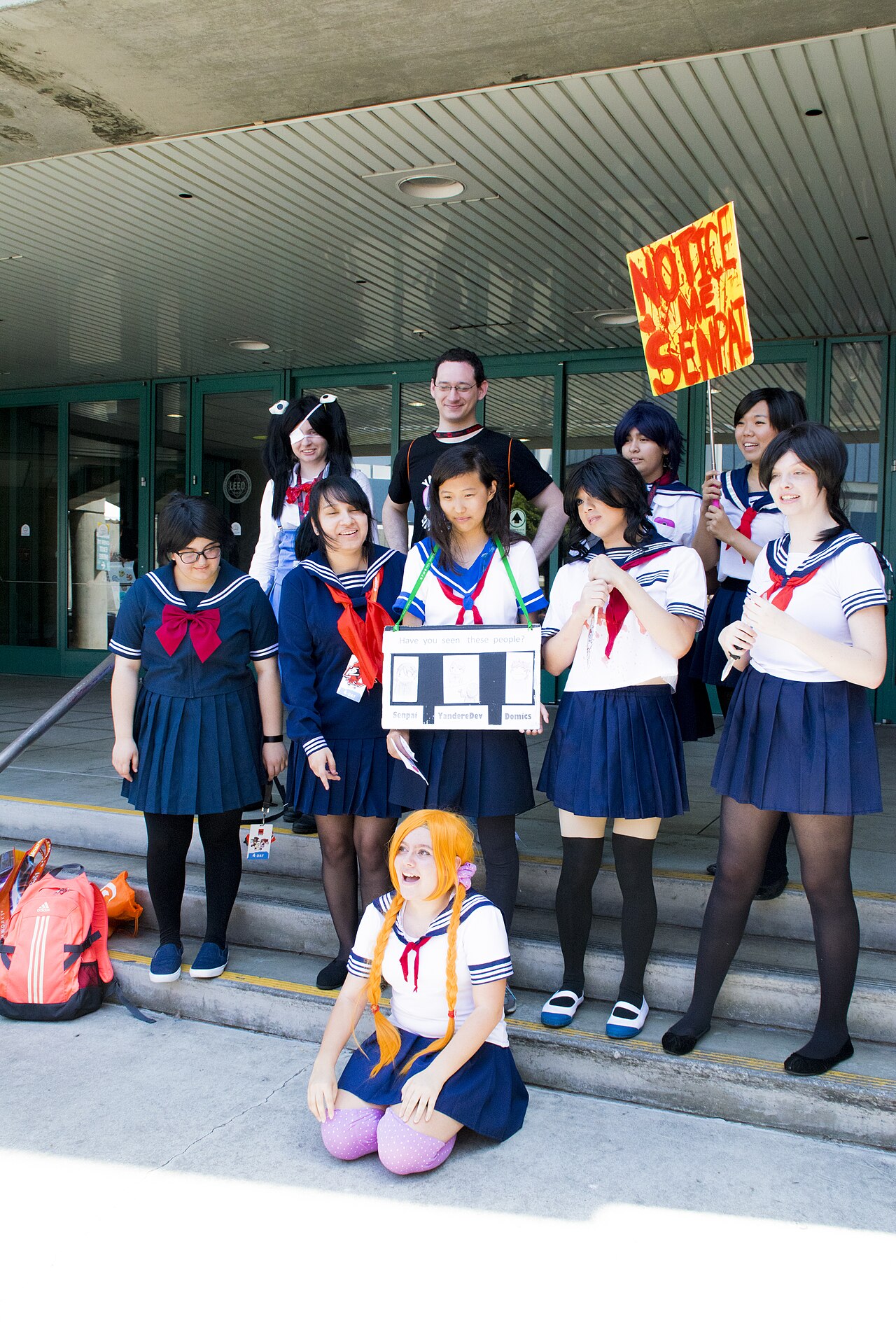
Fans cosplaying as "Yandere-chan" from the game Yandere Simulator at Anime Expo 2016 — the sailor-uniform look, fake blood, and "Notice me, Senpai" sign are all shorthand for the archetype in fandom culture. Photo: YinChannel, CC BY 2.0, via Wikimedia Commons.
Not every yandere is played for horror — many stories use a lighter, comedic version where the obsessive behavior is exaggerated for laughs rather than genuine menace, closer to an over-the-top clinginess than actual danger. Fans sometimes distinguish this softer end of the spectrum as "yangire" (ヤンギレ) when the emphasis is on a sudden violent snap rather than sustained psychological obsession, though usage of that term is looser and less standardized than yandere itself.
Cultural Context
Yandere sits within a broader vocabulary of Japanese character-type slang — moe, tsundere, kuudere, dandere — that anime and manga fandom developed to classify recurring personality patterns, particularly in romance and harem genres where a cast of love interests each need a distinct emotional "hook." These labels function like genre shorthand: naming a character's -dere type instantly signals what kind of romantic tension the audience should expect.
Yandere in particular taps into a long-running fictional trope — love that becomes dangerous through possessiveness — but packages it specifically for anime/manga audiences, complete with visual and narrative conventions (a sudden dead-eyed expression, an unsettling calm voice, a knife appearing in an otherwise cute scene) that experienced fans recognize instantly as a warning sign. Because the trope is exaggerated and clearly fictional, it's generally treated as a form of dark comedy or thriller catharsis rather than a genuine endorsement of the behavior it depicts — the appeal lies in the tension between the "cute" surface and the "unhinged" reality, not in celebrating obsession itself.
The term has also crossed into broader internet culture, where it's applied loosely (and usually humorously) to describe clingy or jealous behavior in real relationships, similar to how メンヘラ is used for someone perceived as emotionally unstable in a relationship — though メンヘラ describes a real (if stigmatizing) personality label, while ヤンデレ remains rooted in its fictional, character-archetype origins even when borrowed for jokes about real life.
Related Terms
- ツンデレ (tsundere) — cold-then-warm counterpart archetype; see the tsundere article
- メンヘラ (menhera) — real-world slang for someone seen as emotionally unstable, often in a relationship context
- ヤンギレ (yangire) — a character who snaps into sudden violence, without necessarily the sustained obsessive love of a yandere
- クーデレ (kuudere) — cool/aloof on the surface, with a similar hidden-warmth structure to tsundere
- ヤンデレ系 (yandere-kei) — "yandere-type," used as a fan-community tag for characters or media
Related Dictionary Words
to fall ill
love; affection; care
attachment; adhesion; insistence; tenacity; fixation; obsession; clinging (e.g. to old customs)
possessiveness; desire to monopolize (monopolise); desire for control
love; romance; tender passion; emotion; affections
jealousy; envy
madness; insanity
pure love
restraint; restriction; fetters; yoke; shackles
delusion; wild idea; (wild) fancy; (ridiculous) fantasy
confinement; imprisonment; incarceration
dependence; reliance
nutjob; mental job; lunatic; mentally troubled person
heroine; female protagonist
love; affection
person with an unhealthy romantic obsession