AKB48
eekeebii footiieitoA massively influential Japanese idol group founded in 2005 around the "idols you can meet" concept, famous for its Akihabara theater, general elections, and handshake events.
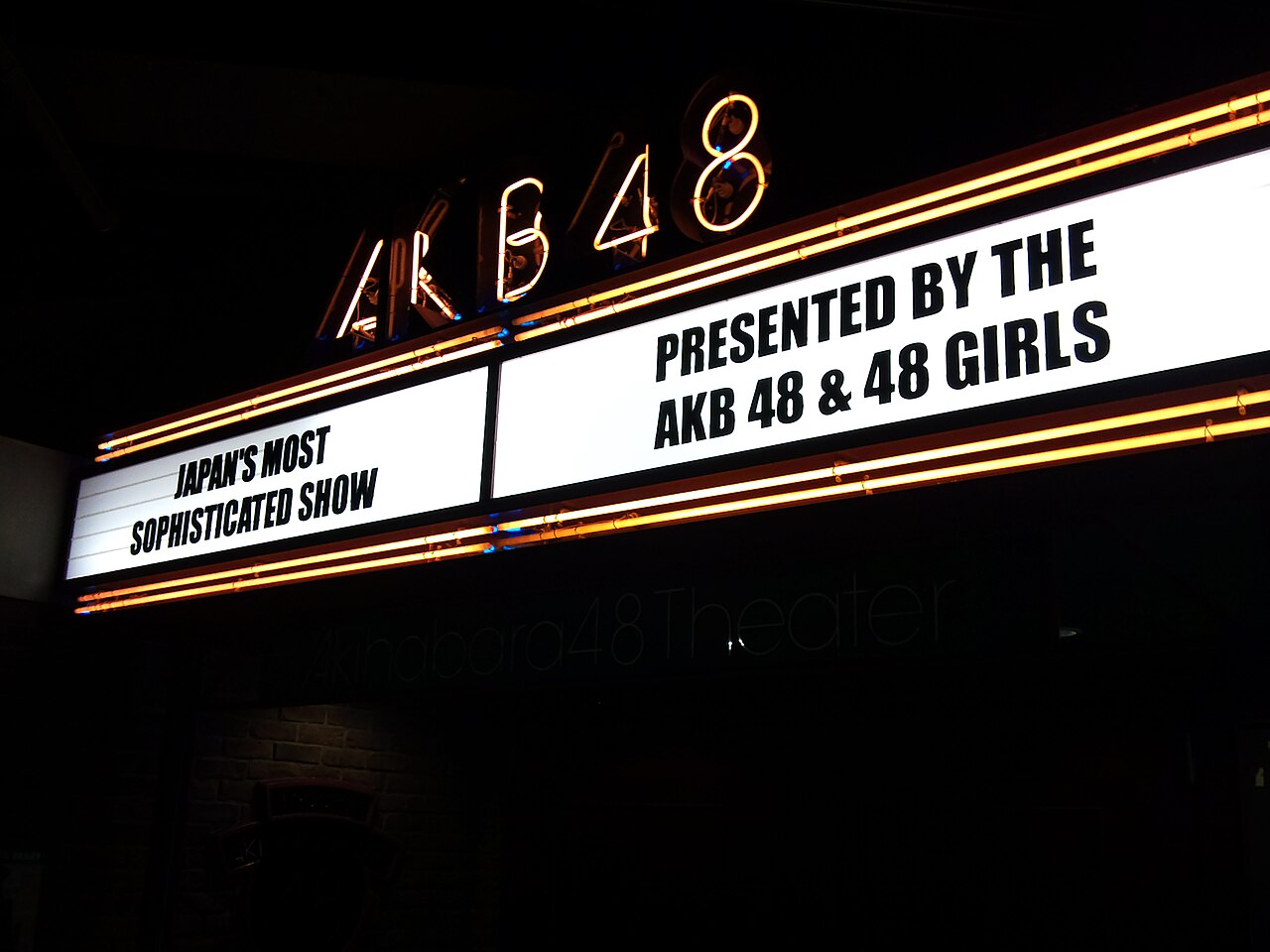
The marquee of the AKB48 Theater in Akihabara, Tokyo, home of the group's daily live performances. Photo: Karl Baron, CC BY 2.0, via Wikimedia Commons.
Meaning
AKB48 (エーケービーフォーティーエイト) is a Japanese アイドル (idol) グループ formed in 2005 by producer Yasushi Akimoto (秋元康, Akimoto Yasushi). The name comes from Akihabara (秋葉原), the Tokyo electronics-and-otaku district where the group's home theater is located, combined with "48," originally the target number of members. AKB48 is widely credited with reinventing the modern Japanese idol industry: instead of distant television stars, it built its identity around "idols you can go and meet" (会いに行けるアイドル, ai ni ikeru aidoru), performing near-daily 公演 (live shows) in a small dedicated theater where ordinary fans could watch up close.
Over the following two decades, AKB48 grew from a handful of teenagers performing to near-empty seats into a multimedia franchise with dozens of members organized into numbered チーム, a network of domestic and international sister groups, and some of the best-selling singles in Japanese music history.
The Theater and the "Idols You Can Meet" Concept
AKB48's defining innovation was the AKB48 Theater (AKB48劇場), an approximately 250-seat 劇場 on the 8th floor of the Don Quijote store in Akihabara. From the group's debut in December 2005, members performed there almost every day, cycling through a rotating repertoire of numbered "stages" (each a themed set of songs and choreography). Tickets were cheap and won by lottery, and the tiny room meant fans could stand within a few meters of performers they had watched develop from complete unknowns.
This was a deliberate break from the traditional idol model, in which a management agency debuted a small, already-polished unit on television. AKB48 instead let fans watch members improve in real time, choose favorites among dozens of relative unknowns, and feel personally invested in individual members' growth — a dynamic fans call 推し (oshi, one's favorite member) and the broader practice of supporting them is known as oshikatsu (推し活). This "growth narrative" and sense of parasocial closeness became the template that most idol groups since — including AKB48's own sister groups — have followed.
General Elections (総選挙)
Perhaps AKB48's most famous institution is the annual General Election (AKB48選抜総選挙, AKB48 Senbatsu Sōsenkyo), held from 2009 to 2018 and revived periodically since. Fans purchased CDs (each bundled with a serialized 投票 voting ticket) to cast votes for their favorite members. The results determined the 選抜 (senbatsu, "selected members") who would perform on the group's next single, with the top vote-getter earning the coveted センター (center) position at the front of the formation.
The general election turned membership rank into a publicly tracked, emotionally charged competition, broadcast live on television with tens of thousands of fans in attendance and results treated as national entertainment news. It richly rewarded members who could mobilize devoted fanbases, and it became the mechanism by which relatively unknown members — most famously Yuko Oshima, Mariko Shinoda, and later Sayaka Yamamoto and Yuria Kizaki — rose to nationwide stardom. Because it directly tied commercial CD sales to a member's career, the sousenkyo model has been both praised as a meritocratic, fan-driven alternative to agency favoritism and criticized as an expensive pay-to-win popularity contest (see Criticism below).
Handshake Events (握手会)
Alongside the theater and elections, handshake events (握手会, akushukai) are central to AKB48's business model. Each single release comes bundled with a voucher granting a short handshake-and-conversation slot with a member of the fan's choosing at a large convention-hall event; fans who buy multiple copies of the same CD can 会う their 推し multiple times in a single day. This direct, repeatable face-to-face contact — rare in idol industries elsewhere — is a major reason devoted fans buy singles in bulk, and CD sales figures for AKB48 singles have long reflected handshake-voucher demand as much as musical listening.
Handshake events have not been without controversy: a 2014 incident in which a fan attacked members with a handsaw at an event prompted the introduction of security screening, and critics have long argued the format monetizes fans' emotional attachment in ways that verge on exploitative.
Teams, Graduation, and Membership Structure
AKB48 organizes members into several performing チーム (Team A, Team K, Team B, Team 4, and a training unit called Kenkyuusei/研究生, "trainees"), each with its own regular theater setlist. Members typically join as teenagers, often in matching school-style 制服 costumes evoking a schoolgirl aesthetic, and "graduate" (卒業, sotsugyou) — the idol-industry term for formally leaving the group, usually marked with a farewell concert and public statement — once they choose to pursue solo careers, acting, marriage, or life outside entertainment. This graduation system means the group's lineup constantly turns over, with new generations recruited through open auditions, giving AKB48 a continually renewing cast even as its brand and theater endure for decades.
Sister Groups and the "48 Group" Franchise
AKB48's success led Akimoto and his production team to replicate the theater-plus-local-identity formula across Japan and, later, Asia, collectively known as the 48 Group (48グループ):
| Group | City / Region | Debut |
|---|---|---|
| AKB48 | Akihabara, Tokyo | 2005 |
| SKE48 | Sakae, Nagoya | 2008 |
| SDN48 | Tokyo (disbanded 2010–2012, adult-oriented spin-off) | 2009 |
| NMB48 | Namba, Osaka | 2010 |
| HKT48 | Hakata, Fukuoka | 2011 |
| NGT48 | Niigata | 2015 |
| STU48 | Setouchi region (based on a touring ship) | 2017 |
| JKT48 | Jakarta, Indonesia | 2011 |
| SNH48 | Shanghai, China (later independent of AKB48's management) | 2012 |
| BNK48 | Bangkok, Thailand | 2017 |
| MNL48 | Manila, Philippines | 2018 |
| AKB48 Team TP | Taipei, Taiwan | 2021 |
Each 姉妹 (sister) group has its own local theater, teams, and often its own general election, while sharing AKB48's core concept and much of its songwriting from Akimoto. Some members cross over between groups (a status called kenkyuusei transfer or "concurrent" membership), and joint singles and joint elections have periodically brought the whole franchise together.
Nogizaka46, Keyakizaka46 (later Sakurazaka46), and Hinatazaka46 — the hugely popular "Sakamichi" groups — were created by Akimoto using a similar idol-production philosophy but positioned as AKB48's "rivals" rather than sister groups, and represent the clearest evidence of how thoroughly the AKB48 formula reshaped the entire industry.
Commercial Success and Cultural Impact
AKB48 is the best-selling female idol group in Japanese history and one of the best-selling music acts in Japan overall. Its singles have repeatedly topped the Oricon charts and set first-week sales records, aided heavily by the handshake-voucher and election-voting bundling described above; several singles, including "Heavy Rotation" and "Kokoro no Placard," rank among Japan's best-selling singles of the 2010s. The group holds a Guinness World Record for the largest pop group in the world, and it has appeared in commercials, variety shows, its own theatrical films, and manga/anime tie-ins.
Beyond sales, AKB48 fundamentally changed how the Japanese entertainment industry markets idols: the "you can meet them" theater model, the oshi/fandom economy built around repeat purchases, the general election as a publicity engine, and the franchise strategy of city-branded sister groups have all been widely imitated, both by later idol groups and, increasingly, by the vtuber and gaming/anime character-goods industries that borrow the same fan-investment mechanics.
Criticism and Controversy
AKB48's business model has drawn sustained criticism alongside its commercial success:
- "Pay-to-win" fandom: Because 応援 (fan support) is measured largely through CD purchases — for handshake vouchers and election votes — critics argue the system rewards wealthy fans over broad popularity, and encourages "bulk buying" of duplicate CDs that are sometimes destroyed unopened.
- Dating bans and image control: Idol contracts historically restricted members from publicly dating, tied to the idea that fans are emotionally invested in members' perceived availability. Violations have led to public scandals and, in a notorious 2013 incident, a member shaved her head on video after a magazine reported she had stayed overnight at a boyfriend's apartment — an event widely condemned internationally as excessive.
- Age and labor concerns: Members frequently join in their young teens, raising questions (echoed across the wider idol industry) about workload, education, and the sexualized marketing of a "girl next door" image toward an adult fan base.
- Security: The 2014 handshake-event knife attack (mentioned above) exposed safety gaps in an event format built around unscreened physical proximity to fans.
These debates mirror broader conversations about the Japanese idol industry as a whole; see the アイドル article for more general context.
Vocabulary for Learners
| Japanese | Reading | Meaning |
|---|---|---|
| アイドル | あいどる | idol |
| 劇場 | げきじょう | theater |
| 公演 | こうえん | (live) performance |
| 握手会 | あくしゅかい | handshake event |
| 総選挙 | そうせんきょ | general election |
| 選抜 | せんばつ | selection (of members) |
| センター | せんたー | center position |
| 推し | おし | one's favorite member |
| 卒業 | そつぎょう | "graduation" (leaving the group) |
| 姉妹 | しまい | sister (group) |
Related Terms
- アイドル (aidoru) — the broader Japanese idol phenomenon AKB48 helped define
- 推し活 (oshikatsu) — the fan practice of actively supporting one's favorite idol
- 推し (oshi) — one's favorite member/idol, the term at the center of election and handshake culture
- J-ポップ (J-pop) — the broader pop music genre AKB48 sits within
Related Dictionary Words
handshake event; handshake session; event where it is possible to shake hands with a celebrity, sportsperson, pop star, etc.
general election (of the lower house)
theatre; theater; playhouse
performer (usu. in a boy band or girl group) with an image cultivated to foster a dedicated fan following; Japanese idol
being a fan of; being a supporter of; pushing for
graduation; completion (of a course)
selection; choice; picking out
centre; center
sisters