飴細工
amezaikuA traditional Japanese craft in which artisans hand-sculpt molten mizuame candy into lifelike animals, fish, and flowers using only small scissors and their fingers.
Meaning
Amezaiku (飴細工) combines 飴 (ame, "candy" or "taffy") with 細工 (saiku, "craftwork" or "handiwork") — literally, "candy craftwork." It refers to the art of shaping soft, molten sugar candy into detailed three-dimensional figures: goldfish, rabbits, dragons, songbirds, and seasonal flowers are among the most popular subjects. Unlike Western pulled-sugar work, which is often done with gloved hands over a heat lamp, classic amezaiku is performed rapidly with bare fingers and a small pair of 鋏 (hasami, scissors), while the candy is still hot enough to shape but cooling fast enough that the whole sculpture must be finished in one to three minutes.
The base material is 水飴 (mizuame, literally "water candy"), a thick, clear starch syrup similar to corn syrup, sometimes blended with a small amount of 砂糖 (satō, sugar) and cooked to roughly 100–120°C. A lump of the molten syrup is gathered onto a thin stick, kneaded and stretched by hand to trap air and turn it an opaque white, then pulled, pinched, and snipped into shape before being painted with food-safe dyes. The finished piece is edible, though most buyers today keep it as a photogenic souvenir rather than eating it.
Technique
A working amezaiku 職人 (shokunin, artisan) typically follows a sequence practiced over years of apprenticeship:
- Gathering — a ball of mizuame heated to roughly 80°C is wound onto the tip of a bamboo or plastic stick.
- Kneading — the artisan works air into the mass with gloved or bare hands, whitening the clear syrup and giving it a pliable, dough-like body.
- Sculpting — while the candy is still warm and workable, the artisan pinches, pulls, and rotates it to rough out a body, then uses scissors to snip out fins, ears, petals, or wings in seconds — candy cools and hardens quickly, so there is no time to pause.
- Coloring — food-coloring pigment is brushed or dabbed on with a fine brush once the base shape is set, adding eyes, scales, or gradients.
Because the syrup hardens within roughly three minutes of leaving the heat, the entire figure must be conceived and executed from memory and muscle habit rather than built up slowly — much closer to a live performance than a seated craft. This is why traditional amezaiku was, and still is, often demonstrated in front of a crowd rather than made behind closed doors.
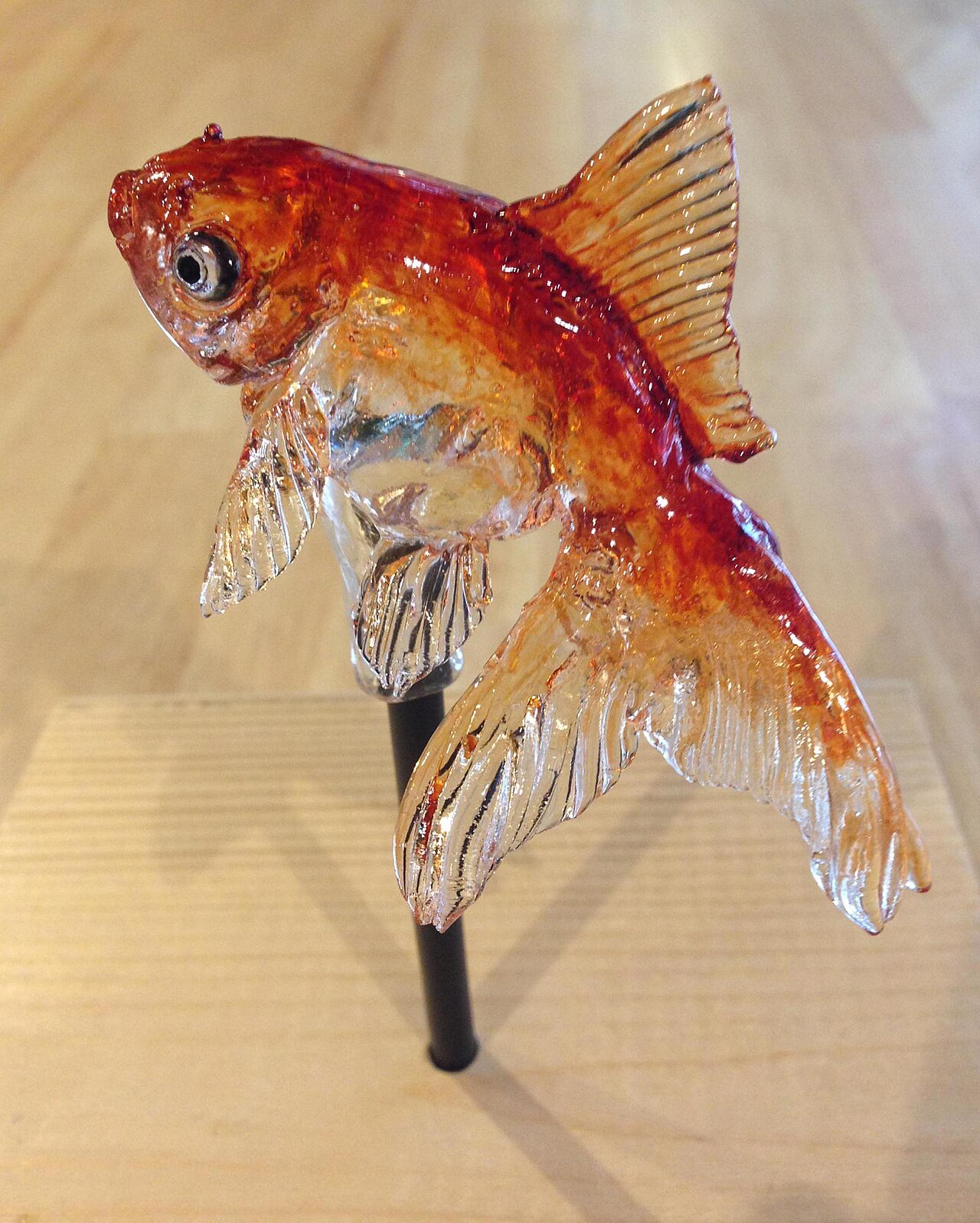
A hand-sculpted candy goldfish (kingyo), one of the most iconic amezaiku motifs, made at Ameshin in Asakusa, Tokyo. Photo: 海獺 (Rakuda), CC BY-SA 4.0, via Wikimedia Commons.
Cultural Context
Scholars trace amezaiku's roots back over a thousand years, to sugar figures brought from Tang-dynasty China and used as temple offerings during the Heian period — simple shapes colored only in red and white, made for religious rather than decorative purposes. The craft as it's recognized today took shape during the Edo period (1603–1868), when mizuame became cheap and widely available and amezaiku artisans became fixtures of city street life. They worked as itinerant performers, setting up at 縁日 (ennichi, temple/shrine festival days) and 祭り (matsuri, festivals), drawing crowds with patter, sleight-of-hand, and rapid-fire sculpting the way a magician draws an audience — the candy was as much a ticket to watch a show as it was a treat to eat.
By the mid-20th century, amezaiku had become an everyday sight outside shrines and at neighborhood festivals nationwide, sold from mobile 屋台 (yatai, food stalls). But as cheap mass-produced snacks proliferated and fewer young people took up the years-long apprenticeship needed to master it, the number of professional artisans shrank drastically — some estimates put the number of full-time amezaiku craftspeople left in Japan at only a few dozen.
The craft has found new life in the 2010s–2020s through a handful of specialty shops that treat it as an artisanal, almost boutique experience rather than a festival novelty. Ameshin, founded in Tokyo's Asakusa district in 2013 by artisan Shinri Tezuka, is the best-known example: customers watch a craftsperson sculpt a custom goldfish or animal to order in a few minutes, and the shop also runs hands-on workshops for visitors to try shaping their own piece. Amezaiku Yoshihara, another long-running Asakusa studio, and independent artists such as Shuhei Ida who work the festival-stall circuit, are part of the same small revival. The dramatic, almost sculptural photographs of finished pieces — a bright orange goldfish rendered in candy, a coiled dragon, a peony in full bloom — travel well on social media, and amezaiku has become a popular stop for foreign tourists in Asakusa and around Tokyo Skytree looking for a hands-on, only-in-Japan craft experience.
Variations and Related Crafts
| Craft | Material | Method |
|---|---|---|
| Amezaiku (飴細工) | Mizuame candy | Hand-pulled and scissor-cut while hot |
| Amecho (飴チョコ) | Chocolate | Molded, not pulled |
| Wagashi (和菓子) | Bean paste, mochi | Shaped while cool, often with molds |
| Western pulled sugar | Isomalt/sugar syrup | Pulled with gloved hands under heat lamps |
Amezaiku is sometimes confused with amecho or with molded wagashi sweets, but it is distinct in requiring the candy to be worked freehand while still hot, with no molds — every piece is technically one of a kind, even when artisans repeat a familiar motif like the goldfish or rabbit hundreds of times.
Where to See It Today
Visitors can watch amezaiku made live (and buy the results) at:
- Ameshin — Asakusa Hanakawado main store and a branch inside Tokyo Skytree Town Solamachi
- Amezaiku Yoshihara — a long-established shop also in Asakusa
- Festival stalls at major shrine and temple events throughout the year, particularly summer matsuri season
Many shops also offer short hands-on lessons (roughly 90–120 minutes) where visitors shape their own simple figure under a craftsperson's guidance, making amezaiku one of the more accessible traditional crafts for non-specialists to try firsthand.
Related Dictionary Words
(hard) candy; toffee
work; workmanship; craftsmanship; handiwork
craftsman; artisan; tradesman; worker; workman
cart (esp. a food cart); stall; stand
festival; feast; matsuri
animal
flower; blossom; bloom; petal
scissors; shears; clippers
mizuame; glucose syrup; starch syrup; corn syrup
sugar
tradition; convention
temple festival; fair; fete day; day related to a particular deity and thought to bring divine blessing to those who celebrate it
Edo period (1603-1868)