仏壇
butsudanThe household Buddhist altar found in many Japanese homes, used to honor deceased family members and ancestors with daily offerings, incense, and photographs.
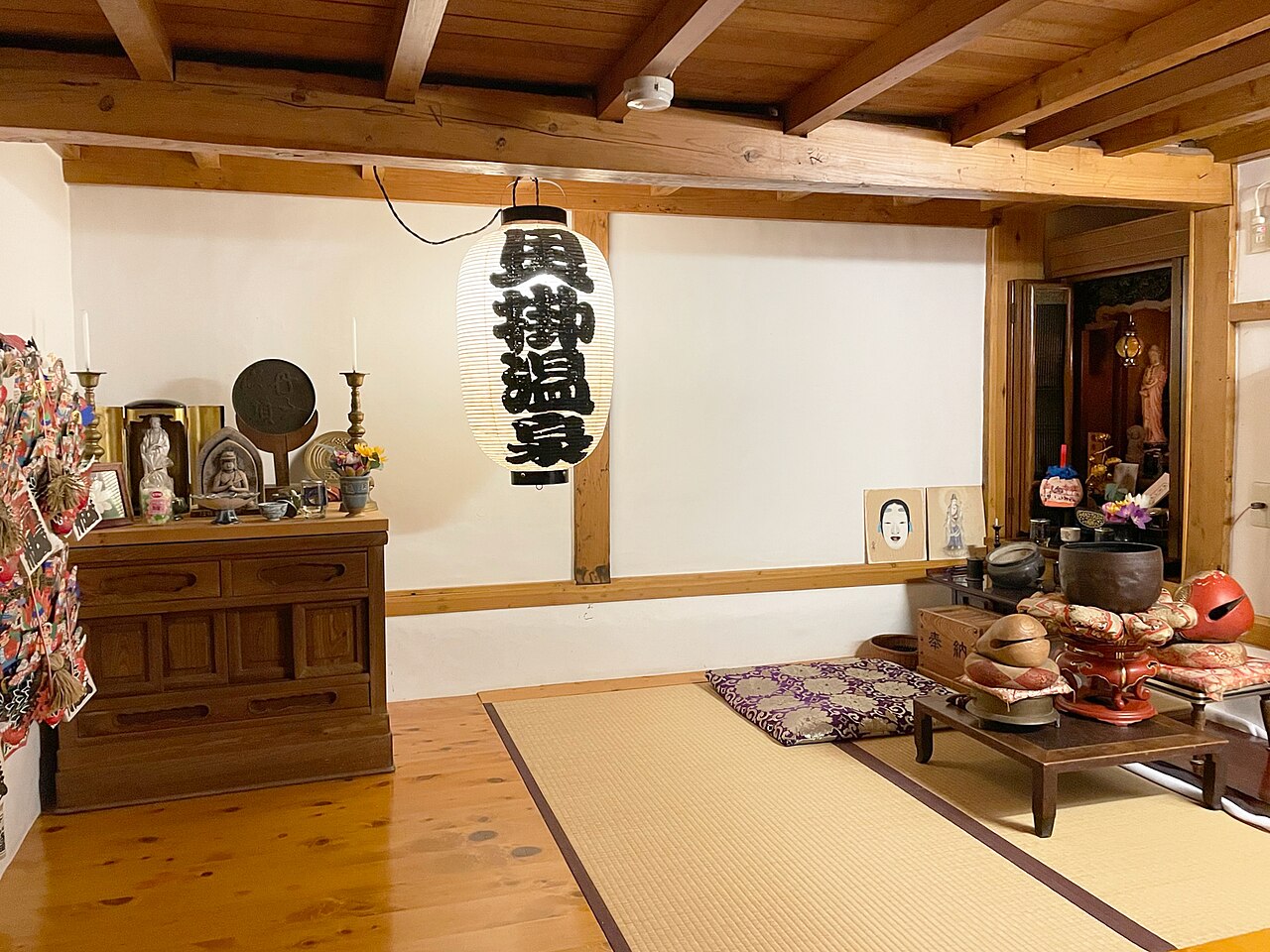
A butsudan altar room at a traditional hot-spring inn in Yuzawa-machi, Niigata Prefecture. Ordinary homes keep the same basic elements — a Buddhist image, mortuary tablets, and offering vessels — usually in a smaller cabinet form. Public domain, via Wikimedia Commons.
Meaning
仏壇 (butsudan), literally "Buddha platform," is a household altar used to honor a family's deceased members and ancestors according to Buddhist tradition. It usually takes the form of a wooden cabinet with doors that open to reveal a small shrine-like interior: a central Buddhist image or scroll representing the family's sect, rows of lacquered mortuary tablets called 位牌 (ihai) inscribed with the posthumous Buddhist names of the dead, and a set of offering vessels for rice, tea, water, and 線香 (incense).
A butsudan is not simply a memorial shelf or a decorative shrine — for many families it is treated as an actual point of contact between the living and the deceased. Speaking to it, reporting news, and requesting a blessing before a big decision are all considered natural ways to use one, much as a person might address a grandparent who has passed away.
The butsudan is often confused by outsiders with the 神棚 (kamidana), the miniature Shinto altar used to enshrine talismans from shrines. The two serve entirely different religious functions — one is Buddhist ancestor veneration, the other is Shinto worship of kami — but they are frequently found in the same house, sometimes even the same room, reflecting Japan's long history of blending Shinto and Buddhist practice.
Components of a Butsudan
While details vary by Buddhist sect and region, most butsudan share a similar set of elements:
| Component | Japanese | Description |
|---|---|---|
| Principal image | 本尊 (honzon) | A statue or hanging scroll of a Buddha or bodhisattva central to the family's sect, such as 阿弥陀 (Amida) |
| Mortuary tablets | 位牌 (ihai) | Small lacquered tablets bearing a deceased relative's posthumous Buddhist name (kaimyo) and dates |
| Photograph | 遺影 (iei) | Framed photo of the deceased, placed beside or near the altar |
| Incense | 線香 (senko) | Burned daily in an incense holder as a central offering |
| Rice and tea | ご飯・お茶 | Small dishes offered fresh each morning |
| Bell | りん (rin) | A small brass bowl bell struck before prayer to mark the start of worship |
| Prayer beads | 数珠 (juzu) | Held in the hands while chanting or praying at the altar |
Many households also keep a small brass container of ash for standing incense sticks, and a vase for fresh or artificial flowers, which are refreshed regularly out of respect.
Usage
Daily practice at a butsudan is usually brief but consistent: refreshing the offerings of rice, tea, and water each morning, lighting incense, striking the rin bell, and pressing the palms together in 合掌 (gassho) while silently addressing the deceased.
毎朝、仏壇に手を合わせてから家を出ます。 Maiasa, butsudan ni te o awasete kara ie o demasu. "Every morning, I press my hands together at the butsudan before leaving the house."
On a person's 命日 (death anniversary), and during the annual お盆 (Obon) festival when ancestral spirits are believed to return home, families gather in front of the butsudan for a more elaborate 法事 (memorial service), sometimes with a Buddhist priest from the family's temple performing 焼香 (incense offering) and chanting a sutra. Special seasonal foods, sweets, or a deceased relative's favorite dish are often placed as offerings on these occasions.
When good news happens in the family — a birth, a graduation, an engagement — it is common to report it to the butsudan before telling anyone else, treating deceased ancestors as members of the family who should hear the news first.
Butsudan vs. Kamidana
| Butsudan (仏壇) | Kamidana (神棚) | |
|---|---|---|
| Religion | Buddhism | Shinto |
| Honors | Deceased family ancestors, via mortuary tablets (ihai) | Kami (deities), via an ofuda talisman |
| Typical placement | Standing or sitting height, often its own room | High on a wall, near the ceiling |
| Purpose | Remembrance and communication with ancestors | Blessing, protection, gratitude to deities |
| Daily offering | Rice, tea, incense | Rice, salt, water, sometimes sake |
Many traditional Japanese homes have historically kept both a butsudan and a kamidana under the same roof, reflecting the coexistence of Buddhist and Shinto practice in everyday life rather than a strict either/or choice between the two religions. A family's connection to a particular Buddhist temple, established through the butsudan and its associated grave, is called being a 檀家 (danka) — a hereditary parishioner household.
Cultural Context
The butsudan's modern form traces back to the Edo period, when the shogunate's 檀家 (danka) system required every household to register with a local Buddhist temple as a way of suppressing Christianity and monitoring the population. Registration obligated families to hold funerals and memorial rites through that temple, and keeping a butsudan at home became the everyday extension of that relationship — a private space where the temple's rituals continued between visits from the priest.
Buddhism in Japan has long emphasized ancestor veneration, blending with older indigenous beliefs that the spirits of the dead continue to watch over and can be communicated with by their living descendants. The butsudan gives that belief a physical, daily focus: rather than confining remembrance to a grave visited occasionally, a family folds a small act of respect into the rhythm of ordinary life, at home, every morning.
Butsudan also vary noticeably by region and sect. The Ryukyu Islands (Okinawa) developed a distinctively large, dark-lacquered altar style tied to strong local ancestor-worship customs, while Jodo Shinshu (True Pure Land) households traditionally favor gold-leafed, ornate interiors modeled on temple altars, reflecting that sect's emphasis on Amida Buddha's Pure Land. Regional woodworking centers such as Hikone and Kawagoe have historically specialized in butsudan craftsmanship, employing lacquering, gold leaf, and metal fitting techniques passed down for generations.
In contemporary Japan, ownership of a full-size traditional butsudan has declined, particularly among younger, urban, and apartment-dwelling households who may lack the space or feel less connected to a family temple. In response, manufacturers now sell compact, modern-styled "mini butsudan" — small enough for a shelf or bookcase, sometimes resembling minimalist furniture rather than a traditional lacquered cabinet — allowing the custom of daily remembrance to persist in smaller, less formal households. Even so, a butsudan inherited from grandparents, often kept in the most prominent room of an older family home, remains one of the most recognizable fixtures of Japanese domestic life.
Related Terms
- 位牌 (ihai) — the mortuary tablet inscribed with a deceased relative's posthumous Buddhist name
- 本尊 (honzon) — the principal Buddhist image enshrined at the center of the altar
- 檀家 (danka) — a household registered as a hereditary parishioner of a Buddhist temple
- お盆 (Obon) — the summer festival when ancestral spirits are believed to return, honored at the butsudan
- 神棚 (kamidana) — the household Shinto altar often kept alongside a butsudan
Related Dictionary Words
Buddhist (household) altar
Buddhist mortuary tablet
incense stick
principal object of worship (at a Buddhist temple); principal image
Amitabha (Buddha); Amida
rosary; string of prayer beads
anniversary of a person's death; monthly return of the date of someone's death
Buddhist memorial service
family which supports a temple; parishioner
portrait of a deceased person
pressing one's hands together in prayer
burning (offer) incense
Obon; Bon Festival; Buddhist festival for honouring the spirits of one's ancestors, held in mid-August or in some regions, mid-July