神棚
kamidanaA miniature household Shinto altar, usually a wall-mounted shelf near the ceiling, where families enshrine a talisman from a shrine and make daily offerings of rice, salt, water, and sake.
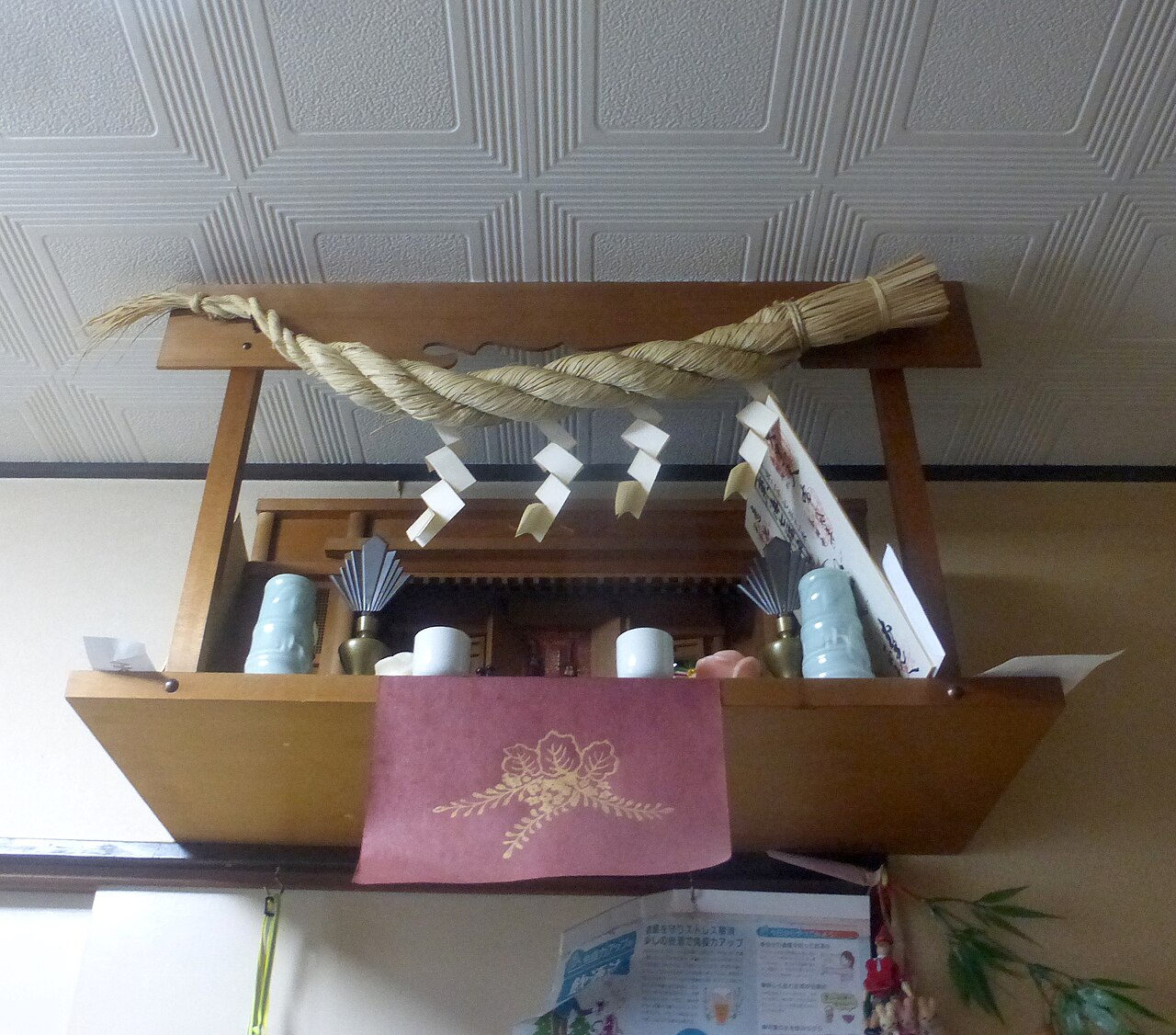
A typical modern kamidana in a Tokyo-area home, showing the shimenawa rope with shide paper streamers, sakaki branches, and small offering vessels in front of the miniature shrine. Photo: Nesnad, CC BY 4.0, via Wikimedia Commons.
Meaning
神棚 (kamidana), literally "god shelf," is a small household altar used in Shinto worship. Unlike a shrine building (jinja) that houses a deity's spirit on temple grounds, a kamidana brings a piece of that sacred connection into the home. It is typically a simple wooden shelf mounted high on a wall, close to the ceiling, holding a miniature shrine called a miya-gata (宮形), which in turn enshrines a paper or wood talisman called an お札 or ofuda (御札) — most commonly one from Ise Jingu, the Grand Shrine of Ise dedicated to the sun goddess Amaterasu, known as taima (大麻) or jingu taima.
The kamidana is often confused by outsiders with the 仏壇 (butsudan), the Buddhist household altar used for ancestor veneration, but the two serve different religious functions and are frequently found in the same home side by side, reflecting Japan's long-standing blend of Shinto and Buddhist practice.
Components of a Kamidana
A complete kamidana setup typically includes:
| Component | Japanese | Description |
|---|---|---|
| Miniature shrine | 宮形 (miya-gata) | Small wooden shrine building housing the ofuda |
| Talisman | お札 / 神札 | Paper or wood talisman representing a deity, renewed yearly |
| Sacred rope | 注連縄 (shimenawa) | Twisted rice-straw rope marking the sacred space, hung with zig-zag paper streamers (shide) |
| Evergreen branches | 榊 (sakaki) | Sacred evergreen placed in vases on either side, replaced regularly |
| Rice | 米 | Offered daily in a small dish |
| Salt | 塩 | Offered daily in a small dish, symbolizing purity |
| Water | 水 | Offered daily in a small cup, changed each morning |
| Sacred sake | お神酒 (o-miki) | Rice wine offered on the 1st and 15th of the month or special occasions |
The shimenawa and its paper streamers (shide) mark the kamidana as a sacred boundary, the same way they mark the entrance to a torii-gated shrine precinct. Sakaki branches are kept fresh as a living link to the natural world that Shinto reveres.
Placement Customs
Where a kamidana is installed matters as much as what sits on it. Common customs include:
- Height: placed as high as possible in a room, ideally above eye level, so that nothing sits or passes above it — a mark of respect for the deity.
- Direction: ideally facing south or east, the directions traditionally associated with light and purity, and away from the household's main entrance.
- Avoid doorways and stairs: it should not be positioned where people regularly walk beneath it or where a door swings directly under it.
- A quiet room: a living room, kitchen, or dedicated household shrine room is preferred over a bedroom or bathroom.
Some apartment dwellers who lack wall space for a full shelf use a simplified stand-alone miya-gata placed on top of a bookshelf or cabinet, as long as it remains elevated and respected.
Usage and Rituals
毎朝、神棚に水とご飯をお供えします。 Maiasa, kamidana ni mizu to gohan o osonae shimasu. "Every morning, I offer water and rice at the kamidana."
Daily practice traditionally involves changing the water, rice, and salt each morning, then bowing twice, clapping twice, and bowing once more — the same nirei nihakushu ichirei (二礼二拍手一礼) sequence used at a shrine's outer worship hall. On the 1st and 15th of each month, families may add an offering of sake.
The most important annual ritual is at year's end: the ofuda is replaced with a fresh one obtained from a shrine, usually around the New Year, and the old talisman is returned to a shrine to be ceremonially burned in a New Year bonfire or during hatsumode visits. This yearly renewal is thought to refresh the protective and purifying power of the household's connection to the kami.
Businesses — especially restaurants, shops, and small offices — commonly keep a kamidana as well, often enshrining an ofuda for Inari, the deity associated with prosperity and rice, in hopes of good fortune in trade.
Kamidana vs. Butsudan
| Kamidana (神棚) | Butsudan (仏壇) | |
|---|---|---|
| Religion | Shinto | Buddhism |
| Enshrines | Kami (deities), via an ofuda talisman | Deceased family ancestors, via mortuary tablets (ihai) and a Buddha statue |
| Typical placement | High on a wall, near the ceiling | At standing or sitting height, often in its own room |
| Purpose | Blessing, protection, gratitude to deities | Remembrance and communication with ancestors |
| Daily offering | Rice, salt, water, sometimes sake | Rice, tea, incense |
Many traditional Japanese homes have historically kept both a kamidana and a 仏壇, reflecting the coexistence of Shinto and Buddhist practice in everyday life rather than a strict either/or choice between the two religions.
Cultural Context
The custom of a household altar to the kami developed over centuries alongside shrine Shinto worship, but the modern, standardized kamidana — a shelf holding a miniature shrine with an Ise Jingu talisman — became widespread during the Edo and Meiji periods, when pilgrimage confraternities (Ise-ko) distributed taima talismans to households across the country as souvenirs of a pilgrimage to Ise. Enshrining the talisman at home let ordinary families maintain an ongoing connection to the Grand Shrine even without traveling there each year.
Alongside the Ise talisman, households traditionally add ofuda from their ujigami (氏神) — the local tutelary shrine of their neighborhood or ancestral community — and sometimes from other shrines with personal significance, such as one connected to an occupation or a wish (safe childbirth, business success, exam success).
In contemporary Japan, kamidana are less common than a generation ago, particularly in urban apartments where wall space and lifestyle habits make the daily ritual less practical. Surveys of household religious practice consistently show a decline in kamidana ownership since the mid-20th century, especially among younger, single, and urban households. Even so, kamidana remain common in older houses, rural areas, and many businesses, and simplified compact versions are sold specifically for small modern apartments, so the practice persists in an adapted form rather than disappearing outright.
Related Terms
- お宮 (o-miya) — an alternate, more colloquial name for the miniature shrine itself
- 神札 (shinsatsu) — another term for the ofuda talisman
- 氏神 (ujigami) — the local guardian deity whose talisman is often enshrined alongside the Ise taima
- 鎮座 (chinza) — the ritual "enshrinement" of a deity's spirit into an object such as an ofuda
Related Dictionary Words
kamidana; household shrine; home shrine
Shinto shrine
amulet or talisman issued by a Shinto shrine or Buddhist temple
banknote; bill; note
sakaki (species of evergreen sacred to Shinto, Cleyera japonica)
(husked grains of) rice
salt; common salt; table salt; sodium chloride
water (esp. cool or cold)
alcohol; sake
Buddhist (household) altar
Shinto; Shintoism
patron god; tutelar deity; guardian deity; local deity