ちいかわ
chiikawaA wildly popular Japanese character franchise about tiny, round creatures whose adorable art style hides surprisingly dark, exhausting struggles for survival.
Meaning
ちいかわ (Chiikawa) is a contraction of 「小さいくて可愛い」(chiisakute kawaii), literally "small and cute." It refers both to the title character — a small, fluffy, big-eyed creature of unclear species — and to the franchise as a whole, whose full formal title is 「なんか小さくてかわいいやつ」(Nanka Chiisakute Kawaii Yatsu, "some kind of small and cute thing"). Created by the illustrator Nagano (ナガノ), Chiikawa began as a series of short comic strips posted to Twitter/X and grew into one of the biggest character-goods phenomena in contemporary Japan, spanning an anime series, department-store pop-ups, and collaborations with everything from convenience store chains to global fashion labels.
The Characters
The cast is a group of small animal-like creatures living together in a gentle but precarious world:
| Character | Japanese | Notes |
|---|---|---|
| Chiikawa | ちいかわ | The title character; anxious, hard-working, cries easily, species unknown |
| Hachiware | ハチワレ | A cat-like friend named for its "split" (八割れ) two-tone fur pattern; upbeat and dependable |
| 兎 (Usagi) | うさぎ | A hyperactive, chaotic rabbit-ish character, occasionally a troublemaker |
| Kurimanjū | くりまんじゅう | Named after a 栗 (chestnut) 饅頭 (manjū bun); quiet, food- and drink-loving |
| Momonga | モモンガ | A mischievous flying squirrel obsessed with being noticed and adored |
The characters live by taking on odd jobs — weeding fields, exam-taking, monster-subjugation duty — to earn just enough to get by, all overseen by armored authority figures who dole out work assignments.
Origin and Rise on Twitter
Nagano had built a career designing sticker characters for the LINE Creators Market before quietly posting early Chiikawa sketches as far back as 2017. The character proper launched on a dedicated Twitter account in January 2020, where Nagano serialized short, four-panel-style 漫画 depicting the creatures' daily joys and hardships in soft, rounded pastel art. The format was perfectly suited to the platform: easy to screenshot, easy to share, and emotionally compact enough to hit hard in a few panels. The account's follower count climbed into the millions within a couple of years, and fans began calling themselves "Chiikawa's parents" (親, oya), a nod to how protective and invested the fandom felt over the vulnerable little characters.
The Anime and Media Expansion
An anime adaptation produced by Doga Kobo premiered in 2022, first airing in short segments within Fuji TV's Mezamashi TV morning program before expanding to a twice-weekly evening slot in 2023. The show kept Nagano's minimalist, hand-drawn-feeling visuals and bittersweet tone largely intact, which helped the series cross over from a Twitter-native niche into mainstream, all-ages popularity across Japan.
Cultural Context: Cute on the Surface, Grim Underneath
What sets Chiikawa apart from typical かわいい mascot characters, such as ゆるキャラ or Sanrio's roster, is the tension between its art style and its content. Beneath the pastel colors sits a world that resembles a grim 異世界 survival setting: characters must pass certification exams to be allowed to work, scrape by on menial labor like weeding or factory piecework, and occasionally face down monsters that may, disturbingly, be former Chiikawa who succumbed to despair and transformed into 妖怪-like creatures. Story arcs have touched on poverty, exhaustion, body horror, and irreversible loss — Hachiware's quiet pride in a chipped bowl he can barely afford, or Chiikawa's crushing anxiety before a test, land as unexpectedly real depictions of economic precarity and burnout.
This is widely read as the reason Chiikawa resonates so strongly with adult audiences, not just children: the series channels very contemporary Japanese anxieties — job insecurity, the pressure to constantly requalify and prove one's worth, the exhaustion of just getting through the day — through characters too round and soft to be threatening, letting readers feel the weight without it becoming unbearable. It sits in a lineage with the iyashikei (healing) genre, but undercuts the comfort with genuine stakes, which is part of why fans describe the franchise as equal parts adorable and quietly devastating.
Commercial Phenomenon and Collaborations
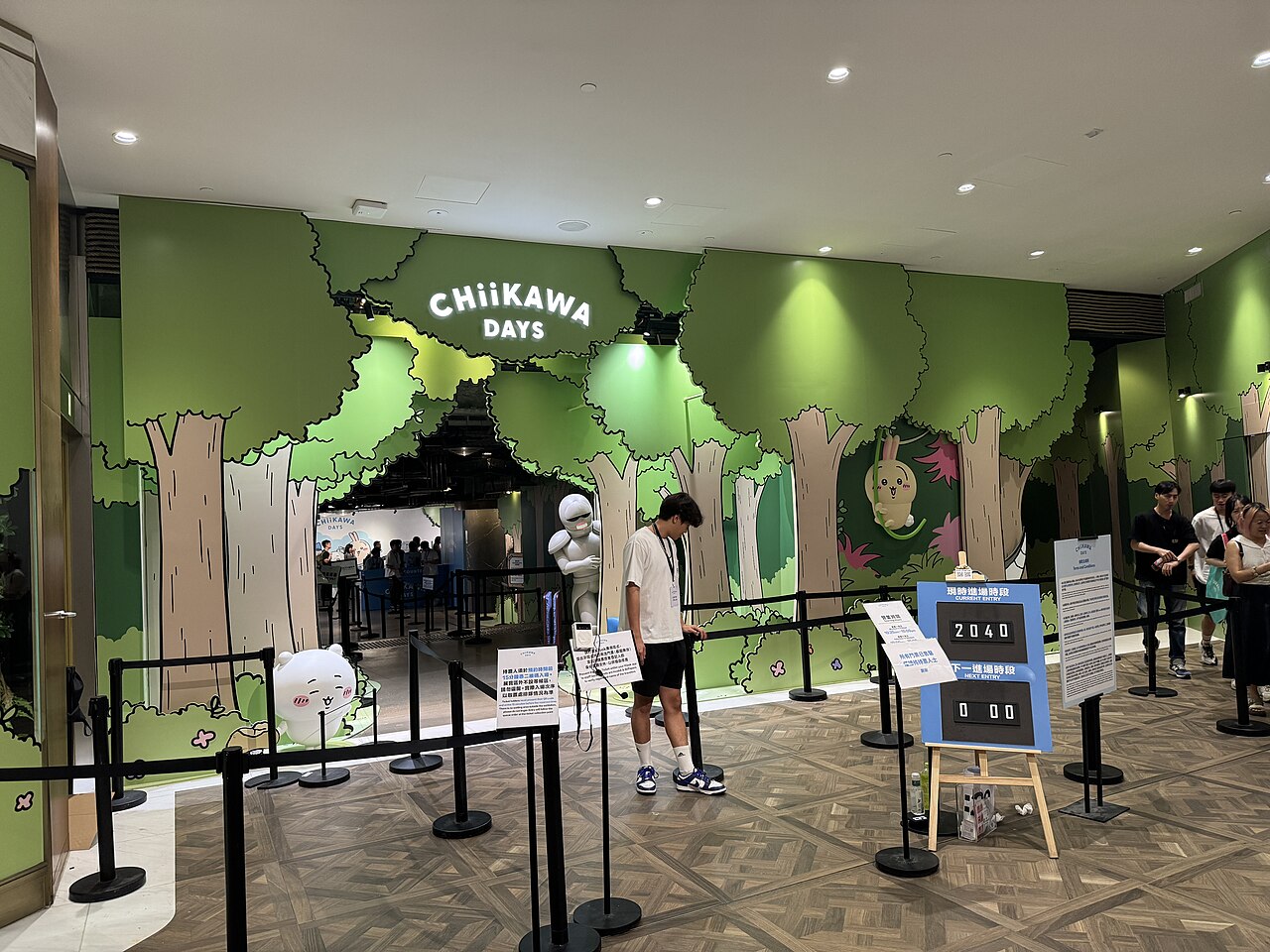
A "Chiikawa Days" pop-up exhibition drawing queues at a shopping mall. Photo: LN9267, CC BY-SA 4.0, via Wikimedia Commons.
Chiikawa's 人気 translated quickly into one of the largest merchandising operations in Japan. Plush toys, capsule グッズ (often sold as gashapon), stationery, and apparel routinely sell out within minutes of release, and resale scalping of popular items has become its own recurring news story. The franchise has run high-profile コラボ campaigns with convenience store chains (notably repeated seasonal tie-ins with 7-Eleven), McDonald's, Sanrio, fashion and sneaker brands, Tokyo Skytree, and pop-up "Chiikawa Days" exhibition spaces in department stores and malls across Asia, drawing hours-long queues. Chiikawa won the Grand Prix at Japan's Character Awards multiple years running, cementing it as one of the country's defining character-IP successes of the 2020s. The series also built a substantial audience outside Japan, particularly across East and Southeast Asia and among Western anime and "kawaii" fan communities online, where clips and merchandise unboxings routinely go viral.
Usage
ちいかわ is used both as the proper name of the franchise/title character and, increasingly, as a loose descriptor for anything achingly "small and cute."
このぬいぐるみ、ちいかわみたいで可愛い。 Kono nuigurumi, Chiikawa mitai de kawaii. "This plushie is cute, kind of like a Chiikawa character."
今日もちいかわ見て泣いた。 Kyō mo Chiikawa mite naita. "I watched Chiikawa again today and cried."
The second example points to a very common fan reaction — Chiikawa episodes are famous for provoking tears despite (or because of) their cute art style, and "ちいかわで泣く" (crying at Chiikawa) is a recurring joke and genuine sentiment among fans online.
Related Terms
- なんか小さくてかわいいやつ — the franchise's full formal title
- ちいかわ構文 (Chiikawa kōbun, "Chiikawa syntax") — internet slang for writing in the flat, halting, hiragana-heavy sentence style associated with the characters' speech and Nagano's captions
- 親 (oya, "parent") — how devoted fans jokingly refer to themselves in relation to the characters
Related Dictionary Words
small; little; tiny
cute; adorable; charming; lovely; pretty
rabbit; hare; coney; cony; lagomorph (esp. leporids)
Japanese chestnut (Castanea crenata)
mantou; Chinese steamed bun
cartoon; comic; comic strip; manga
goods; merchandise; commercial items
collaboration; collab
popularity; public favor
ghost; apparition; phantom; spectre; specter; demon; monster; goblin; yōkai