ダンジョン飯
danjon meshiDungeon Meshi (Delicious in Dungeon) is Ryoko Kui's manga and hit 2024 Netflix anime about adventurers who cook and eat the monsters they meet while descending a dungeon to rescue a party member swallowed by a dragon.
Overview
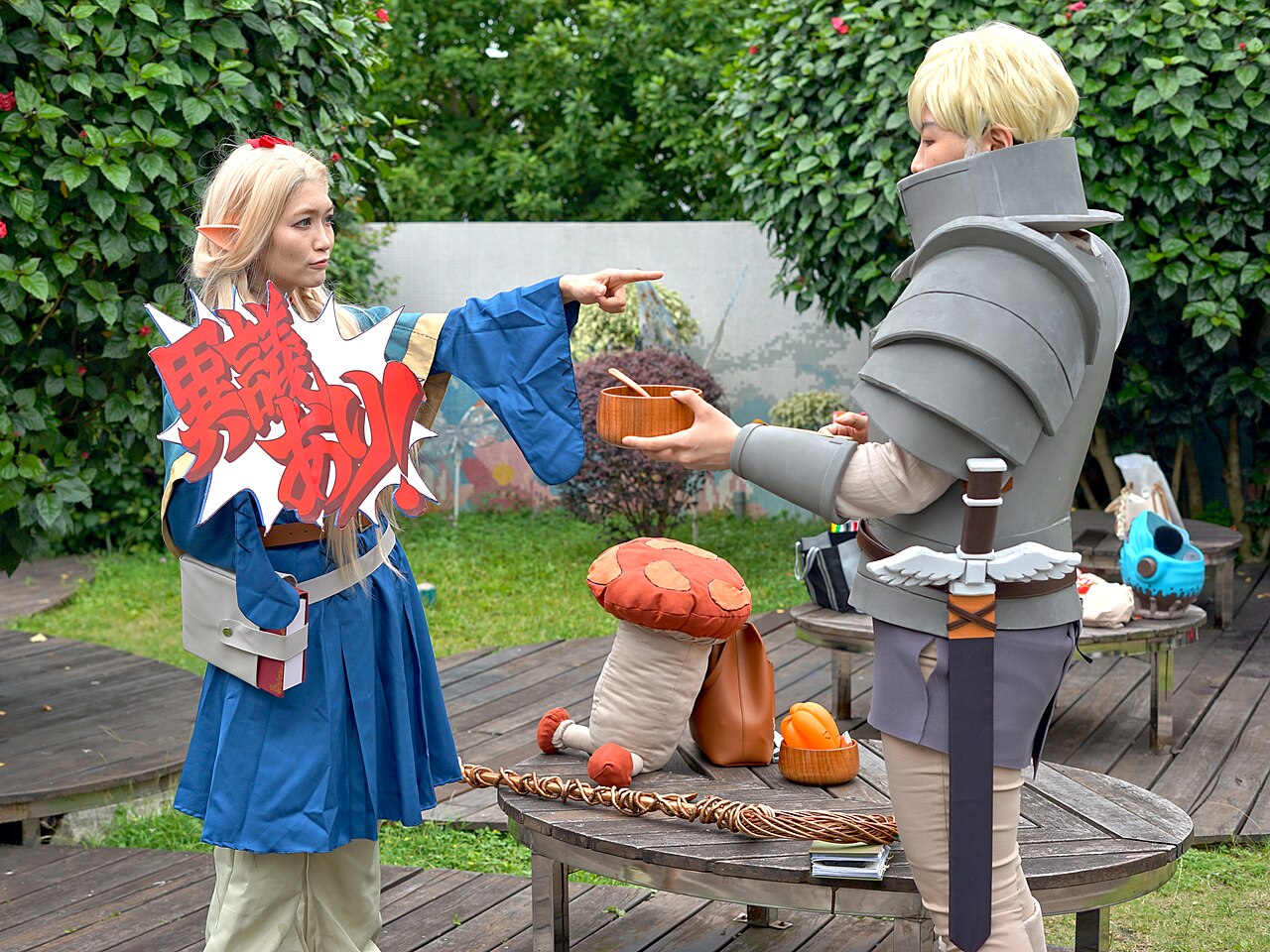
Cosplayers as Marcille Donato and Laios Touden, Dungeon Meshi's central duo, at Anime Expo 2024. Photo: Solomon203, CC BY-SA 4.0, via Wikimedia Commons.
ダンジョン飯 (Danjon Meshi), known in English as Delicious in Dungeon, is a fantasy 漫画 written and illustrated by Ryoko Kui (九井諒子), serialized in Kadokawa's Harta magazine from 2014 to 2023. Its 2024 anime adaptation by Trigger, streaming worldwide on Netflix, turned the series into one of the biggest anime hits of the year, praised for its meticulous world-building, dry comedy, and genuinely mouth-watering monster cuisine.
The premise is a single, absurdly literal question: in a classic fantasy 迷宮 full of hostile creatures, why do adventuring parties always haul in outside 食材 instead of just eating the monsters around them? Dungeon Meshi takes that idea completely seriously, following a party of 冒険者 who cook and eat everything from giant walking mushrooms to living armor as they race against starvation and time.
Story and Premise
The series follows Laios Touden and his party, who descend into a massive dungeon to rescue his sister Falin after she is swallowed whole by a 竜 (dragon) during a failed expedition. Because magical resurrection only works on a fresh corpse, and the dungeon's depths regenerate the dead over time, the party has no choice but to go back in immediately — but a prior retreat left them with no お金 and no supplies for a return trip.
Rather than turn back, Laios proposes eating the monsters they encounter along the way: a decision equal parts practical and, for Laios, deeply enthusiastic — he has been a lifelong (if socially awkward) monster nerd. His party is skeptical but desperate:
| Character | Role |
|---|---|
| Laios Touden | Party leader; encyclopedic, cheerfully unbothered monster enthusiast |
| Marcille Donato | Elf mage; squeamish about eating monsters, worried about aging as a long-lived elf watching human friends grow old |
| Chilchuck Tims | Halfling lockpick/trap specialist; the group's most reluctant, pragmatic voice |
| Senshi | A dwarf who has survived alone in the dungeon for years by cooking monsters, and becomes the party's expert chef |
Each 階層 of the dungeon introduces new creatures, new dangers, and — almost every episode — a new 料理 built from whatever they've just fought off. Giant scorpions become sashimi, walking mushrooms go into stew, and mimics (treasure chests that are secretly monsters) are handled with particular narrative relish. The recurring structure of encounter, identify, then cook and eat gives the show a satisfying procedural rhythm on top of its ongoing rescue plot.
このダンジョンでは、モンスターも立派な食材なんだ。 (Kono danjon de wa, monsutā mo rippa na shokuzai nanda.) "In this dungeon, monsters are perfectly good ingredients too."
Monster Cuisine and World-Building
What sets Dungeon Meshi apart from typical fantasy adventure stories is how rigorously it treats its world as a functioning 生態 system rather than a video-game backdrop. Kui worked out plausible biology, diet, and behavior for nearly every creature in the dungeon — where a basilisk sleeps, what living armor is made of, why a certain slime tastes the way it does — and Senshi's recipes are worked out with the same seriousness, down to how to safely process poisonous parts and what seasoning cuts a monster's natural bitterness.
This grounded approach extends to a genuine in-universe monster encyclopedia (referenced in-story and released separately as official companion books), and fans have gone as far as attempting to cook real versions of the dungeon's fictional dishes at home — mandrake stir-fry, giant scorpion sashimi, and basilisk omelets have all become genuine fan-cooking projects shared online, blurring the line between フィクション and real グルメ culture in an unusually direct way.
Cultural Context and Reception
The manga ran for 14 巻 and won the Manga Taishō Award in 2015, but it was Netflix's 2024 anime adaptation — animated by Trigger with an unusually faithful, patient pace — that made Dungeon Meshi a global phenomenon. It became one of the most-discussed anime of the year on social media, praised for balancing comfortable slice-of-life food-show pacing against a genuinely dark undercurrent: 空腹 (hunger) and death are treated as constant, real threats rather than plot devices, and the story gradually reveals a much larger, more melancholy mystery beneath the dungeon involving ancient magic and Laios's own complicated relationship to the monsters he loves.
Dungeon Meshi is frequently discussed alongside other fantasy-adventure hits like 葬送のフリーレン as part of a wave of anime that reexamines familiar RPG and tabletop-adventure tropes (parties, classes, dungeon delving) with unusual emotional depth and craft, rather than playing them straight as pure power-fantasy 異世界 escapism. Unlike isekai stories, though, no one is transported from modern Japan — the cast is native to its fantasy world, and the show's humor and horror both come from taking that world's mundane logistics (food, money, biology) completely seriously.
Legacy
Since the anime's release, Dungeon Meshi has driven a surge of interest in tabletop-RPG-flavored storytelling and in Ryoko Kui's other work, and has become a fixture at conventions worldwide, where Laios, Marcille, Senshi, and Chilchuck cosplay is now common. A second anime season has been confirmed, continuing the adaptation of the manga's back half, and the series is frequently cited as a rare example of a monster-of-the-week structure that never loses sight of its larger emotional stakes.
See Also
- Otaku fandom culture that embraced the series' worldbuilding and cosplay
- Isekai, the related-but-distinct genre Dungeon Meshi is often discussed alongside
- Sousou no Frieren, another emotionally driven fantasy-adventure hit from the same era
Related Dictionary Words
dungeon
cooked rice
labyrinth; maze
foodstuff; ingredient
adventurer
dragon (esp. a Chinese dragon)
cooking; cookery; cuisine; food; dish
ecology; life and habits (of an animal)
fine food; high-quality food
empty stomach; hunger
medicinal herb
living thing; living creature; animal; life
companion; fellow; friend; mate; comrade; partner; colleague; coworker; associate
money
class; level; stratum; layer; hierarchy
roll (e.g. of cloth)
fiction