コスプレ
kosupureThe Japanese-coined practice of dressing up as characters from anime, manga, and video games that grew from 1970s fan conventions into a global cultural phenomenon.
Meaning
コスプレ is a portmanteau of the English words costume and play. The word describes the practice of dressing up as a specific character or concept — most often from アニメ, 漫画, video ゲーム, tokusatsu, or pop music — and embodying that character through 衣装, props, makeup, and performance. Unlike simple 仮装 (fancy dress or masquerade), cosplay carries an expectation of accuracy and dedication: the goal is faithful recreation, not loose resemblance.
The word is pronounced ko-su-pu-re in Japanese, with equal stress on each mora, and is written in katakana to signal its foreign-loanword origins.
History in Japan
The roots of cosplay in Japan reach back to the early science fiction fan community of the 1960s and 1970s. Costume-wearing was documented at science fiction conventions such as Ashinocon in Hakone (1978), where attendees appeared in outfits inspired by Western sci-fi literature. But it was the founding of Comic Market — コミックマーケット — in 1975 that created the fertile soil cosplay needed to flourish. Comiket provided a mass gathering of fans united around 同人 (self-published) works and shared love of characters, making it the natural home for costume culture.
The word itself was coined in 1983 by Nobuyuki Takahashi, a writer for the Japanese magazine My Anime. After visiting the 1983 World Science Fiction Convention (Worldcon) in Los Angeles and witnessing American fans in elaborate costumes, Takahashi wanted to introduce the concept to Japanese readers. He deliberately chose not to translate the English word masquerade — which carries aristocratic, old-fashioned connotations — and instead coined the compact blend word cosplay. Within a year or two, the term had entered common use at manga and anime conventions across Japan. By the 1990s, following coverage in mainstream television and magazines, cosplay had reached a broad popular audience.
The Culture
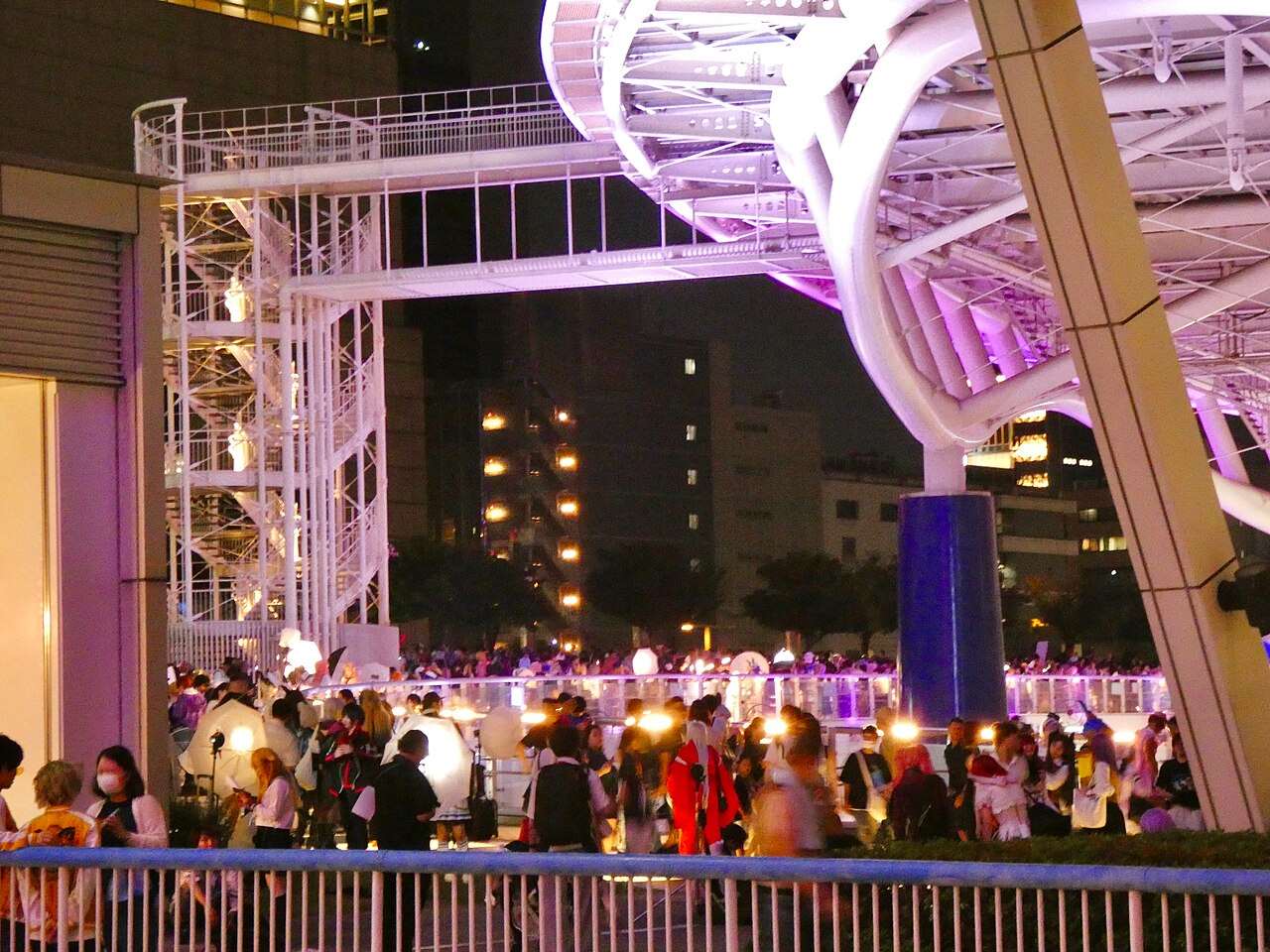
Competitors at the World Cosplay Summit 2024 in Nagoya. Photo: Kyu3a, CC BY-SA 4.0, via Wikimedia Commons.
Cosplay in Japan operates along a spectrum from casual fan participation to near-professional artisanship. At one end are participants who purchase ready-made costumes from dedicated retailers such as Cospa and Cospatio in Akihabara, where licensed costume sets typically range from ¥8,000 to ¥30,000. At the other end are cosplayers who hand-sew every panel of fabric, sculpt their own props from foam and resin, and apply theatrical-grade makeup and contact lenses — treating 創作 as the creative work itself and 趣味 (hobby) as the driving force.
Photography is central to the culture. Cosplay events typically include designated 撮影 (photography) zones where cosplayers pose for 写真 (photographs) taken by fellow attendees or professional photographers. The relationship between cosplayer and photographer is collaborative: many cosplayers actively seek skilled photographers to document their work, and the resulting images circulate widely on social media platforms including Twitter/X and Instagram.
Social media has also created the figure of the professional cosplayer — someone who funds their craft through sponsorships, merchandise sales, and appearance fees. Several Japanese cosplayers, such as Enako and Shion, have achieved celebrity status, appearing in mainstream magazines and at corporate events.
Notable Events
コミックマーケット (Comiket)
Held twice yearly in Tokyo Big Sight — in summer (August) and winter (December) — Comiket is the world's largest fan convention, attracting roughly 200,000 参加者 (participants) per day at its peak. The outdoor plaza and surrounding areas become the main cosplay 会場 (venue), where cosplayers gather for photographs between browsing doujinshi. Participation as a cosplayer requires registration and adherence to a code of conduct covering costume safety, photography consent, and public decency.
ワールドコスプレサミット (World Cosplay Summit)
The World Cosplay Summit (WCS), held annually since 2003 in Nagoya, Aichi Prefecture, is the world's largest international cosplay 競技 (competition). Cosplay teams representing more than 40 countries travel to Nagoya to compete in elaborate stage performances judged on accuracy, craftsmanship, and theatrical presentation. The event is supported by Japan's Ministry of Foreign Affairs as part of its cultural diplomacy efforts, reflecting the government's recognition of cosplay as a vehicle for Cool Japan soft power.
その他のイベント (Other Events)
Beyond Comiket and WCS, cosplay thrives at events such as AnimeJapan (Tokyo Big Sight, spring), Jump Festa (Makuhari Messe), and numerous regional conventions. Akihabara itself hosts periodic open-air cosplay days. Ikebukuro's Sunshine City is another hub, known especially for cosplay tied to the BL (boys' love) and otome genres popular among female fans.
Types and Styles
Cosplay in Japan draws from a remarkably wide range of source material:
| Category | Examples |
|---|---|
| Anime / manga | Characters from Naruto, One Piece, Demon Slayer |
| Video games | Characters from the Final Fantasy and Pokemon series |
| Tokusatsu | Super Sentai, Kamen Rider, Ultraman |
| Vocaloid | Hatsune Miku and other virtual singers |
| J-pop idols | Members of AKB48, BTS (imported) |
| Historical / samurai | Sengoku-era warlords, shrine maiden (miko) dress |
| Original character | Oni-ko — a cosplayer's own original design |
A distinctive Japanese sub-style is crossplay — cosplaying as a character of a different gender — which is accepted and celebrated at most events. Genderswap cosplay, reimagining a male character as female or vice versa, has its own dedicated following.
Global Spread
Japan exported cosplay to the 世界 through several channels. Anime's spread via fansub VHS tapes in the 1990s and later through streaming in the 2000s brought Japanese characters to international audiences eager to portray them. Events like Anime Expo in Los Angeles and MCM Comic Con in London adopted cosplay as a core attraction, and the internet allowed techniques and inspiration to cross borders instantly.
Today, cosplay is practiced on every continent and has expanded well beyond Japanese source material to include Western comics, films, and television. Yet Japan retains a distinctive place in global cosplay 文化 (culture) — as the origin of the word, home of Comiket, and host of the World Cosplay Summit, it remains the spiritual center of the craft.
The Japanese government formally embraced this status through its Cool Japan initiative, which positions cosplay alongside anime, manga, and cuisine as a pillar of cultural export. For many international fans, traveling to Japan specifically to cosplay at Comiket or on the streets of Akihabara has become a pilgrimage — a way of connecting with the culture at its source.