原宿
harajukuTokyo's iconic fashion district in Shibuya ward, birthplace of Japan's most creative street fashion subcultures and a global symbol of youth culture.
The District
原宿 (はらじゅく, Harajuku) is a neighborhood in 東京's 渋谷 ward, straddling the area between Harajuku Station and Omotesando. The name itself — written with the characters for "meadow" (原) and "lodging" (宿) — hints at its quieter origins as a residential hamlet outside the old city. Today it is anything but quiet: Harajuku is one of the world's most recognisable youth 文化 destinations, drawing tourists, fashion pilgrims, and curious 若者 (わかもの, young people) in equal measure.
The district sits in an interesting tension between two worlds. On one side, the serene forested grounds of 明治神宮 (めいじじんぐう, Meiji Shrine) — built in 1920 to honour Emperor Meiji and Empress Shoken — offer a solemn counterpoint to the commercial buzz next door. On the other, Harajuku Station spills visitors directly onto the 街 (まち) that became synonymous with creative self-expression.
Takeshita Street (竹下通り)
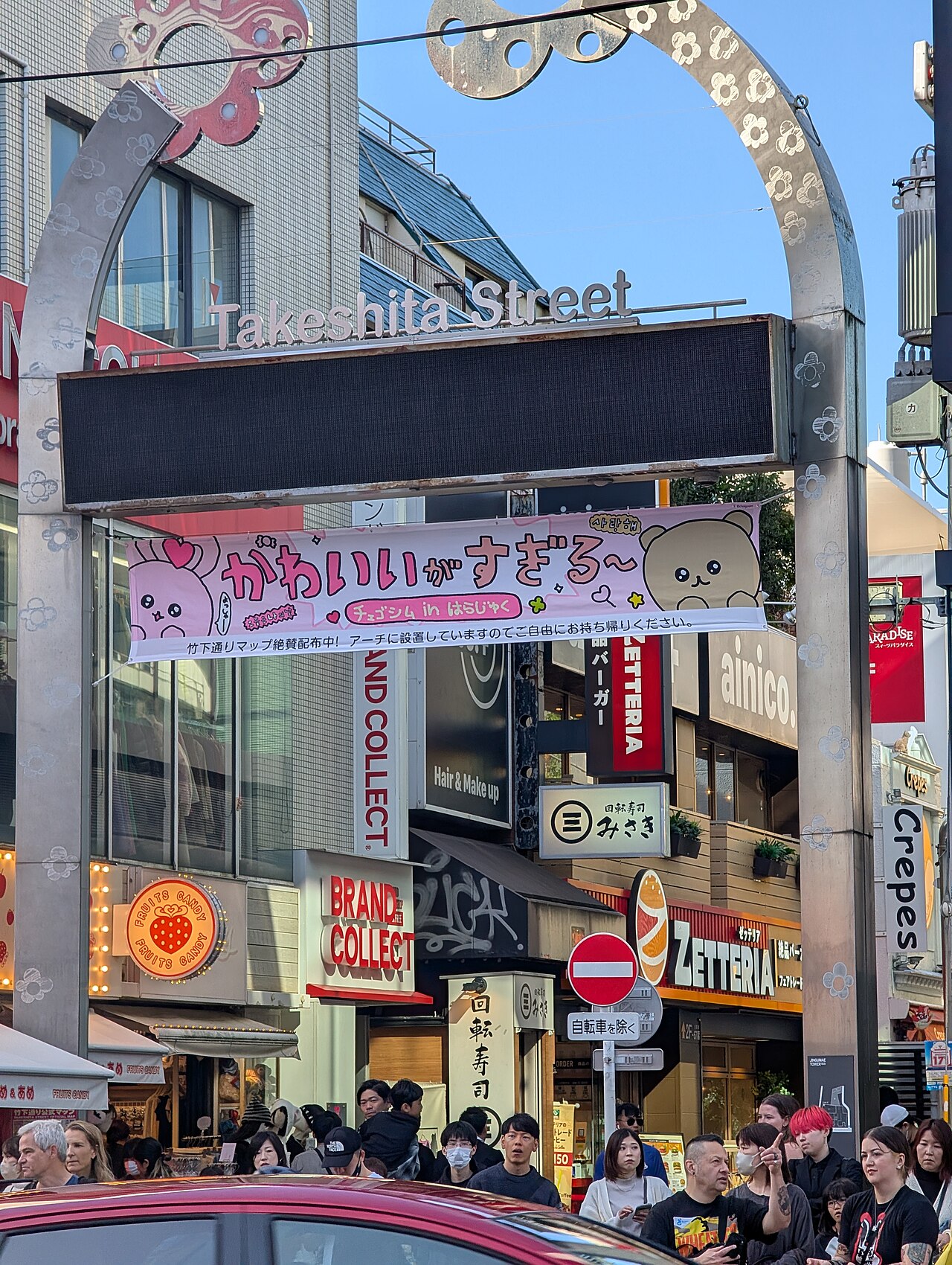
Takeshita Street (竹下通り), the heart of Harajuku's youth fashion scene. Public domain (CC0), via Wikimedia Commons.
竹下通り (たけしたどおり, Takeshita Street) is a narrow, roughly 350-metre pedestrian lane that runs from Harajuku Station toward Meiji-dori. It is the epicentre of Harajuku's youth ファッション scene. On weekends especially, the street becomes a slow-moving river of shoppers squeezing past boutiques selling everything from pastel tutus and platform boots to Lolita dresses and Decora accessories.
The street's commercial identity crystallised in the 1970s and 1980s as small independent shops catering to teenagers began to cluster here. Crepe stands — Marion Crêpes being the most famous, open since 1976 — became an inseparable part of the Takeshita experience, and the sweet smell of freshly-made crêpes wafting over the crowd is one of its most distinctive sensory signatures.
Boutiques on Takeshita tend toward the affordable and the theatrical. Brand names give way to independent designers, and the merchandise changes constantly to track the latest micro-trends. Visiting Takeshita Street is not just shopping — it is an exercise in observing 流行 (りゅうこう, trends) as they happen in real time.
Fashion Subcultures
Harajuku became the nursery of several distinctive Japanese street fashion movements, each with its own aesthetic logic:
Decora (デコラ) layers fluorescent colours with enormous quantities of plastic accessories — hair clips, bracelets, necklaces — creating an effect of maximalist, almost childlike joy. The goal is cheerful visual overload.
Fairy Kei (フェアリー系) draws on pastel versions of 1980s Western toys and cartoon aesthetics — think washed-out pinks, lavenders, and powder blues combined with vintage-style knitwear and retro charm accessories.
Lolita fashion (ロリータファッション) — covered in depth in its own article — emerged partly from Harajuku's boutiques and the bridge between them and Takeshita Street. Its emphasis on Victorian and Rococo silhouettes, petticoats, and elaborate headwear gave the neighbourhood some of its most visually striking regulars.
Gyaru (ギャル) — also with its own article — brought a dramatically different energy: tanned skin, bleached hair, and platform boots, more influenced by California than Kyoto, yet unmistakably shaped by Tokyo street culture.
These subcultures were not simply fashion choices; they were identity statements, often representing a conscious rejection of Japan's strict social conformity. Harajuku was the rare space where looking radically different was not only tolerated but celebrated.
Global Influence: The Harajuku Girls
Harajuku's international profile surged in 2004 when American pop star Gwen Stefani released her debut solo album Love. Angel. Music. Baby. The album — often abbreviated L.A.M.B. — was steeped in Harajuku iconography, and Stefani began touring with four Japanese-American backup dancers she called the "Harajuku Girls," named Love, Angel, Music, and Baby.
Stefani's use of Harajuku as an aesthetic shorthand — the album's single "Harajuku Girls" described the neighbourhood in near-mythological terms — introduced the word to a global audience that had never heard of Takeshita Street. The song and its accompanying visuals presented Harajuku fashion as exotic and hyper-feminine, a portrayal that attracted both enormous commercial success and significant criticism for flattening a complex living subculture into a costume.
Regardless of one's view of that representation, the cultural impact was real. In the years following the album's release, searches for Harajuku-related fashion spiked internationally, Western magazines began covering the neighbourhood's street style, and the word itself became a recognisable brand — even if what it signified in the Western imagination differed considerably from the day-to-day reality on Takeshita Street.
Ura-Harajuku (裏原宿)
裏原宿 (うらはらじゅく, Ura-Harajuku, literally "Back Harajuku") refers to the network of streets behind the main Harajuku area, centred around Cat Street (キャットストリート). Where Takeshita Street is loud and affordable, Ura-Harajuku is quieter and more considered.
From the mid-1990s, Ura-Harajuku became home to a generation of Japanese streetwear designers who would go on to reshape global fashion. Labels like Neighborhood, A Bathing Ape (BAPE), Undercover, and Goodenough operated small boutiques here — some with deliberately limited stock and unmarked storefronts — creating a culture of scarcity and connoisseurship that predated the global hype-streetwear phenomenon by a decade.
The aesthetic of Ura-Harajuku — heavy on military references, American workwear, bold graphics, and limited runs — became the foundation of what is now recognised internationally as Japanese streetwear. Hiroshi Fujiwara, often called the godfather of Japanese street fashion, was central to this scene. The influence of Ura-Harajuku on brands like Supreme, Off-White, and the entire sneaker resale ecosystem is difficult to overstate.
Harajuku Today
Harajuku has changed considerably in the past decade. The old Harajuku Station building — a wooden Western-style structure dating to 1924 and beloved as a landmark — was demolished in 2020 and replaced with a modern facility, a development that many locals and fans mourned as symptomatic of broader gentrification.
Larger international brands have moved onto Takeshita Street and Omotesando, the leafy boulevard sometimes called "Tokyo's Champs-Élysées" that runs from Harajuku toward Aoyama. Independent boutiques face rising rents. The cosplay and extreme fashion crowds that made Sunday afternoons on the nearby Jingu Bridge famous — a gathering that was a fixture from the 1980s through to the mid-2000s — have largely dispersed, in part due to local government restrictions and changing habits.
Yet Harajuku has not lost its creative pulse entirely. New generations of designers continue to work from the area, social media has globalised its reach in new ways, and the fundamental tension that made the neighbourhood interesting — between structured Japanese society and the young people who dress to escape it — has not resolved itself. Visitors today may find fewer peacock-feather outfits on the streets than they imagined, but the layers of history, from Meiji Shrine's solemn forest to the crêpe-scented chaos of Takeshita Street, remain packed into a remarkably small and walkable piece of 東京.